The calculation of taxes and fees for cross-border imports has been a complex issue in the operation of electricians, covering various aspects of customs policy, tax calculation and compliance declarations. This paper provides detailed information on the method of calculation of tariffs and related rules for cross-border imports, including the definition of tax-exempt prices, the treatment of preferential promotions, the role of hs codes and the logic of tariff calculation in different cases。

Background
Compared to goods imported across borders and those traded in general, the special point is the need to pay customs duties, which are generally borne by taxpayers (individuals purchasing retail imports of goods imported through cross-border e-commerce). Businesses typically combine taxes and charges with commodity amounts in order costs to charge taxpayers. Remittance of payments to customs on behalf of the payee (e-commerce enterprises, e-commerce trading platform enterprises or logistics enterprises) and then commissioning of the corporate settlement. If the tax is borne by the business, the goods (including taxes) are marked on the electrician platform and no longer charged to consumers, but still have to be paid to customs。
Ii. Restrictions
Before describing how taxes and fees are collected, it is necessary to explain to you the customs limits, given the differences in algorithms and ratios within and beyond the limits. The limit is to avoid illegal imports, such as smuggling, and the state imposes restrictions and compliance preferences on the import consumption of individual consumers. According to the latest 24-year bulletin of the general customs administration, it is mainly the following two points that goods overstretched on a single or annual basis are taxed in full (including customs duties, value added taxes, excise taxes)。
Iii. Fat 1. Definition of fat
The final tax price includes the transaction price of the goods, transport and related costs (international freight) prior to their arrival at the point of entry into the country, and insurance premiums。
Special scenario: retail imports by cross-border electric operators
Example: freight 10 dollars; commodities a: 2 3 dollars/unit total $6; commodities b: 1 3 dollars/unit total $3
Customs rules for calculating taxes and fees are: retain to points (i. E. Two decimals) rounded. The part of the cost of goods included in the “taxed price” of the tax is the sum of the sum of the multiple items of a commodity, so that attention is paid to the difference in amounts between individual and multiple items due to rounding。
2. Whether preferences are included in tax prices
Do coupons and crediting components are included in tax-exempt prices in orders for cross-border electrical importers ' platforms
According to the circular on retail import tax policies for cross-border electronic commerce (financial duties [2016] no. 18) provides that the actual traded price (including the retail price of goods, freight and insurance) for retail imports of electronic commerce across borders is used as the tax-exempt price。
Preferential promotion is a common method of marketing for electricians, and customs determines the preferential promotion price in accordance with the following principles:
Non-cash credits (e. G. Coupons, credits):
The “concessional relief” paid in the form of a virtual currency, such as electric vouchers, coupons, credits, etc., in order payments should not be deducted from the tax price, which should be determined on the basis of the order price. For example, the original value of the commodity was $100, with $50 paid after using a $50 coupon, but the declared tax price remained at $100。
Cash credits (e. G., direct discount, full reduction):
If the preference is open and applicable to all consumers (e. G. Direct price reduction promotion), the tax is paid at a discount price; however, if the preference is targeted only at a specific group of people, customs may still be taxed at the original price。
Iv. Hscode
Tariffs, value added rates and consumption rates for commodities are defined through hs codes。
Hs code, known as customs code, is the acronym of the international convention for the harmonized commodity description and coding system (harmo)Nized system, abbreviated hs. Each commodity is associated with the previous hs class when it enters customs, as in the case of the hs search site's cut-off for pets. Https://www. Hsbianma. Com/
V. Tax calculations 1. Type of tax
1) tariffs: customs established by the government introduces taxes levied by exporters when goods are imported through a country's borders。
Cross-border electrician limits of 0 per cent, with excess rates based on commodity hs codes
2) value added tax (vat): a transit tax based on the value added generated by goods in the course of their movement。
13% or 9% in general (e. G., food oil)
3) excise tax: a generic description of the various taxes to which the flow of consumer goods is subject. For specific commodities only
Like 30% cosmetics, 20% high-end watches
Tax logic
(1) tax logic for ordinary goods
A. Within the limit (one time, $5,000, 26 000 per year)
Under the customs preference policy, the import chain vat, excise tax is levied at 70 per cent of the statutory taxable amount。
Example: for a milk powder at a tax price of $1,000, value added rate of 13 per cent and excise tax of 0 per cent:
B. Excessive or indivisible commodities
General trade taxes are required:
Example: an undivided cosmetic package price of $6,000, tariffs of 5 per cent, vat of 13 per cent, excise tax of 30 per cent:
2. Rules on excise tax collection for special categories
(1) description of type
The following types are not entirely based on hscode rules for the recognition of taxes and fees:
(2) example
The search for high-end cosmetics can be seen, described as the consumer tax rate, which is based on price/weight。
The search for high-end cosmetics can be seen in the description of the consumer tax rate, which is 15 per cent of the tax price of 10 yuan/g. On the basis of the sales price, there are two scenarios, 0 per cent and 15 per cent。
According to the customs proclamation, there will also be price/platform scenarios. Prices/volumes may also be described in some literature。
According to the customs bulletin: 1 l = 1 kg at the time of declaration for high-grade cosmetics of liquids. Describes the volume, which is the weight. Price factors are known at the time of the next order, and if we are to judge whether a excise tax is required, we need to confirm how another influencing factor determines value。
The value of another factor was submitted to customs at the time of the declaration. As can be seen from customs bulletins and hs queries, the statutory first unit of measure and the statutory second unit of measure for high-grade cosmetics are fixed at kg and in pieces. It was also agreed that the declaration elements for high-end cosmetics contained packing specifications。
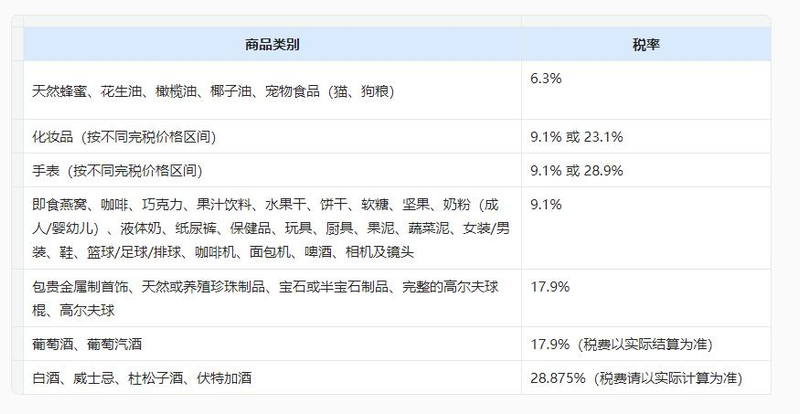
Reference to common commodity tax rates