In its 2022 insight for digitally integrated development in china, iri mentioned that global data volume grew at a rapid rate of more than 59 per cent per year, 80 per cent of which was non-structured and semi-structured, and that china's data volume increased more rapidly than the world. In particular, many organizations are currently in the process of digitizing the transition, and the organization's level of data volume is continuously increasing in geometrical terms. In terms of storage, however, structured data represent only 20 per cent, the remaining 80 per cent being unstructured data in the form of documents, voice, pictures, etc., and almost all our daily office documents are unstructured data。
At the moment, the traditional business systems address more structured data management and business process management issues, which make it difficult to effectively address and respond to storage and application issues arising from the proliferation of knowledge files. However, knowledge documentation is also an important reference for organizational decision-making, so knowledge must move to business, integrate business, and support business to better enhance the organization's core competitiveness. How, then, do organizations capture, store, use and innovate knowledge files? How can exclusive and efficient knowledge networks be established? What is the added value of good knowledge document management for the organization? We had the privilege of inviting panwa quitsu, director-general of the ministry of the enterprise, to give us a detailed reading。
1. What are the difficulties and problems encountered by organizations in managing knowledge files
Response: with regard to the problem of managing knowledge files, we can look at three aspects:
First, the bulk of knowledge sources at the organizational level are dispersed, and they may arise from the annex archive of the business system, from the user's local computer terminals, or from relevant stakeholders in the organization, such as suppliers and customers, and it is a challenge to complete and facilitate the collection of knowledge。
Second, organizational knowledge files need to be managed with rights control, process control, standardized version management, numbering rules, label properties, etc. The issue of how to build structured knowledge in a consistent and secure manner is also a matter that needs to be addressed。
Thirdly, for front-end users, the desire to obtain knowledge services in a timely and accurate manner in the course of an operation through quick and accurate searches and how to transform the knowledge assets accumulated by the organization into the force of the front-end operation is also a dilemma and a challenge for each organization。
2. Heard that this year a specific digital knowledge document management application — the knowledge network — was launched, could you give us a brief introduction? How does it solve these difficulties
A: before i give you the official introduction, let me give you a brief introduction, focusing on the oa field for 21 years, which is the “priority software enterprise in the national planning layout” and the oa industry listing company. There are 200+ branches throughout the country, with over 8000+ professional teams. To date, services have been successfully provided to 87 subdivisions and more than 60,000 government agencies and enterprises throughout the country。
Pan-micro literacy is a digital knowledge management platform that has grown in oa software. Knowledge management has been accompanied by office processes for more than 21 years. How can the invisible knowledge in the minds of every employee be transformed into explicit knowledge? How can day-to-day office work be consolidated into a systematic knowledge base, with knowledge scattered over communication, processes and project processes? Clients have put a variety of demands on us. In more than 20 years of development, we have addressed one client after another, and today the pan-microknowledge management platform has grown into a stand-alone digital knowledge management platform — the knowledge network. The knowledge chain is a digital, business-integrated knowledge document management system built with a wide range of low-code platforms, mobility and intelligent capabilities. The corporation is committed to providing the organization with a complete knowledge file management solution, allowing the organization to group all unstructured data into a unified platform, enabling the automatic collection, automatic delivery, intelligent question and answer of the knowledge document and “knowledge from work to work”。
3. What are the functions and bright spots of panorama
Response: a pan-scale knowledge-based documentation management system, first and foremost an organization's knowledge-file container capable of quickly capturing knowledge documents from different system sources. At the same time, knowledge services are being rolled out to the front-end business systems. While dealing with matters in the business system, we can do a whole loop of knowledge previews, editing, updating, retrieval, etc. To build, share, use and innovate。
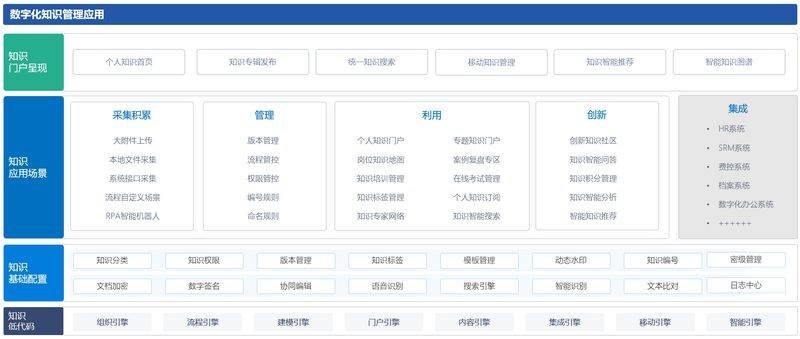
Specifically, its functional highlights include the following:
Automatic intelligence acquisition of knowledge: we will build a complete knowledge repository from the multiple dimensions of organization, products, projects, etc., in conjunction with the management characteristics of the organization, and first by opening the collection interface to automatically integrate the documents of applications such as oa, erp, hr and crm into the knowledge platform. Information and documentation of operational value on the internet can also be collected through rpa technology. Of course, we also support the uploading of imported documents by manual systems and the automatic collection of documents, voices and photographs in mobile instant communication tools。
Secure and orderly management of knowledge: in the knowledge base, we can establish corresponding rules based on organizational management requirements, and each collected knowledge document can be automatically classified, numbered, empowered, process triggers, version updates, according to strategy, to make the deposition and management of knowledge files more secure and orderly。
Knowledge sharing and referral: in our work, we can share a wide range of knowledge through different application channels, such as single document point-to-point knowledge recommendations, multi-documenting knowledge on the same subject packaged in a structured map format, system-specific documents can be controlled through approval processes, hidden knowledge can be disseminated through the creation of a network of experts within the organization, the knowledge of the organization is fully shared internally and collaboration at the documentation level is not spatial or time-limited。
• precision of the use of knowledge: in the use of knowledge, staff are given precision in the knowledge base through micro-search, intelligent search engines; mobile ends can also use small e, voice commands to quickly find knowledge and experts. Moreover, in the course of operating the business system, the system provides real-time support, making recommendations for knowledge in combination with jobs, user behaviour, process nodes, project tasks, rules of access, and also building knowledge maps using smart engines in a vast knowledge base to build an organization-specific knowledge neural network。
Knowledge innovation optimization: we can achieve a virtuous cycle of knowledge management by leveraging organizational innovation cultural practices through functional applications such as operational knowledge communities, knowledge collaboration, knowledge questions and answers, and by stimulating staff's innovation practices through tools such as scorecard management, performance rules, knowledge statements, etc., creating a climate of innovation in day-to-day knowledge activities, platform operations, content operations, etc。
Document management throughout the life cycle: the knowledge network can process documents from the pre-trial, new, changed, invalidated, deleted, etc., and during the process of processing and approval of documents it can distribute approval rights such as viewing, editing, downloading, printing, etc., the status of the document will change accordingly to draft, enter into force, invalidate, etc., depending on the progress of approval, and the system will also record in detail editorial revisions of the document, the effective publication version, and related information such as borrowing, training, distribution, recycling, etc. For each system document。
4. What are the technological advantages of panorama
Response: the technical features of a pan-micro knowledge-based document management system are mainly in six areas:
Smart technology: integration of various smart technologies, such as ocr, rpa, semantic recognition, so that knowledge documents can be collected and used efficiently。
Mobile fit: pc, mobile integrated knowledge acquisition and accumulation, multi-end fit, user can accumulate, share and innovate files through a mobile phone。
Easy integration: accomplishing knowledge access to business systems through integrated centres, allowing documents to be automatically captured, to be called on demand and to integrate documents with business depth。
Easy to expand: a low-code platform can give organizations the ability to customize and build their own digital knowledge document management applications, building on needs and expanding new applications。
Safety and security: the corporation provides a well-designed security system and a rigorous safety policy covering system layers, data layers, strategic layers, access layers, avoiding loss of knowledge files and risk of leakage。
All-in-a-branch support: the knowledge network provides full-a-branch support from bottom cpus, servers, intermediates, databases, browsers to various document environments, which can create an organization-wide eco-innovation platform。
5. What would be the added value of the application of pan-micro-information companies
Response: a pan-micro knowledge-based document management system that combines industry business characteristics and user-specific needs with a life-cycle application of knowledge from collection, management to use, innovation. It can be seamlessly integrated with a generalized synergetic platform or in depth integrated into other isomeric systems that provide knowledge services to users quickly and accurately in their operations。
Harmonized harvesting of sediments: unified collection of knowledge documents from different sources and systems, uniform storage, complete and timely deposition of organizational knowledge。
Documentation standards landing: to meet standards of documentation control in different industries, and to make documentation control systems in different industries more effective。
Digital signature protection against tampering: using technical means such as digitally credible identity, digital signature, to make the identity of the system user credible, behavioural defence, knowledge document protection against tampering, and digital results credible。
Integrating into the business landscape: individualized knowledge services are delivered to business systems at the forward end based on the business scene; the intellectual voice search tools are combined to enable knowledge files to be more accurately located and shared。
Strict safety and security: provide a complete safety and security strategy to avoid the risk of loss of organizational knowledge files and leaks。
Intelligently accurate delivery: through rpa robotics, semantic analysis, semantic understanding, knowledge mapping to those who need it, work scenes that need it, such as project management processes and process approval processes, so that knowledge can really come from and be used for work。
Can you give us one or two examples of any mature cases that have been applied
Response: there is a great deal of experience in all 87 subdivisions of industry, such as iso documentation control systems in the manufacturing industry, gxp documentation control systems in the pharmaceutical industry, synergetic documentation management in the engineering and construction industry, document-classification management in the military industry, and so on. Together with a subdivision of low-code platforms, industry service experience for more than 21 years, we can help each enterprise to develop a complete and landable knowledge document management system。
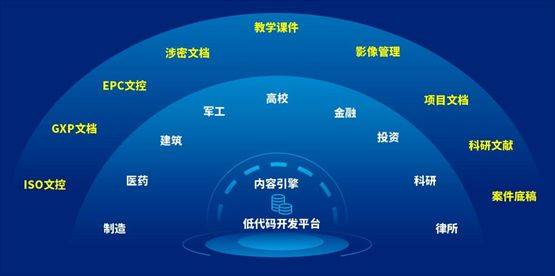
For example, the ely group has worked with us to build a unified knowledge-sharing platform covering 90,000 users across the group, based on a corporate business strategy, a land-based knowledge management support initiative, a dedicated knowledge repository for research and development, projects, training, brands, etc., a unified collection of knowledge from oa systems, plm systems, user desktops, effective knowledge-sharing through knowledge portals, knowledge maps, community-based, question-and-answer questions to promote the transformation of stable knowledge, provide a global smart search engine, and position issues precisely。
For example, a military-industrial enterprise has established a collaborative platform for knowledge-sharing to meet the requirements of the military-industrial industry's secrecy, structured the internal knowledge materials through knowledge labels to facilitate user-group retrieval; structured the project knowledge map to present the summary of project results in the face of the company's global project; and intensive management and sensitive word management of professional files to ensure the security and compliance of knowledge application systems。
Of course, we have a lot of cases, and we're interested in searching for a network of communicators for more information。
7. What are the future development goals
Response: a pan-micro knowledge-based document management system can help organizations to automatically capture, effectively accumulate, fully share and innovate knowledge files, interconnect their brains, and help organizations to build up into new knowledge-based organizations that are pioneers in the digital economy. In the future, we will invest more in three areas of development:
Smart technology applications to improve the efficiency of collection and utilization of knowledge files. To make full use of current cutting-edge smart technologies to make knowledge collection and delivery more efficient and accurate, meeting the needs of users and the work landscape。
Platform-based capacity to enhance application of extension flexibility. Make full use of portal engines, process engines, content engines, search engines, modelling engines, integrated engines, intelligent engines and low-code platforms at the micro-dependency level to allow for personalized configuration and flexible expansion of knowledge document management. It is also linked to business systems to integrate knowledge document management with business depth。
Credible identity technology, throughout knowledge document management. Full use is made of technical means such as digitally credible identities and digital signatures to ensure that the identity of the system's users is credible, that behavioural defences are protected, and that knowledge files are protected against tampering and that digital results are credible。
Finally, it is hoped that enterprises and organizations with knowledge management needs will all think of panwai nai nai nai nai