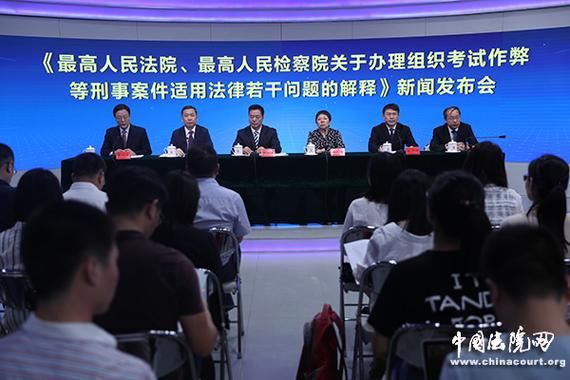
The interpretations of the supreme people's court and the supreme people's procuratorate on certain issues of the law applicable to criminal cases in false litigation were adopted by the trial committee of the supreme people's court at its 1732nd meeting, on 25 january 2018, and by the thirteenth procuratorial committee of the supreme people's procuratorate, at its second meeting, on 13 june 2018。
Supreme people's court
26 september 2018
Supreme people's court
Interpretation of certain issues of the law applicable in criminal cases of false prosecution
(as of 1 october 2018)
Rule 2018. Number 17
In order to punish the criminal activities of false proceedings in accordance with the law, to maintain judicial order and to protect the legitimate rights and interests of citizens, legal persons and other organizations, in accordance with legal provisions such as the criminal code of the people's republic of china, the code of criminal procedure of the people's republic of china and the code of civil procedure of the people's republic of china, a number of questions concerning the law applicable to the handling of such criminal cases are explained below:
Article 1. Any person who, by means of false evidence or false statements, commits one of the following acts, fabricating a civil legal relationship, falsifying a civil dispute and bringing a civil action before a people's court shall be deemed to have brought a civil action “on the basis of a false fact” as provided for in article 307, paragraph 1, of the penal code:
(i) an malicious conspiracy with one of the spouses to fabricate a common debt between the spouses
(ii) malicious collusion with others to fabricate debt relations and debt-for-money agreements
(iii) involuntarily colludes with the company, the legal representative of the enterprise, the director, the supervisor, the manager or other manager to fabricate the company, the business debt or the guarantee obligation
(iv) fabrication of an ipr tort relationship or an unfair competition relationship
(v) declare false claims during insolvency proceedings
(vi) malicious collusion with the enforced person, the fabrication of a claim or priority over attachment, seizure, freezing of property, security interest
(vii) other acts involving either unilateral or malicious collusion with others in the fabrication of civil legal relationships such as identity, contract, tort, inheritance, etc。
To conceal the fact that the debt has been paid in full, to bring a civil action before the people's court to demand that another person perform the debt, on the basis of “civil action based on a false fact”。
An application to the people's court for enforcement of an arbitral award made on the basis of a fabricated fact, an instrument of a notarized claim, or an application to participate in the distribution of property in the execution of the subject matter in the course of civil enforcement by means of a fabricated fact, is “a civil action brought on the basis of a fabricated fact” under article 307, paragraph 1, of the penal code。
"contribution law":
Article 307 of the criminal law of the people's republic of china: any person who initiates a civil action on the basis of false facts, obstructs the order of justice or seriously infringes the lawful rights and interests of others shall be punished by imprisonment for a term not exceeding three years, by detention or by control, and by a fine or a fine only; in serious cases, by imprisonment for a term not exceeding three years and not exceeding seven years and by a fine。
If the unit commits the above-mentioned offence, the unit shall be liable to a fine and the person in charge and other persons directly responsible shall be liable in accordance with the preceding paragraph。
In the first case, illegal possession of another person's property or evasion of a legal obligation constitutes another offence, and is punishable by heavier penalties。
Judicial officers who use their office to commit the first three acts in conjunction with others are subject to heavier penalties; they also commit other offences and are convicted of heavier penalties in accordance with the more severe penalties。
Article 2. A civil action initiated on the basis of a false fact shall be deemed to be “aggression of the order of justice or serious infringement of the legitimate rights and interests of others” under article 307(1) of the penal code if:
(i) causing the people's court to take measures of preservation of property or of conduct on the basis of fabricated facts
(ii) to cause people's courts to sit and interfere with normal judicial activities
(iii) results in the people's court making decisions on the basis of fabricated facts, making property distribution programmes, or filing cases to enforce arbitral awards based on fabricated facts, notarized claims instruments
(iv) multiple civil actions based on false facts
(v) has been subject to civil action measures of constraint or criminal prosecution for having initiated civil proceedings on the basis of false facts
(vi) other circumstances which are prejudicial to the order of justice or which seriously infringe the legitimate rights and interests of others。
Article 3. A civil action brought on the basis of a fabricated fact shall be deemed to be “serious” under article 307 (1) of the penal code if:
(i) in the case of article 2, paragraph 1, of this interpretation, causing economic loss of more than $1 million to others
(b) in one of the circumstances of article 2, paragraphs 2 to 4, of the present interpretation, if it seriously interferes with the normal activities of the judiciary or seriously impairs its credibility
(iii) the automatic performance by the obligor of the obligation of payment of the property established by the in force judgement or the enforcement of the property interest by the people's court, in an amount greater than one million dollars
(iv) if the claim of the other person is unattainable in an amount greater than one million dollars
(v) illegal possession of the property of another person, amounting to more than $100,000
(vi) caused others to be held in criminal detention, arrested measures or prosecuted for failing to implement a judgement or ruling of a people's court based on a false fact
(vii) other aggravating circumstances。
Article 4。
Article 5. Judicial officers who use their office to commit jointly with others the first three paragraphs of article 307 (1) of the penal code shall be subject to heavier penalties; they shall also be guilty of abuse of authority, of incompetence in the administration of justice, of execution of sentences, of offences involving abuse of authority, etc., and shall be liable to heavier penalties in accordance with the heavier penalties。
Article 6. The participation of legal agents, witnesses, experts, etc., in the proceedings, in conspiracy with another person to initiate a false civil action, to knowingly give false testimony or to give a false opinion, to commit jointly an act under the first three paragraphs of article 307 (1) of the penal code, shall be punished in accordance with the provisions of the joint offence, and shall also constitute an offence against testimony and contribute to the destruction, falsification of evidence, etc., and shall be subject to a heavier penalty in accordance with the provisions of the heavier penalty。
Article 7。
[contribution law] [forger, forgery, trade in official documents, documents, seals of state organs; theft, seizure, destruction of official documents, documents, seals of state organs; forgery of seals of companies, enterprises, undertakings, popular groups; forgery, forgery, sale of identity documents]
Article 280 of the criminal code of the people's republic of china: anyone who forges, forges, buys, sells or steals, robs or destroys documents, documents or seals of state organs shall be sentenced to imprisonment for a term not exceeding three years, detention, control or deprivation of political rights, and to a fine; in serious cases, to imprisonment for a term not exceeding three years and not exceeding ten years and to a fine。
Anyone who forges the seals of a company, enterprise, enterprise or people's group shall be sentenced to up to three years ' imprisonment, detention, control or deprivation of political rights, with a fine。
Anyone who forges, forges, buys or sells documents such as identity cards, passports, social security cards or driving permits that may be used to prove identity by law shall be punished by imprisonment for a term not exceeding three years, detention, control or deprivation of political rights, with a fine, and, in serious cases, by imprisonment for a term not exceeding three years and not exceeding seven years。
Article 8 if the unit commits an act under article 307 (1) of the penal code, it shall, in accordance with the sentencing criteria set out in this interpretation, be liable to the punishment of the person directly responsible and other persons directly responsible, and shall impose a fine on the unit。
Article 9 the application of article 307 (1) of the penal code does not meet the criteria of seriousness, the perpetrator is the first offender, voluntarily repents in the course of civil proceedings, accepts the decision of the people's court, actively refunds the proceeds or refunds, which may be considered a minor offence, does not prosecute or exempt from criminal punishment; if it is necessary to impose the penalty, the penalty may be extenuating。
The provisions of paragraph 1 of this article shall not apply to judicial officials who use their office to commit acts under article 307, paragraph 1, of the penal code together with others。
Article 10. Criminal cases of false litigation are governed by the people's courts of the place where the court is seized or where the enforcement court is located. In the case of article 307, paragraph 4, of the penal code, the higher people's court may appoint the lower people's court to refer the case to other people's courts for trial。
Article 11 this interpretation refers to decisions, rulings, conciliations, payment orders, etc. Of people's courts in accordance with civil laws such as the code of civil procedure, the business insolvency act, etc。
This interpretation has been in force since 1 october 2018。