Report of the office of the state council
Observations on the implementation of the unified national electricity market system
State department (2026) number four
The people's governments of the provinces, autonomous regions and municipalities directly under the central government, the ministries of the state council and the direct agencies:
With a view to further deepening the reform of the electricity system, accelerating the improvement of market and price mechanisms for adapting to new energy systems, improving the system of a single national electricity market and achieving an efficient market allocation of electricity resources throughout the country, the state council has agreed to the following observations。
I. General requests
Guided by xi jinping's new-era china-specific socialist ideology, the party's 20th and 20th plenary sessions have been guided by a thorough and accurate implementation of the new development concept, in accordance with the requirements of building a single national market, deepening the reform of the power system and building a new electricity system, maintaining national unity and smooth circulation, working to break market segmentation and break down regional barriers, promoting efficient and organic market connectivity, promoting an integrated approach to the high level of dynamic balance of supply and demand in the electricity market, increasing its size, improving its structure and expanding its functions, improving the integrated, competitive, safe and efficient and well-regulated electricity market system, and ensuring the safe and reliable operation of the electricity system so as to achieve a well-functioning market, efficient rules of trade and equitable distribution of benefits, with strong support for ensuring energy security, economic and social development and a green low-carbon transformation。
By 2030, the system of a single national electricity market has been almost completed, with all types of power supply and electricity users, except for secure users, being directly involved in the electricity market, where market trades account for about 70 per cent of all electricity used in society. Inter-provincial inter-zonal and intra-provincial joint transactions, full-scale transfer of spot markets, full harmonization of market-based rules and technical standards, generally sound market-based electricity pricing mechanisms and the formation of a fair and uniform market regulatory system. By 2035, the system of a single national electricity market will have been fully implemented, the market functions will have matured and the share of marketed and traded electricity will have risen steadily. Organic integration of trans-provincial and intra-provincial trade, with electricity resources with more power, regulation, environment, capacity, etc. The preservation value is fully reflected in the market, the electricity resources are fully allocated and used efficiently throughout the country, and the national integrated energy market system, with electricity as the main source of energy and multiple energy synergies, has been first formed。
Ii. Promoting the optimal distribution of electricity resources throughout the country
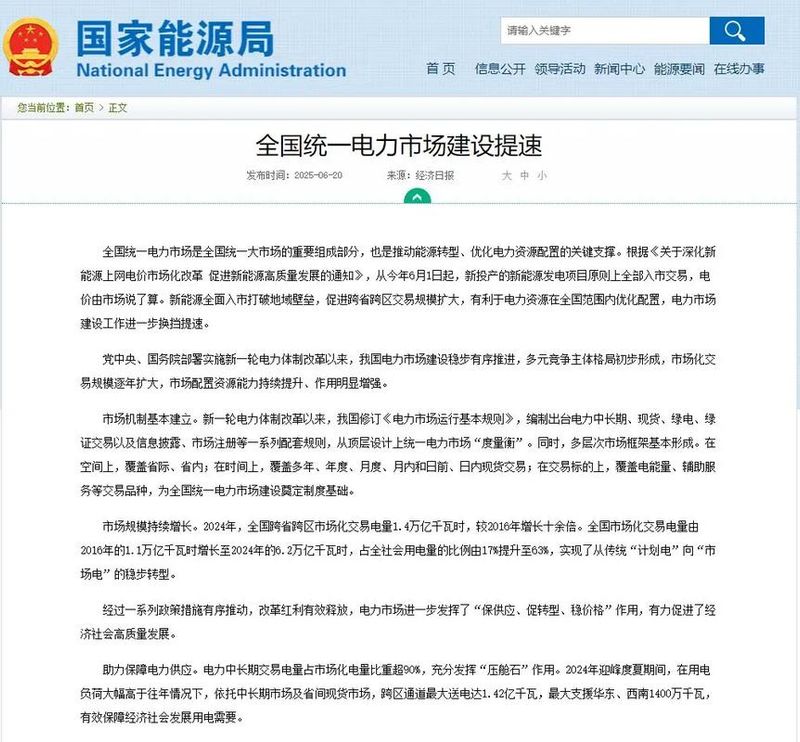
(i) optimizing the path to a unified national electricity market system. To strengthen cooperation and coordination between the government and the government in order to promote the integration of cross-provincial cross-regional and intra-provincial transactions within the framework of the unified electricity market, with a view to further breaking market barriers and promoting inter-provincial power solidarity. Promotion of inter-provincial cross-regional trades and intra-provincial transactions to be linked in terms of participation, spatial scope, time allocation, organization of time series, deviation processing, organic integration in the registration of subjects, transaction declarations, transaction clearance, information disclosure, etc., and gradual cross-provincial inter-provincial and inter-provincial transactions from business owners, with the transition to a one-time demand for volume and power market to break down joint trade models matching supply and demand across the country. The study explored possible ways of organizing electricity transactions in neighbouring provinces on a voluntary basis. Further promotion of connectivity of power trading platforms, mutual recognition of exchange information, and “one-stop registration, national sharing” of power market operators. When the conditions are ripe, research will be carried out to establish a national power exchange centre。
(ii) improving the inter-provincial inter-district electricity trading system. (b) to establish a marketable trading channel between the national grid and the southern grid operators, to harmonize the way in which the transactions are organized, to facilitate the interaction of information and to achieve the normalization of transactions across the zones as soon as possible. The construction of a more adequate capacity and flow to a more rational pattern of transmission channels and grid main grids continues to increase the scale of transmission across provinces and the share of clean energy transmission. In the context of ensuring security, scientific arrangements have been made for a priority inter-provincial and inter-provincial scale of electricity generation, with a reasonable expansion of autonomous inter-provincial market power delivery and enhanced multi-channel concentration optimization. Integrated construction and operation of electricity markets in the south region, improvement of long-triangular power interconnections and exploration of intraregional synchronous grid power swaps within the framework of inter-provincial transactions。
Iii. Functions of the electronic market
(iii) full construction of spot markets for better price discovery, regulation of supply and demand. Full utilization of the important role of spot markets in detecting real-time prices, accurately reflecting supply and demand, and better guiding the optimal allocation of electricity resources. Promoting the virtual formalization of the spot market by 2027. Promote the use of comprehensive offers from various operators on both sides to participate in the electricity market. The participation of users in spot transactions between provinces is promoted in good faith, subject to the clear implementation of each party's responsibility for the supply of electricity. Strengthening the linkages between spot markets and other markets in terms of time-series transactions, prices, settlements, etc., and optimizing the distribution of electricity through time-consuming price signals among operators, stimulating the potential for flexible regulation of the electricity system。
(iv) continuous improvement of medium- and long-term markets that guarantee a secure and stable supply of electricity. Better use of the basic role of the medium- and long-term markets in stabilizing the supply order of electricity production, guaranteeing the smooth functioning of the markets, and securing electricity for the basics. Implementation of performance incentives for medium- and long-term contracts, long-term stabilization of power resources and enhanced risk response capacity. To promote the fine-tuning and standardization of medium- and long-term markets, with consecutive openings, uninterruptible transactions, increasing the frequency and flexibility of transactions, covering different cycles such as years (multi-year), months and months (many days). Establish sound regulatory standards, flexible and efficient systems for the adjustment and transfer of medium- and long-term contracts. The inter-provincial priority power generation scale plan is being fully implemented through mid- and long-term contracts. Strengthening effective linkages between local medium- and long-term markets and spot markets in terms of transaction time, market price limits, etc., and the contracting and performance of medium- and long-term contracts by operators involved in spot market transactions must meet national energy security requirements。
(v) accelerate the construction of a market for auxiliary services that supports the flexible regulation of electricity systems. Regulate the market for fm auxiliary services, accelerate the establishment of the market for backup services and explore new types of auxiliary services, such as landslides, as appropriate. Accelerated integration of fm, back-up services markets with spot markets. The area where the spot market continues to operate is based on the principle of “who benefits and who bears” and the cost of effectively channelling support services。
(vi) improving green electricity markets for better environmental values. To improve the national integrated green market and to further develop its role as the basis for renewable energy electricity production, consumption and environmental identity determination. Increase the scale of green electricity consumption and accelerate the establishment of green certificate consumption systems that combine compulsory and voluntary consumption. Increased monitoring of green certificate prices to guide green certificate prices to a reasonable level. Promotion of long-term purchase agreements between the issuing parties for green certificates. Encourage the implementation of the provincial priority scale plan for new energy generation in the form of green power trading, and promote multiple green power trading models, such as multi-year trading contracts, polymerization. The research on agro-forestry biomass generation project is involved in the national voluntary greenhouse gas reduction trading market. Accelerate the establishment of green electricity consumption certification mechanisms, the full introduction of technologies such as block chains, and the implementation of chain-wide certification of green electricity production, consumption, etc. Continue to strengthen the traceability of green electricity consumption and study the viable path for incorporating green certificates into carbon emissions accounting. Improved systems of green electricity standards, enhanced international communication dialogue in the application of green certificates, accounting, etc., and facilitated the transformation of our green electricity consumption standards into international standards。
(vii) establishment of a reliable capacity market to support the regulation of power generation. Further refinement of the capacity-price mechanism for regulating resources such as coal power, pumping capacity, new storage capacity, etc., and study of compensation for reliable capacity of power systems in accordance with uniform standards. Support areas that are in a position to do so to explore competitive offers for capacity-based electricity, to ensure that systems have a reliable capacity that is sufficiently adequate in the long term by marketable means, to explore capacity markets when conditions are ripe, to effectively guarantee the sustainable development of power sources, such as coal power, and to enhance bottom-push supply capacity。
(viii) creating a well-regulated, easy and efficient retail market. Clear wholesale-retail price transmission, which, while safeguarding the legitimate rights and interests of end users, directs demand side resources to participate actively in the system through time-lapse price signals. Develop retail market trading rules, strengthen process regulation, information disclosure and risk control in retail markets, and foster healthy market ecology. Strengthening the regulatory management of power sales companies, revising the management of electricity sales companies, and leading the transformation of electric companies to integrated energy service providers。
Iv. Promotion of equal and broad participation of all categories of operators in the electricity market
(ix) further promote the participation of power side operators in the electricity market. Implementation of a new energy sustainable development price clearing mechanism to encourage multi-year transactions between new energy enterprises and users. To promote the integration of all types of power sources in the electricity market at the new energy base of the sago desert and to strengthen inter- and intra-provincial integration. Promote the equitable sharing of system reconciliation costs by distributed power sources and support the participation of distributed new energy sources in markets in the form of aggregate trading, direct trading, etc. Further optimize the operating model of the coal power unit, rationally determine the way the unit is operating and the depth of peaking, fully participate in the electricity market through the internet, and derive revenue from various types of transactions to cover the operational costs of construction. On the basis of ensuring energy security, the electricity market is supplied with a variety of power sources, such as rhythm-propelled gas and electricity, hydropower and nuclear power. Explore the establishment of systems that reflect the low-carbon value of nuclear power and encourage coal power units to reduce the volume of electricity traded during heavy pollution weather warning。
(x) expanding the participation of user-side operators in the electricity market. To improve the system for the settlement and appraisal of proxy differentials in electricity purchases, to gradually reduce the size of grid surrogates and to promote direct participation by users of 10 kv and above in the electricity market. Increased demand side resource development and utilization to encourage and support demand side resource participation in electricity markets according to their own endowments。
(xi) the orderly promotion of the participation of new players in the electricity market. In the context of ensuring safety, the principle of prudential inclusion is being upheld, the flexible participation of new players, such as virtual power plants, smart microgrids, adjustable loads, etc., in the electricity market is being promoted, and the revision of new standards such as operational controls, networking, two-way measurement and information interaction among operators is being accelerated. Promotion of equitable sharing of the costs of transmission and distribution of electricity, system regulation and social responsibility by new business owners, as well as mandatory contributions to government funds and surcharges, leading to rational investment by new business owners, regulation of operations and healthy development。
V. Building a unified national electricity market system
(xii) harmonized electricity market rules. Continuous development of a system of basic rules for the electricity market, based on the basic rules for the operation of the electricity market and supported by rules for the chain of transactions, to enhance the integration of rules. (c) to guide local by-laws to strengthen the compatibility and harmonization of local and national rules. Regulates the process of drafting, revising, reviewing, publishing, etc. Of electricity market rules and establishes a system of periodic revisions。
(xiii) sound power market governance systems. To improve the power market governance system for planning and design by government authorities, independent regulation by the power regulatory agency, co-regulating by the power market coordination organizations, and monitoring of the services of the power market operators, and to improve overall governance. (c) strengthen multisectoral and process-wide regulation to promote an organic interface between market regulation, industry regulation and national regulation. (c) remedial local interference in electricity market transactions and efforts to break down local protection and market segmentation. A combination of regulatory instruments, such as digitalization, is used to address various types of disruption to the electricity market, such as price collusion and abuse of market power. Non-compliance with market access conditions for electricity should not be allowed outside the negative market access list。
(xiv) improving mechanisms for electricity price formation. Improving mechanisms for the formation of electricity prices, largely determined by the supply-demand relationship, and promoting market prices to reflect the multidimensional value of electricity resources. Establishment of a unified national electricity billing policy and market price risk control system. The regulation of local electricity prices is further regulated and preferential electricity prices cannot be introduced in violation of the law. Strengthening the regulation of the price of natural monopolies, improving the regional and provincial power grid transmission and distribution system, and regulating the price of electricity delivered by specialized projects across provinces and regions, and exploring the application of two or single-volume electricity prices when conditions are ripe。
(xv) harmonization of technical standards for electricity markets. Harmonizing the power market's key technology framework, core data models, information disclosure subjects, information interface standards, regulatory regulation, and promoting power market infrastructure connectivity. Continuous improvement of basic standards for electricity markets and standards for general categories, access categories, business categories, operations categories, evaluation categories, etc., and standardization in such areas as access by business owners, market information disclosure, transaction settlement development, data modelling, etc。
(xvi) establishment of a unified national electricity market credit system. Develop a unified list of credit information in the electricity market, evaluation criteria and checklists of application measures, and promote integrated and integrated sharing of credit information and system interconnection. Supporting power exchange agencies, trade associations and third-party credit services are encouraged to conduct credit evaluations of power generation enterprises, power sales enterprises, electricity users and new players, under the guidance of the relevant authorities, in accordance with uniform evaluation criteria, in order to create an honest and credible electricity market environment。
Strengthening policy synergies
(xvii) increased synergy between electricity planning and the electricity market. To promote the adaptation of power planning systems to the market environment, to take full account of factors such as the balance of supply and demand in the design and adjustment of planning, and to effectively guide the development of synergies between power supply planning, in particular the layout of renewable energy projects and grid planning. Local electricity planning should be based on national electricity planning。
(xviii) strengthening emergency disposal and risk management systems. The establishment of an emergency power market disposal system to determine the organizational programme, adjustment and settlement of existing transactions in the event of an emergency in the power system and an anomaly in the electricity market, the application, scope, etc. Of the authority of the government, the power regulatory body, if necessary, authorizing the power market operator to intervene in the market. (c) to improve risk monitoring, early warning and control processes and develop emergency disposal measures such as power generation transfers, load control, etc., in cases of accident disasters, severe disruption of the power balance, and price disruptions caused by business-related irregularities。
(xix) establishment of a power market evaluation system. • develop quantitative indicators and evaluation methods for the evaluation of electricity markets, encourage the participation of independent third-party agencies, electricity exchange agencies, disseminate information on the performance of electricity market construction in various locations, strengthen horizontal comparisons of electricity markets and longitudinal analysis of progress over time, and exchange experiences and continuously improve the national unified electricity market system based on the results of the evaluation。
Strengthening organizational leadership
Under the central central unity of the party, greater synergy and solid progress were made in building a unified national electricity market system. The national commission for development and reform and the national energy agency will work together to improve coordination and coordination among the parties concerned and to improve their policies. They will ensure the active participation of regulatory agencies, local authorities, power market operators and electricity companies in the construction and operation of the electricity market and will facilitate the effective implementation of policy measures. Significant matters are reported in a timely manner。
State council office
8 february 2026
(this one is publicly available)