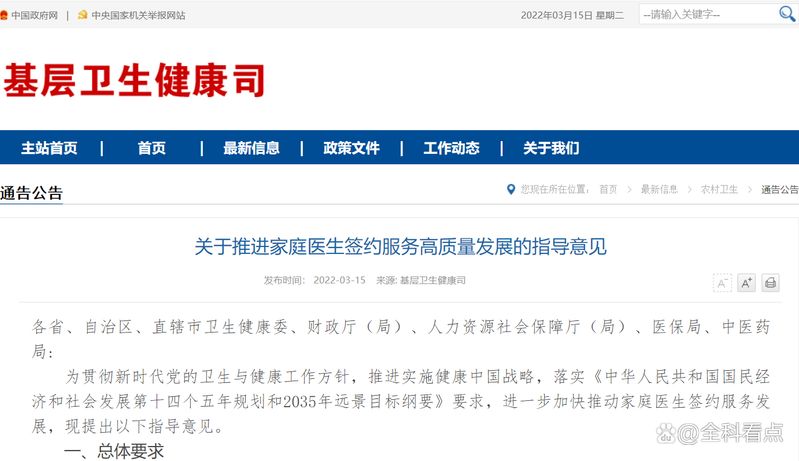
The national board of health and health, the ministry of finance, the ministry of human resources and social security, the national health service, the national board of chinese medicine and the national board of disease control, provide guidance on promoting quality development of contracted services for family doctors
National guard number 10
Provinces, autonomous regions, municipalities directly under the central government's health commission, department of finance, office of human resources and social security, health and medical services:
In order to follow up on the new age party's health and health policy, to advance the implementation of the healthy china strategy, and to implement the requirements of the fourteenth five-year plan for national economic and social development of the people's republic of china and the vision 2035 framework, to further accelerate the development of contracted services for family doctors, the following guidance is provided。
I. General requests
(i) developmental thinking. It has actively increased the availability and coverage of contracted services by family doctors; strengthened the coverage of contracted services, highlighting the full cycle of health-care services and promoting effective contracting and compliance; and strengthened incentives and safeguards for contracted services, enhancing policy synergy and ensuring the effectiveness of contracted services and promoting the quality of contracted services。
(ii) main objectives. To ensure the quality of the service and the satisfaction of the contracting population, a gradual and active expansion of the coverage of contracted services and the gradual establishment of a family doctor system with a family doctor as the health guard. From 2022 onwards, the coverage of contracted services for the entire population and priority population increased by 1. 3 percentage points per year, and by 2035, the coverage of contracted services reached more than 75 per cent, the coverage of families was almost complete, and the coverage of contracted services for the target population was more than 85 per cent and the satisfaction rate was about 85 per cent。
Ii. Expanding the supply of services
(i) the orderly expansion of sources of family medicine. Family doctors can be general practitioners, as well as other types of clinical practitioners (including chinese), village doctors and retired clinicians in health institutions. Different forms of contracting are encouraged for doctors at the primary level, and qualified level ii and iii hospital doctors are actively encouraged to join the family doctor service. Family doctors can provide contractual services both individually and in teams。
(ii) supporting social forces in contracting services. To encourage local authorities to provide policy guidance in the areas of contracted services, health insurance claims, services, and green referral, so as to create conditions for social health-care providers to contract services that meet the individual and diversified health needs of the population. Local support should be provided for the contracting of health-care institutions。
(iii) strengthening the training system for family doctors. (c) strengthen the normative training of general practitioners, assistant general practitioners, transfer training, orientation and free medical student training, promote the examination of village general practitioners and actively expand the pool of family doctors. Optimizing the capacity of family doctors for clinical services and the general concept, knowledge and skills training system, with a focus on enhancing targeted, operational and practical skills training。
Iii. Experience of services
(i) improved capacity for medical services. To further improve the infrastructure and equipment of primary health-care facilities, to strengthen basic health-care services at primary health-care institutions, to upgrade the management capacity of family doctors for common, multi-prevalence and chronic diseases, to encourage rural health centres and community health-care centres to carry out service programmes that meet the requirements of appropriate qualifications, in accordance with their capacity and the needs of the population, and to expand services such as rehabilitation, health-care combinations, peace-building and intellectual support。
(ii) improving the quality of basic public health and health management services. Public health services, such as preventive health care, are actively being provided, basic public health services and other public health services are being implemented for the contracted population, guidance on the prevention of chronic diseases is being strengthened and electronic health files are being made accessible to the individual contracting population. • provide quality health education services and optimize health management services in accordance with the health status and service requirements of the contracted population, and increase the awareness and satisfaction of the contracted services。
(iii) guarantee reasonable use of medicines. Policies such as the management of essential medicines have been implemented to strengthen the integration of primary health-care facilities with the catalogue of drugs used in hospitals above the second level, and to further adapt them to the needs of the contracted population. In accordance with long-term prescription regulations, priority is given to the provision of long-term prescriptions for eligible contracted chronically ill persons, which in principle can be prescribed for 4-12 weeks. By 2025, long-term prescription services should be available in all township health centres and community health centres。
(iv) home service. Quality control of medical care is strengthened in conjunction with the practical provision of services such as home-based treatment, follow-up management, rehabilitation, care, palliative care, health guidance and home-based beds for older persons with disabilities, who are in need of such services。
(v) optimization of referral services. In order to coordinate regional health resources of good quality, urban medical groups and district medical community-led hospitals should place a percentage of medical resources, such as expert numbers, booking equipment, etc., at the disposal of family doctors, who may be provided with a part of the reserved space to facilitate priority access, examination and hospitalization of patients referred to them by family doctors。
(vi) strengthening chinese medicine services. To strengthen the construction of medical and medical facilities and facilities in primary health-care institutions, to improve the conditions and facilities of chinese and chinese medical services, to promote the universal inclusion of chinese and chinese medical services in contracted services, to strengthen the staffing of medical and medical personnel in contracted teams, and to encourage family doctors (teams) to acquire and use technical methods of medical and medical care such as needles, pick-ups, canteens and acupunctures, and to provide medical and medical care。
(vii) to establish an orderly medical order. Further promotion of appointments and smart consultations at primary health-care institutions, and promotion of referral by family doctors to primary health-care institutions. Family doctors are required to provide a comprehensive picture of the health of contracted residents and members of their families through their daily medical services, to strengthen contacts with contracted residents, and to guide them in the development of their choice of primary health-care facilities. The contracting population may actively promote the use of credit payments, inter-firm settlements, the consolidation of payment chains such as signage, inspection, testing, medical treatment and taking medicines, and the introduction of one-stop settlements to reduce the number and length of queues。
Iv. Optimizing service delivery

(i) promote flexible service agreements. The service agreement should specify the rights of the contracting parties and list the services. The service agreement is valid for between one and three years and allows family doctors and contracted residents to conclude service agreements for periods of two or three years, depending on the needs of the population and the work of primary health-care institutions. Support for family doctors and residents to enter into service agreements with families and encourage local communities to explore the possibility of entering into service agreements with functional communities such as party bodies, business enterprises, industrial parks and business buildings。
(ii) strengthening the integration of health care throughout the system. Through the direct involvement of specialist doctors in contracting services and the priority referral of family doctors through green channels, a “one-stop” combination of specialized services is provided to the contracted population, strengthening collaboration between general and specialist doctors, promoting the integration of primary medical care, and enhancing continuity, synergy and integration of contracted services。
(iii) encouraging modular contracting. In line with the grid-based configurations of the municipal medical groups and the district medical community, tertiary hospitals are encouraged to adopt a “packed-up package” approach, promoting the sinking of quality medical resources through a variety of means, including peer support, co-construction, low-skilled personnel and multi-point practice, and working with primary health-care institutions in the districts to build up the capacity of contracted services and working with family doctors。
(iv) promoting “internet+contracting services”. Building or improving information systems on the services and management of family doctors based on the regional health information platform for all, providing online services such as protocols, health counselling, follow-up visits to slow cases and two-way referrals. Service behaviour recorded in information systems is an important indicator for evaluating the performance of family doctor services. Strengthen regional health information sharing, access family doctor services and management information systems to data channels such as medical institutions, basic public health systems, and actively promote the application of new technologies such as artificial intelligence。
(v) health counselling services. In conjunction with the basic health situation of the contracted population, the contracted population is provided with targeted health counselling services in a variety of forms, including health assessment, health guidance, health education, disease prevention, counselling, psychological counselling, etc., by means of face-to-face, telephone, social software, home doctor services and management information systems. The contracted population is closely linked to each other, increasing mutual trust and interaction and developing long-term stable service relationships。
(vi) focused populations. Priority is given to contracting services for older persons, maternity, children, persons with disabilities, persons living in poverty, family planning special members and persons with hypertension, diabetes, tuberculosis and severe mental disorders. Poverty-free areas need to be integrated into the actual situation and gradually include persons with chronic diseases in groups such as poor and unstable households, marginal poor households, sudden-onset poor households, older persons, etc., among the target groups of contracted services。
V. Improved safeguards mechanisms
(i) strengthening organizational leadership. Local responsibilities must be strengthened and concrete implementation programmes must be put in place in a practical and timely manner to refine the objectives and measures of work. There is a need to strengthen coordination and coordination by establishing a system for ensuring that the services contracted by family doctors are properly coordinated, and by creating a working mechanism for government leadership, sectoral collaboration and participation of grass-roots health-care institutions in a variety of social resources, ensuring that the tasks are carried out, expanding the coverage of contracted services and improving the quality and satisfaction of contracted services。
(ii) sound incentives. Contractual services are paid for by family doctors (teams) to establish contractual service relationships with residents, to carry out the corresponding health service responsibilities, and to provide medical services, health services and other necessary services. The cost of contracted services is shared by the health insurance fund, the funding of basic public health services and the payment of fees by contracted residents. A reasonable measure of the standard for the settlement of contractual services by a family doctor would, in principle, place no less than 70 per cent of the cost of contracted services on the remuneration of persons participating in contractual services by a family doctor, which would be paid after the examination. Level ii and above medical institutions are required to favour the distribution of pay for performance in favour of medical practitioners under contract. (c) clarify the content of the basic and individualized service packages for contracted services by family doctors and adjust the cost accounting criteria accordingly。
(iii) play a primary health-care orientation role. In the adjustment of the price of medical services, priority is given to health-care services that reflect a hierarchy of treatments and high technical and labour value, facilitating access. Promotion of head-to-head payments for outpatient visits to primary health-care institutions, orientation of people to take initiatives at the grass-roots level, and promotion of greater access to primary health-care services for contracted residents. In areas where this is possible, it is possible to explore the possibility of paying out-patient funds for contracted residents to primary health-care institutions or family doctors (teams) on a head-on basis, and for patients referred by a class-based health-care facility or family doctor (teams) to pay for the transfer. The health-care sector strengthens protocol management, improves settlement methods, ensures that insured persons have access to quality medical services, strengthens performance evaluation and improves incentives for savings retention. The policy of differentiated payments continues at different levels of health care, and differences in the reimbursement levels between primary and secondary health care institutions and those above have been rationalized。
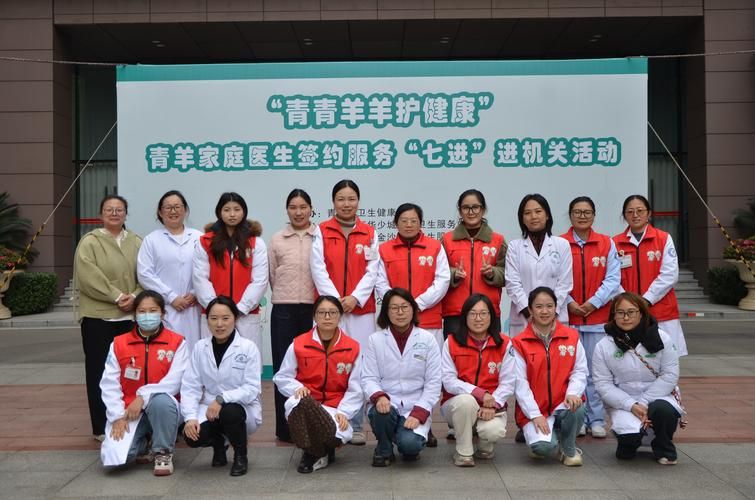
(iv) strengthening advocacy guidance. (c) strengthen the dissemination of contracted services by family doctors, increase the visibility of contracted services and increase their use by the population. Emphasis is placed on raising awareness of the content of contractual services and providing reasonable guidance to residents in their expectations. • to identify examples of high-quality and efficient promotion of contracted services for family doctors, with a view to promoting positive models and creating a favourable social climate for the development of contracted services for family doctors。
(v) promotion of professional honour for family doctors. Supporting family doctors (teams) is encouraged to compete for merit, focusing on the development of good quality and popularly recognized model family doctors, creating a positive image of the family doctors who are keen to serve the population, giving appropriate priority to family doctors in the various forms of recognition and evaluation within the health system, and increasing social recognition and trust in family doctors。
(vi) strengthening oversight, appraisal and evaluation. To strengthen the quality of services contracted by family doctors and monitor them, using as indicators the number of contracted services, the percentage of priority population groups, the rate of renewal, the effectiveness of health management, the quality of services provided and the satisfaction of the contracted population, and to conduct periodic monitoring and evaluation of primary health-care institutions and family doctors, using information and community visits, the results of which are linked to the allocation of funds and the distribution of performance. The national board of health and health will conduct annual and five-year periodic evaluations of the progress of contracting services for family doctors in all regions, with the relevant departments, and communicate the results。
Ministry of finance
Ministry of human resources and social security
National bureau of chinese medicine
3 march 2022
Click below to read the original language of the policy reading " guidance for the promotion of quality development of contracted services for family doctors "