Relevant documents
Work programme on administrative protection of intellectual property, 2026. DOCX
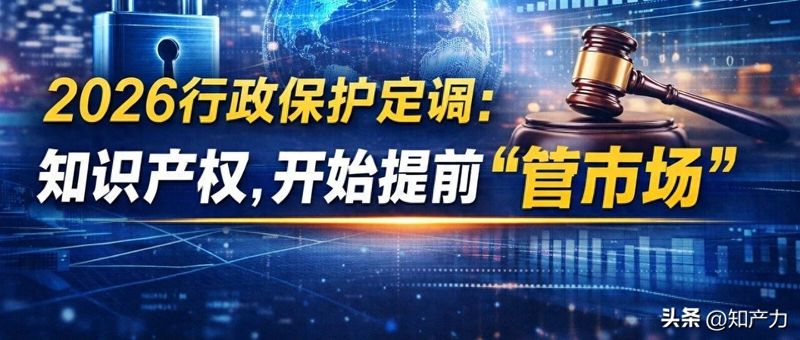
In april, the national intellectual property agency published the work programme on administrative protection of intellectual property 2026. It is not just an annual law enforcement list, but it really sends the signal that the administrative protection of intellectual property rights is moving from “after-action” to “front-end order-making” and from mono-point rights to full-chain governance of applications, use, adjudication, platforms, foreign and regional synergies. Areas such as artificial intelligence, standard necessary patents, photovoltaics, cross-border electricians, and misleading use of trademarks have been incorporated into this year's regulatory landscape。
The most noteworthy aspect of this programme is not the conventional expression “continuously enhanced protection”, but the clear shift in the focus of administrative protection。
At the beginning of the document, the rules of the system were put in the vanguard, with a clear proposal to accelerate the promotion of a new round of comprehensive amendments to the trademarks act, to the integrated circuit chart design protection regulations and their implementing regulations, to study the development of standard requirements for administrative adjudication and conciliation of patent disputes, guidelines for administrative adjudication and conciliation of patent disputes, and, in particular, to highlight emerging areas such as artificial intelligence, and to strengthen research on intellectual property protection needs and institutional rules。
This means that the administrative protection of 2026 is no longer just “how to enforce the law”, but is beginning to assume more of the task of “how to fill the rules, how to draw borders and how to keep expectations”. It no longer merely waits for disputes to occur before intervening; rather, it moves to a more forward end by building institutional interfaces。
What is behind this is a further upgrading of the logic of intellectual property governance. In the past, administrative protection was more understood as a complementary tool beyond judicial protection; and now it is assuming a stronger front-end governance function that responds directly to the regulatory anxiety in new industries, new technologies and new business practices。
The role of administrative protection is changing. In the past, it was more like, “something happened and then dealt with”, and now it's more like, “stand the situation down ahead”。
If moving the rules forward is the overall direction of the document, then the closest to the actual change in business is that the regulatory focus is moving further from the registration to the use end。
Specialized in a separate section, “strengthening the management of the use of trademarks”, the programme explicitly requires strict regulation of misleading behaviour, such as false representation through trademarks, focusing on such areas as food medicines, children's toys, household appliances, etc., and points out the problems of misperception caused by the combination of registered trademarks with trade names, advertising terms, packaging of goods, etc. The relevant violations are also reported promptly to the market regulatory authorities for investigation and prosecution。
This indicates that the regulatory focus this year is not just “registerability of trademarks”, but “how are trademarks used and what cognitive results they produce in the market”。
The change behind this is crucial. The logic of trademark governance is extending from registration order to market expression order. Businesses that used to swim between “registering legally and using obscurity” would become more dangerous. The question is no longer just whether or not to obtain a certificate, but whether the logo, after entering the market, is combined with trade names, adverts, packaging designs, creating misleading, magnifying illusions and distorting source identification。
Also noteworthy is the emphasis placed in the document on the dynamic management of geographical markers, risk screening during quarterly listings and priority protection of geographical markers. This indicates that administrative protection is becoming more concerned about whether the goods in circulation in the market are real, regulated, distorted and misleading。
The administrative protection of intellectual property rights has begun to move deeper into brand, commodity and market expression itself。
If the trademark is partly “use governance”, then the patent is partly “upgraded by administrative decision”。
The programme explicitly proposes the improvement of the system of administrative decisions at the “national-provincial-municipal” level, undermining the responsibility of provincial and municipal subjects; the timely production of supporting documentation for the establishment of administrative decisions on major patent infringement disputes that meet the conditions for filing; the provision of support for local piloting of administrative decisions on patent infringement that are required by standards; and the introduction of a joint cross-regional examination of administrative decisions on patent infringement in the optical-voltaic sector, leading to the establishment of a compliance management system for intellectual property rights in light-volt enterprises。
These are important things to look at together。
First, it indicates that administrative decisions are no longer simply a convenient avenue for dealing with small and medium-sized ordinary disputes, but are being extended to complex cases, major cases, industrial chain cases。
Secondly, the explicit inclusion of standard necessary patents in the pilot orientation means that administrative protection is preparing to enter the more judicial and international arenas of the past。
Thirdly, the use of photovoltaic names for joint cross-regional trials is no longer purely case-oriented, but is clearly characterized by industrial governance。
The signal behind this is indeed clear that administrative decisions are being given a more efficient meaning. It is not just a “segregation court pressure”, but it is more likely to be a governance interface for fast-tracking divisions and reducing uncertainty in priority industries。
Particularly in technology-intensive, productive and conflict-exposed industries such as photovoltaics, once patent disputes are concentrated, the impact is not just on the number of enterprises that win or lose, but on the operating costs, trading expectations and pace of expansion of the entire industrial chain. At this point in time, joint cross-regional hearings, decision-making and empowerment, and the participation of protection centres, are in fact pointing to a more explicit objective: not just to deal with individual cases, but to stabilize the industry。
This programme is followed by a very clear front line, and the extension of administrative protection is expanding rapidly and is moving forward in real terms。
On the external side, the document calls for the strengthening of risk early warning mechanisms abroad, with emphasis on monitoring disputes such as standard patents, “337 investigations”, cross-border electrician litigation, and malicious brand-calling; on the platform, for encouraging areas in a position to do so to use large data for real-time monitoring of abuse leads from electric power platforms to guide their timely handling; and on the regional side, for enhancing cross-regional law enforcement collaboration, for information-sharing, joint evidence-gathering, recognition of results and full chain tracking and disposal in kyyotsu, the long triangle, port-au-prince aushu bay region, as well as in chengsu, wuhan and xi'an。
This means that the administrative protection of 2026 is no longer sufficient for “territorial cases”。
It's more like a cross-sectoral, cross-regional, cross-scenes response network
On the internal level, the executive branch must be more closely linked to the courts, the public prosecutor's offices, public security, market supervision, customs, industrial correspondence, etc.; on the external side, it must be more proactive and early in warning of risks abroad, the services of enterprises going to sea and dealing with cross-border disputes; on the platform, it is no longer simply asking for “a complaint to be filed” but to start monitoring data, discovering them well in advance and holding them accountable。
This means that what businesses really have to face is no longer just litigation or enforcement that has taken place, but rather a set of more proactive, connected and systematic governance mechanisms。
It's a judgment
This document conveys at least three clear trends。
First, administrative protection is being upgraded from a case-handling mechanism to a market governance tool。
Second, intellectual property protection is becoming more embedded in industrial policy and competition。
Thirdly, emerging areas of protection are moving from discussion to implementation。
New areas of intellectual property protection have begun to move deeper into the market itself。