Definitions and categories of intellectual property rights
Projects and states
[intellectual property] is the right of citizens, legal persons or other organizations to possess, use, dispose of and profit from their intellectual work, business and other specific objects of interest。
In short, it refers to the exclusive and exclusive rights that creators enjoy for a period of time based on intellectual achievements. Its english name is “intellectual policy”, known daily as “ip”。
Most of the three most common intellectual property rights are trademarks, patents and copyrights, which are collectively referred to as industrial property rights。
However, the scope of intellectual property rights is broader, according to the types of laws and regulations concerned: copyright, patent rights, trademark rights, geographical indications, trade secrets, integrated circuit chart design, etc。
Legislative authority:
Article 123 of the civil code of the people's republic of china
Civil subjects enjoy intellectual property rights in accordance with the law。
Intellectual property rights are the exclusive rights of the right-holders under the law with respect to the following objects:
(i) works
(ii) inventation, practical novelty, appearance design
(iii) trademarks
(iv) geographical indications
(v) commercial secrets
(vi) integrated circuit layout design
(vii) new varieties of plants
(viii) other objects provided for by law。

Four main features of intellectual property
Four characteristics
1. Intangibility
Since the object of an intellectual property right is not a tangible substance, but an object of a non-material work, goodwill or invention, such as intellectual output or goodwill, it must depend on the existence of a certain material vehicle, so intangibleity can also be described as non-material。
General access to material carriers does not amount to the intellectual property rights they carry. In addition, the transfer of ownership of a material carrier does not amount to a simultaneous transfer of the intellectual property rights it carries; the infringement of ownership of a material carrier does not amount to a simultaneous infringement of the intellectual property rights it carries。
For example, we have purchased a book for a writer whose book can be divided into two categories:
1 the tangible material vehicle for publishing books - the object of property rights
2 text in published books — objects of copyright
When we purchase published books we acquire ownership rights, but we do not acquire copyright rights in published books, so they cannot be reproduced, distributed, etc. In private。
2. Geographicality
Intellectual property rights are protected by law only in the territory they acquire by law, unless specifically provided for in an explicit international treaty, bilateral or multilateral agreement。
This is because intellectual property is not only a legal right but also a product of the public policy of a state and must be imposed by law, in which the scope and content of the right are inextricably linked to the provisions of national law。
A simple understanding is that patent rights applied in china have legal effect only in china; if trademark rights are registered in japan, the trademark rights have legal effect only in japan。
3. Timing
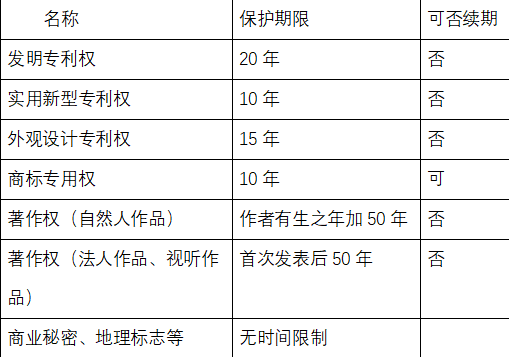
Most intellectual property rights are protected for a limited period of time, and once the period of protection prescribed by law is exceeded, the rights will be terminated on their own, and the relevant intellectual achievements will be incorporated into the public domain as a public resource available to all。
In accordance with our national legislation, patent protection for inventions is 20 years; patent protection for visual design is 15 years; and patent protection for practical new types of patents and trademarks is 10 years, in which trademark rights may be renewed。
The period of protection of copyright (in the case of works of natural persons) is the life of the author plus 50 years; the period of protection of copyright (in the case of works of legal persons, audiovisual works) is 50 years after the first publication。
There is no time limit for commercial secrets, geographical indications, etc。
4. Exclusive
Exclusiveity means that intellectual property is exclusive to the subject of the right and that no person other than the owner of the right may own or use the exclusive right of intellectual property without the consent of the owner or as specifically provided by law, which would otherwise constitute a violation。
Role of intellectual property rights
Funaction
Intellectual property, like corresponding tangible property, is of value and useful and marketable. The use of intellectual property rights consists mainly of transfers, licences, pledges, etc。
In the context of our larger market for encouraging innovation, the intellectual property strategy has become an important component of the core competitiveness of enterprise development. At the same time, the establishment and implementation of an intellectual property management system by enterprises can also regulate business management, create a professional and efficient workforce and guard against business risks。
How can enterprises ' intellectual property rights be consulted
If you wish to confirm information on a given enterprise's trademarks, patents, etc., you can select the selection conditions from the board at the end of pc [intellectual property rights], or you can enter the keyword “mark name”, “patent name” or “title of work” directly in the search column. (see figure below)
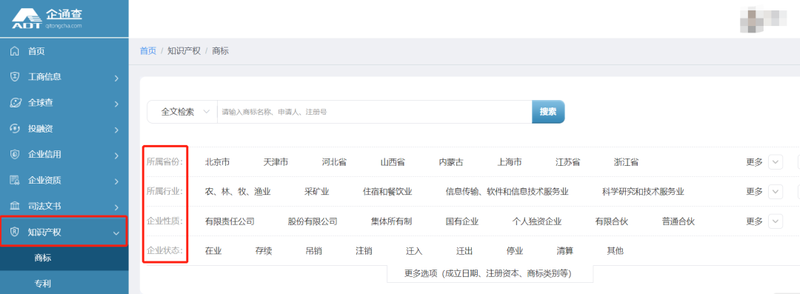
Select filter condition query
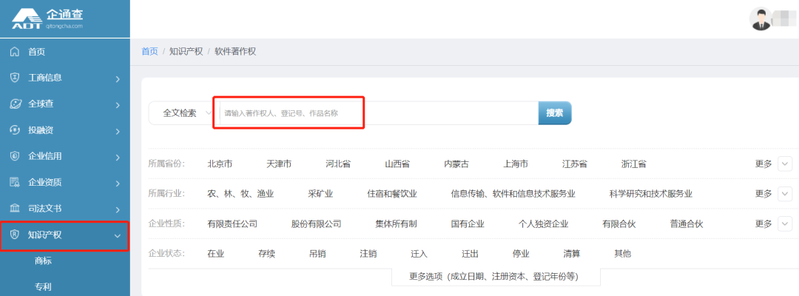
Directly enter trademark/patent name
In addition, it is possible to check at the pc end of the check whether the information [on the website file] is consistent with the subject of the intellectual property that is being consulted and to determine the authenticity of the subject. Because the relevant laws in our country clearly state that domestic servers cannot be used as site space without a website filing。
According to the management scheme for the international networked security protection of computer information networks, website filings are designed to prevent violations of the website's laws, as well as violations of the intellectual property rights of others。
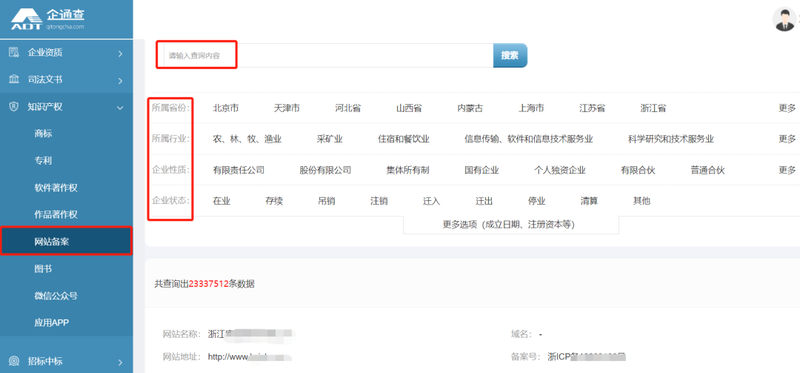
Search directly for keywords or filter conditions
Legislative authority:
Article 12 of the scheme for the safe management of computer information networks international. Interconnection units, access units, legal entities and other organizations using the international network of computer information networks (including those connected and affiliated with municipalities across provinces, autonomous regions, and municipalities directly under the central government) shall, within 30 days from the date of the official connection of the network, file a file with the receiving authority designated by the public security organs of the people's governments of the provinces, autonomous regions and municipalities directly under the central government。
The units listed in the preceding paragraph shall be responsible for reporting to the local public security authorities the number of access units and users to the network and for reporting promptly on changes in the number of access units and users to the network。
Article 23. Violations of articles 11 and 12 of this act entailing failure to perform the duty of filing a complaint are punishable by a warning issued by the public security organ or by a stoppage of up to six months。