There are multiple numbers in mahjong, but for new players, it is a headache to deal with the multiple numbers in mahjong. What are the numbers of mahjong? What are the characteristics of each? Let's see if sichuan has any rules
Base model (g) and base quarter:
Flat-hot: the average four pairs. For example: 123,345,789 million 234,66 cylinders (twice)
Big pairs: all four sets are the same cards. For example: 111,333,444,222 66 barrels (2 times)
Qing one color: only one colour for a zhu card. For example: 111,234,345,666. 88 million (4 times)
Qing dynasty: qing dynasty dynasty (eight times)
Seven pairs: special card type, no four sets
Two pairs, seven pairs for a card. Like 113,344,677,588 barrels (4 times)
Long sevens: the improvement of the dark sevens and two of the sevens are the same (or more) and can be considered as the dark sevens with root. Note: four of the same cards cannot be drawn. Like 113,344,666,5588 barrels (8 times double each)
Qing seven pairs: qing one pair of seven pairs (16 times)
Qinglong seven pair: qing one color seven pair
In addition, as sichuan ma will need to have access to the door, the odds are very low and, if encountered, can be dealt with in full。
Special algorithm:
The following base model is calculated in some areas, and the calculation is subject to negotiation before the game。
Gold hook fishing (large single fishing): means that all the remaining cards have been touched (or bars) and that only one hand plate has been left behind for single fishing. Like 111,333,444,222,6 cylinders. 4 times
Strip: all cards with one or nine. For example, 123,123,999,000, 123,789. 4 times
Clear belt: qing yi-sing. (16 times)
Will be: a total of 258 pairs. Like 222,555,888 million 222,888 barrels. (no such laws exist in some areas) (16 times)
Extra multiple:
Flows on the bar: a card to be filled with。
Guns on the poles: the cards to be added to the bars will be fired。
(b) bar-knocking: touching a card and touching the fourth card is the same, and when it comes out, another person can use it, and this is not the case。
With root: a bar or the same card from four unbard, each double。
(the following additional multiples are calculated in parts of the country, and the calculation is subject to consultation before the game
Undersea: undersea card, last card of the wall handing or firing。
It's the last of all the cards that can be hushed and all the others appear (in the halls and in the bumps). If 30,000 have been touched, 30,000 in hubing will be absolute. Two out of twenty-five, four out of five, three out of five, and the last five out of five. Since all the cards must appear at the time of the duel, there must be no need for the card in his hand. So there's only cards, sides, two sides of the way. No other cards。
In practice, the base card type is generally eight times the top (full). One to 1, 2, 4, 8 (幺), two to 2, 4, 8, 16 (二6), and five to 5, 10, 20, 40 (五2,4). There are 16 caps or no caps。
Bar
Pills: feels the same cards and sets the bars. Two times each without a card
Straight-line (barking): three of the same cards in your hand, and the fourth one in your hand. (breathing twice)
Twist (bā): three cards have been touched, and you touch the fourth. Every family without a card is twice as many
Pipes and quills are called “winds” and straight lines are called “rains”。
Because, when there is no hype, the profit of a straight line (two times) is less than that of a bend (three times), so in order to avoid the possibility of a straight line being touched and then bending, it is required that the hand of the hand be drawn immediately, and that it be inserted into the deck and then taken out。
In order to avoid the above-mentioned situation (which cannot be settled after being inserted into the deck), in some regions, the profit from a straight bar has been doubled by the barman and one by the non-barker, so that the profit from a straight bar has been increased to four times, more than by a bend (three times). This would allow for a free-flowing bend, free of the constraints of the current round. This is also known as “the rain”. This has led to the evolution of another term in some areas: shifting rain. That's when the cards that you're playing after the bend are smashed by others, then all the gold medals you get are transferred to the hu。
It is up to you to agree on which rules to adopt。
Note: if the game is yellow and the player is still calling and there are other players and there are no more players, it's useless. In order to avoid some players being deliberately free of the game by losing money because of the fact that some players are losing more than others, it is necessary to make the last four cards available, if they are able to do so。
Self-improvement
By definition, when the player touches himself (the card that he wants to use), he doubles the base gold on the original basis, and if the five-dollar mahjong mahjong is involved in a four-fold base figure + 1 (the bottom line), the amount of money he wins is five times the base amount。
Call the horse
In some cases, there are more than four players playing cards, and there is free time for players to play cards in rotation. At this point, the player can "call the horse."。
Rule: at the beginning of the card game, after the player has taken the card, the horseman is asked to take a card randomly from the end of the deck and to call it a horse, without publicity. He then sets his own number in the direction of the dealer on the basis of the points on the card, and the horseman binds the player to the number. When the game is over, the caller and the callee will win and lose the same thing。
The first is that the extra players have joined the game to avoid boredom while they are free; the second is that the fun and surprises of the game are added to it, that there are often unlucky people who call the hussy, and that some players are waiting to touch themselves in order to win more without a cannon, and that if, unfortunately, they call the plaques, then they will be unlucky。
Settlement = basic card type (usually eight caps) + bar (not top) + touch (one times) + call horse
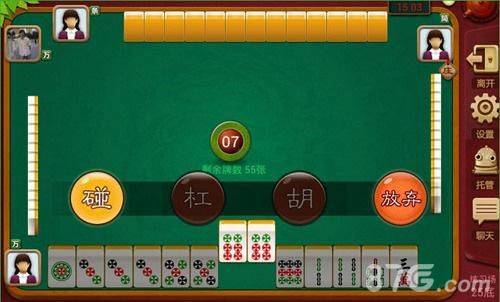
Mahjongg game screenshot
All right, guys, that's the end of the sichuan basic rule
The rules of mahjong in sichuan
Open rules
And card rules
Get the cards
The hunk rules
Multiplier rules
The rules for counting money
Glossary
Shikawa mahjong is very skilled
Winning technique
The trick
Humpty technique
Counting skills
Card technique
Winning cards
Card recognition technique
Card counting technique
Listen to cards
Card technique
Sichuan mahjongg's formula is complete
Fold formula
Formula
I've heard a lot about you
Grab the cards
It's a good idea
I'm sorry
Combat tactics