In december 2025, the spot price index in brazil fell by 2. 6 per cent, while ice futures fell by 0. 7 per cent over the same period. Domestic and international prices declined by 6. 4 per cent and 6. 0 per cent, respectively, over the same period. In its latest report, the brazilian cotton farmers ' association (abrapa) adjusted the area under cotton cultivation to 2. 05 million hectares in 2026, a decrease of 5 per cent (2. 17 million hectares in 2025), with production projected at 3. 83 million tons, a decrease of 10 per cent in 2025. Single cotton production is expected to be 1,866 kg/ha, a 4. 7 per cent decrease over the same period (2025, 1958 kg/ha). By mid-january 2026, 40 per cent of brazilian cotton cultivation had been completed。
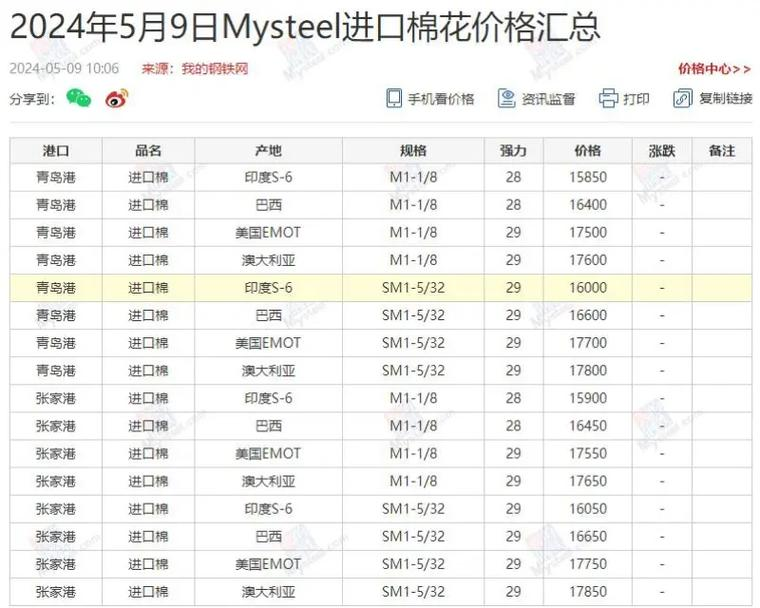
On 12 december, american cotton m1-1/8 arrived in hong kong with an upward adjustment to $12653/t; domestic cotton prices of 3128b were more volatile, at a price of $14992/t. On the cotton side, domestic cotton purchases are now supported by rigidity, while international markets are affected by the weak economy of europe and japan, and demand for cotton lacks momentum for growth, further exacerbating the external and internal cotton price differentials. For zheng kam, the recent roll-out of the zheng cotton cf2601 contract has resulted in a cumulative increase of more than 500 points, as well as a simultaneous small upturn in domestic cotton spot prices, while ice cotton futures have been affected by the weakness of american cotton export sales, among other factors, and price differentials have been driven by the split between prices. Internal and external cotton prices increased to $2240 per ton. Cotton prices in and out of the country have been volatile in the near future, with short-term price differentials or chainsaws expected to prevail。
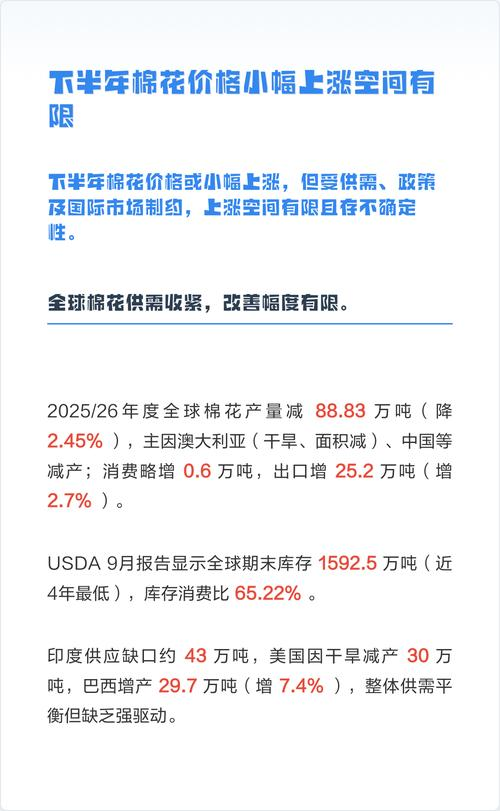
On 10 december, the domestic market price of 3128b in xinjiang was $14911 per ton, an increase of $19. 00 per ton over yesterday; zheng kammeriya received $13780 per ton, an increase of 4000, or 0. 29 per cent. The current base difference for the period (the spot price - zheng cotton master line price) is $1131/ton. Today, usda publishes cotton supply and demand data, and the world is still under adequate supply pressure, with cotton production falling to 11979 million packs in 2025 and imports falling to 43. 73 million packs, but global cotton exports and consumption have also been revised downwards to 43. 74 million and 1,861 million packs, respectively, and final stock estimates have been further improved to 7,597 million packs, indicating an increase in global cotton market supply pressure and continued repression of international cotton prices。
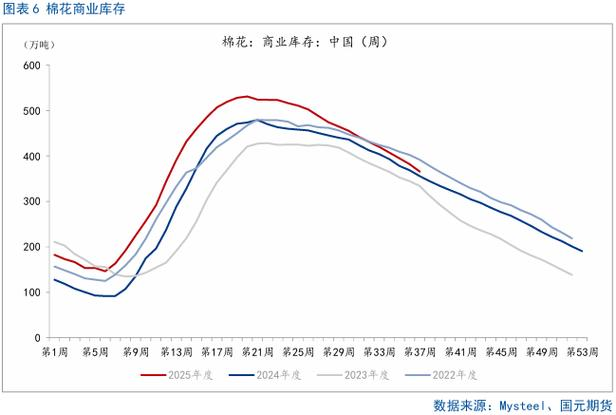
The follow-up cotton market remains more uncertain, short-term or stable. Despite the expectations of operators for the boom season, the recovery in end consumption has been slow, with downstream weaver factories and garment enterprises having a long inventory digesting cycle and under financial pressure, procurement will remain prudent, and a centralized procurement surge will be difficult to establish and demand will continue to constrain. The pressure on spin-off costs has not diminished, and prices for raw materials, such as cotton, are stable but high, human and energy costs are stacked, profit space is compressed and prices are difficult to fluctuate significantly, even if there is a willingness to increase prices. And the impact of the neo-commodity process, weather and other factors on the supply and price of cotton will indirectly affect the cotton market and increase market uncertainty. Taken together, in the short term, the cotton veil market or the maintenance of a weak dynamic will require attention in the long term to such factors as the recovery of final consumption, policy orientation and changes in international markets, in order to bring about a substantial recovery。
The current market lacked strong direction on 7 august, most traders waited for export sales reports and the usda report, and ice-american cotton constriction was similarly not effectively driven and short-term narrow concussion was maintained; on the spot, market delivery was weak and moody, attention was paid to changes in the international trade situation and tariff adjustments, and it was expected that short-term cotton prices would temporarily sustain inter-zone shocks。