The previous two days had given primary schoolgirls an account of the knowledge systems required for undergraduate students in computer science and technology. It's more logical to feel like it. Appropriate readers: students who have just entered the computer system and who have not yet understood the entire knowledge system of computer science and technology. Students in this school have benefited in particular。
The whole computer science is like a human being with two legs. One is called mathematics, one is called physics. Math is mainly about mathematical logic. More important among them are the form logic system, the turing topic and the churchr topic. The form logic system describes the world in a logical way, building the entire logic system, the mathematical system and even computer science on a few rules of reason and reasoning. Turing, which is the foundation of computer science, points to the power of the form logic system: machines can be calculated using the rules of the form logic whenever they are human. And it suggested a way to do it, the turing machine. The churchr question points to the inadequacy of the form logic system: a machine may not prove it if one can prove it. More precisely, in the form logic system, there is no universal algorithm that can judge the true or false of all propositions. That's the mathematical basis of computer science。
And the physical basis of computer technology is digital logic circuits. It's not about analog circuits, it's about electromagnetics, because it's not so much about logic. First of all, the digital circuit gives logical circuits, such as how to achieve them — only when both inputs are high-level and output is high-level — that is, with the door. And digital circuits give the design method for combining logic. This directly makes possible the design of the arithmetical logic module (alu). Finally, digital circuits give a design method for time-series logic, with the typical result being the emergence of repositories and counters, making time-series control possible。
But mathematics and physics alone are far from constituting such a vast and complex knowledge system of computer science and technology. From a historical point of view, the desire for computing capacity directly created the emergence of computers. What's a computer? An efficient machine to calculate. In order to achieve this goal, we need to address at least two questions: first, how to communicate with the machine, that is, how to make it understand what it should do, which is the origin of the software knowledge system. And then, how the machine works itself, and that's the origin of the hardware knowledge system. Then, as the times progressed, many new branches of science were born that also required computing capabilities, and the science of how to apply computers came into being. The following is a bottom-up analysis of the knowledge architecture of computer science and technology from hardware, software and applications。
Digital circuits have achieved basic components such as alu, depository (storage) etc. The next question is how to use these components to form a machine that can complete efficient calculations. The system structure of modern and commonly used computers is designated by von neumann students, known as the von neumann structure. The schoolmate took the entire computer down to five large pieces: an algorithm, a controller, a storage, an output and an output. Computers are binary. Commands and data are stored in storage on an equal footing. When the computer calculates, the controller is responsible for the global movement, then goes to the repository to get the instructions and then takes the operator's operations (e. G. Take back a and b) according to the content of the instructions (e. G. Request to calculate a + b). The number of operations (a and b) and the category of operations (plus) are then sent to the operator, which calculates and calculates and returns the result (a + b and the sum) to the memory as instructed by the controller. This is the simplest workflow in computers. As to how computers work, this course on the principles of computer composition is presented. The course not only described the composition of the entire computer system, but also detailed the working principles of the various components, such as bus, storage, etc. Finally, issues such as the design of cpus will also be addressed。
Hardware experiments are also an integral part of hardware learning at the senior level. The digital circuit experiment is mainly an opportunity for students to practice basic circuit design methods. Modern circuit design is not as cumbersome as it used to be when drawing circuit maps and then carving them manually, but rather using hardware to describe language (hdl). Knocking on the computer, telling the computer what kind of circuit you want to design, the computer automatically aggregates, wires, and eventually burns the results into chips like the fpga or the cpc. The digital circuit experiment is a process that allows students to experience the basic use of hdl and fpga. As for experiments on the principles of computer composition, it is mainly for students to use the hdl to design various parts of the computer, such as a stack of repositories, time-series control components, sram, program counters, etc. The final design is a simple eight command cpu. The design of more complex cpus - e. G. 16, 32 or even 8086 - was left for cpu design and testing。
With the foundation of the principles of computer composition, computers can be built. The higher level of the course is the extension of the principle to practice — the micromechanical principle. Using a modern and commonly used framework x86, the course introduces typical instructions for 8086 processors, making it possible to interact with computers in reality. This course will teach how to communicate at the lowest level through machine and compilation languages and computers, so that computers can calculate according to human instructions. It can be said that by the time this science developed, computers had reached a practical stage。
A science does not involve quantitative mathematical calculations, and the term “science” is always of little background. The top-level course in hardware, the computer system structure, which is the subject of contact at the undergraduate level gives hardware science such a base. The course introduced the method of quantitative assessment of computer performance from a mathematical point of view and gave the means of optimizing computer performance from different angles: the rational design of the command set, flow line technology, the rational setting of high speed caches, etc. Thus, the hardware course at the undergraduate level ends。
Knowledge of software is presented below. This part is relatively familiar with non-computer science and technology subjects such as computer applications, computer engineering and even non-computer students. Before introducing the entire knowledge system, let's look at the typical software development process:
Getting a software development mission - a project that goes down to, say, a normal course, the first step is needs analysis: analysing what this program's input is, what the output is, what the mathematical relationship between the output and the input is. What is needed after needs have been identified is an algorithm analysis: an analysis of how the problem is solved. Based on typical algorithms designed to determine the algorithms that apply to this problem in combination with the usual algorithms - – whether it's a deep search in the dirt, a broad search, a dynamic planning, greed, or a higher-level a* search, a subtext, etc. Once algorithms have been established, the basis for their achievement — the data structure — needs to be determined on the basis of the default algorithm. For example, algorithms require only access to adjacent elements, but the insertion of deletions is frequent, using a chain watch; random access to linear elements is required either in sequence or in hashi, etc. Once the data structure has been established, do not forget to validate the entire software architecture: are the algorithm-based modules sufficiently rational and can they work together normally? Since it is difficult to change the structure of the entire program once it has reached the stage of actual coding, particular attention should be given to the coding. The work that follows is simple: actual coding, debugging, testing, etc. Of course, the sequences between the above steps can be changed, for example, bythinking in c++ suggesting that test codes be prepared before designing a program, while software engineering requires that documents be maintained throughout the development process, etc。
From the start of the software development mission, the architecture of software science is easily accessible. First, we need an advanced language to communicate with computers that is compatible with human thinking. On its basis, the data structure can be achieved, thus laying the foundation for the achievement of algorithms. The structure of the data is naturally an algorithm. It goes up to structured programming ideas and norms, such as object-oriented thinking, software engineering ideas, etc. Software science seems to have improved at this point. But don't forget that there is a foundation behind it in advanced languages: compilers and operating systems. These two courses: compile principles and operating systems serve as bridges between communication software and hardware。
As for computer applications, there are too many areas involved. For example, artificial intelligence, digital signal processing, computer networks, operating systems, etc. The operating system is also classified as a computer application because its realization is also supported by much computer science, such as algorithms, graphics, etc. Each domain is based on its own mathematics: for example, artificial intelligence requires form logic, digital signal processing requires information theory, fractional transformation and sampling theory, computer networks apply more probabilities, etc. Thus, computer applications can be divided into two layers, the lower is mathematics, and the upper is a specific discipline。
By this point, the entire computer science and technology knowledge system is basically finished. This is probably what it looks like:
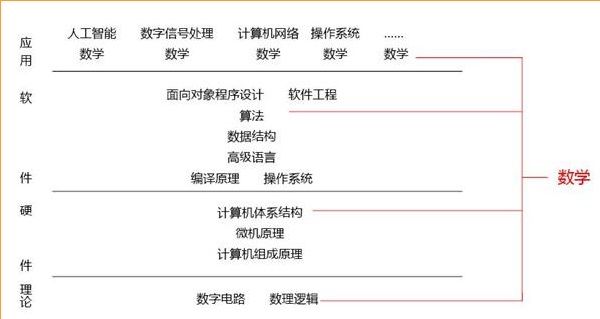
And then you can see, throughout the system, math goes through. It can be said that mathematics is the soul of computer science and technology, and a solid mathematical base is a considerable advantage for students in this profession。