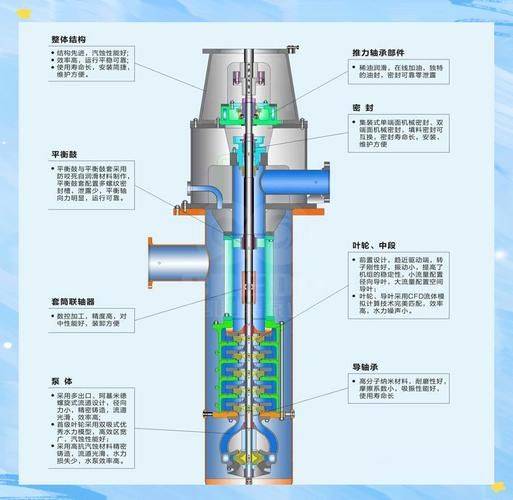
The working principles of the condensed pumps and the role and operation of the condensed pumps. Condensed water pumps are important operating equipment in fire power plants, which operate to boost the condensed water of the condensed wells of the condensers (air chiller units) and then further heat the oxygen out of the aerobics by the axial sealers and low pressure heaters. Pressured condensed water can also serve as a third-stage sideways, axle-hull systems, cooling water for low-pressure sidewalkers, and contains complementary sources of water for customers such as vacuum pumps, closed tanks and cold tanks. Condensed pumps, according to their configuration, can be divided into vertical pumps and bed-pump structures as multi-stage centrifuge pumps, working in the same way as centrifugal pumps, since the entrance to the condensed pumps is in a negative state of pressure, in order to avoid the vapourization of the condensed pumps, generally have a induction wheel at the entrance to the condensed pumps, and have a vacuum pipe attached to the condensed pump body, with the source of the vacuum pipe constantly pumping into the interior of the compulsor the air that is released into the pump and from the condensed water, and then from it. Vacuum systems drain to the atmosphere. Ii. Status of coagulation pumps in coal-fired power plants. The fire power plant is in a condensed water system and is normally equipped with two condensed pumps, each with a 100 per cent load flow, with one condensed pump operating in normal operation and the other in reserve. Condensed pumps, in addition to having vacuum pipes, are equipped with sealed water at mechanical seals on the inhaled side, usually with two routes for the water source of the sealed water, with closed or salted water being used as a source of water along the way, and with a self-sealed water when the condensed pump is functioning. Condensed water pump bearings, in addition to lubricants for lubrication and cooling, are accompanied by an axial cooling water with closed or salted water as a cooling medium. With the modification of the mechanical sealing of the condensed pumps, some of the plants ' condensed pumps achieved self-sealed technology, eliminating the external water sources as sealed water. 3. The construction of a standing condensed pump. All stages of the condensed water pump are vertically hung inside the ground-marked high and low columns and can be removed for major repairs. Condensed water enters the first stage of the pump by inhaling the horn. Inhalation of horns (import forkpipes) is integrated with the sink. Each pump can operate continuously by the system's characteristic curve. The calculated first-critical rotation rate of the condensed pump rotors is 3270 r/min when operating under the design condition. After a long period of work, when the seal gap is three times the normal value, the critical rate is reduced to 1830 r/min. It is therefore recommended that the seal be replaced with a three-fold design gap. Condensed pumps operate at any time below the rotor critical rotation speed. Condensed pumps consist of the inhaled horns, the first stage of the wheel, the second and third stages of the pump, support pipes and drainage bends, mechanical seals, bearings and electric motors. The figure below shows the construction of a three-stage tank-type condensed pump. The first stage of the condensed pump is designed to be double-sided inhaled to meet the inhalation-to-turn requirements without excessive increase in the length of the pump. The flow of water is guided by a horn to the level of stability and optimal flow speeds into the boreholes. Water from the outer edge of the first leaf wheel is introduced from double snails into the second stage. In the combined face of the double snails, in the lower horn, supported by a condensed water lubricating bearing. In order to facilitate maintenance, the operating gap between the necks of the axle and the neck of the lobes is equipped with reversible drums and inner linings. 2) the second, third and third stages of the pump are single-sided, so each level has a single-side water-entry wheel operating in a diffuse shell. The inhalation mouth of the wheel is directed downwards to the front stage, with a reverse neck ring and balance room to minimize the hydraulic load. The route leads the flow of water from the outer edge of each wheel to the inhaler of the lower wheel. Each level of pump shell has a compact water lubricating bearing to support the pump axis. The wheel key is fixed to the axis and is positioned in the direction of the axis by the end of the end and by a drum with the shoulder. 3) condensed water drained from the last level of the pump through the support tube and drainage bend, which is also called the support tube and supports the weight of the pump through a vertical tube. A steel-made drainage bend and electric motor substation, which functions as both a drain vent and a whole pump, with an electric motor to drive the pump on top of its frank. 4) mechanical seals are placed in a filling box where the pump axis passes through the drain bend to avoid leakage along the pump axis. (c) the opening of the sealed pressure, which is used to connect the sealed pipe. Condensed water from a condensed pump exported from the mother tube, cooled and sealed for operation through a pressure-relief device and organized air entry when the pump stopped. 5) axle bearings with thrust bearings and radial bearings on the condensed pump motor shelf, bearing the weight of the moving parts and the water loads imposed. The bearings have a fully integrated lubricants system. The bearings are designed to have a high capacity to operate under certain overload conditions. 6) emps are driven by a standing cage-type induction motor. 4. Condensed pumps shall operate with care 1. Condensed pumps shall, in the normal course of operation, monitor the bearings connected to the pumps, the temperature, the temperature of the electrical bearings, and the conditions of pressure on the exit. 2. In the course of normal operations, the sealed water enters and returns to the water gate in open condition. 3. Condensed water taps the air doors open and the source of the air inside the pump is constantly pumped out. 4. Condensed pumps are required to ensure a certain level of hot water wells during normal operation and, in normal conditions, hot water wells must not be less than 300 mm in order to ensure condensed water pump entrances. It won't bring in a lot of air. 5. Special attention needs to be paid to the occurrence of abnormal conditions, such as condensation of pumps, in the normal course of operation, if the sealed water is too small or interrupted to cause pressure on the crew to decline. 6. When a condensed pump is activated or when the flow is too low in the course of operation, the condensed water recycling door needs to be opened to ensure that the flow within the condensed pump is sufficient to prevent the pump from becoming impenetrable。