Financial management operations course
Course background:
Do you feel that as a procurement officer:
- it's difficult to deal with finance people
- financial expertise in terms of cost, turnover, budget, rate of return, profit and loss analysis is dead. Dry
-i don't know how to compare a supplier's offer
- we can't talk about prices. The supplier says we're losing money
- kpi indicators are year-by-year
- to choose a strong supplier, it's often the size of the company, but the price doesn't go down, the delivery doesn't seem to be real
The course is tailored to the above confusion and introduces, from a procurement perspective, the necessary financial knowledge of procurement in an easy-to-understand manner, to inform procurement staff about the operations of enterprise financial management and to use financial knowledge to improve procurement performance。
Course characteristics:
Knowledge presentations, case analysis discussions, role exercises, interactive exchanges, brainstorms, emphasis on participant participation。
Curriculum
First day
“let figures tell the truth” — financial knowledge and analytical skills required for procurement
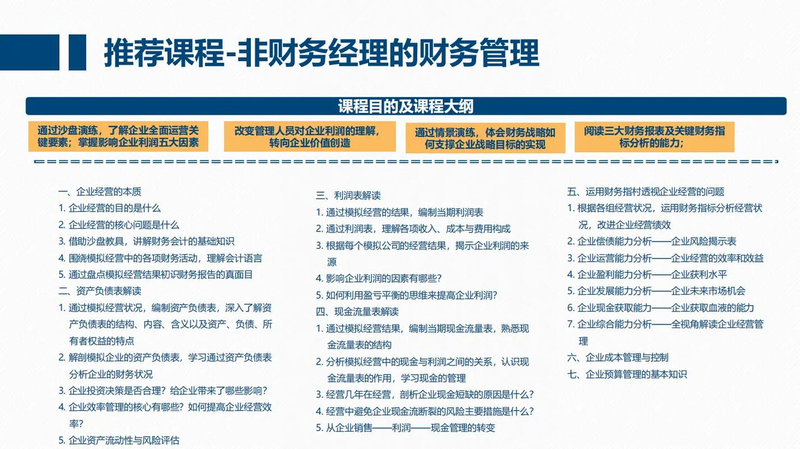
How non-financial persons view the financial statements
- 3 statements in the finance - balance sheet, income statement, cash flow statement
- balance sheet structure and main elements
- structure and main elements of the cash flow statement
- structure and main elements of the income statement
Case 1: real exercise of balance sheet + profit/loss statement
- debt service analysis
- assets and liabilities ratio
- mobility ratio/speed ratio
- analysis of operational capacity
- rate of turnover of accounts receivable
- inventory turnover rate
Revolving rates of accounts payable
- cash flow rate
- profitability analysis
- asset rate of return
- the return on investment
- sales margin
- make numbers talk — how to measure vendor capacity in the financial statements
Case 2: use of financial data in the vendor audit process
“elimination of waste and crowding out of moisture” — cost dismantling and cost optimization skills required for procurement staff
- “tracing” — component of cost
- cost breakdown — “6+1” cost classification method
Case 3: cost analysis of a rubber product achieves 20% cost optimization case sharing
- main factors affecting product prices
-case 4: "secrecy behind thin-soldier sales" - marginal cost analysis method
- cost logic throughout the life cycle (tco)
- internal and external factors influencing supplier pricing
- vendor proposal mechanism and response modalities
Case 5: abc practice practice in cost analysis
- 15 common methods of cost optimization (centralized procurement, esi, learning curve...)
Case 6: application of the learning curve in procurement downgrade business
- how to anticipate vendor costs in advance
- common cost optimization methods:
- target cost method, lcs, standardization, centralized procurement, e-procurement...
- value engineering and value analysis (the importance of vave, esi and epi)
- "calculation makes sense" - learning curves
Case 7: application of the learning curve to cost optimization
- cost control methods for complex product procurement — application of lpp model
Case 8: application of lpp models in cost optimization
Next day
3. Integrated supply chain costs and optimization tools from a financial perspective
- cost analysis in supply chain
- types of stocks and hidden costs
- method of calculating the financial value of inventories
- fio method
- * methodology
- weighted average method
-moving average method
- individual valuations
- common inventory assessment indicators
Case 9: ito set-up method (nine muse method) and ito design in different industries
- the confirmation of the most economical order
- push and pull together supply chains and best points
- data-based best order decisions
Case 10: safe inventory, physical setup of swing stock
-five distribution modes of logistics (milk-run, vmi, cross-docking, synchronized logistics jis, direct)
Case 11: cost optimization for overseas distribution by a multinational enterprise
-a reasonable projection based on data (weighted average method, seasonal index method...)
Case 12: post-market demand response for new products
- types of taxes and fees and ways to optimize them
- value added tax
- business tax
- extra taxes
- corporate income tax
- personal income tax
- paper
- tax optimization and reasonable tax avoidance
4. Improved procurement performance from a financial perspective
- impact of procurement proceeds on financial performance
- procurement budget planning and management
- expenditure analysis and product classification for procurement
Case 13: analysis of procurement expenditure and decision-making on procurement optimization
- vendor strategic matrix — 16 tactical management of supply business
Case 14: time value of cash npv - strategic cost-sharing for a cherry business logistics distribution supplier
- new blue sea market - supply chain finance
Case 15: supply chain finance model b2b platform
Financial management operations course
Reproduced: http://www. Nlypx. Com/gkk detail/282973. HTML