Hey, i'm hao, and i bring you up-to-date life dynamics every day, but every piece is dry; if you think this information is useful for your life, just pay attention
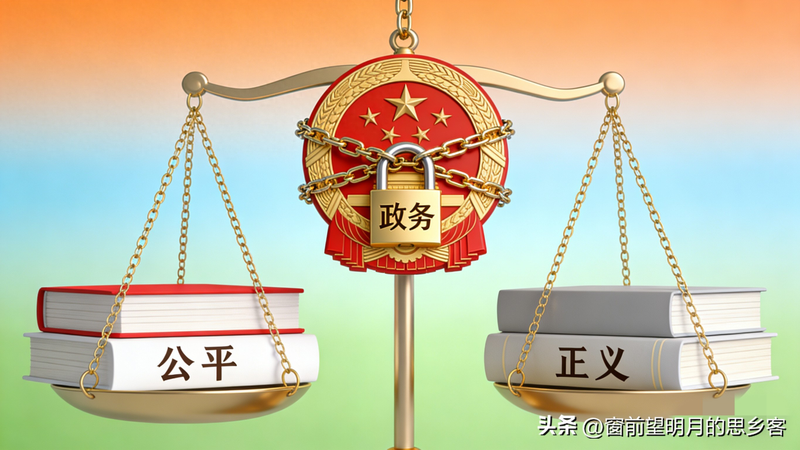
We've been told, "let's talk about the rule of law," but the rule of law is not an empty word! The true rule of law is one thing at the core: it is the true rule of law that makes those who hold power clear and accountable, and that leaves power to be held hostage. This is not just a matter for us, ordinary people, but an important way for the country to move forward. It is a matter of peace and fairness for everyone。
I. The point is: whether it's the law or the power
In the rule of law in our country, there is a fundamental argument — that the law is greater than power — and that's not casual. No matter how many officials and how important their powers are, they have to follow the constitution and the laws, and no one can get out of the law. This is also what the state has always stressed, and building a society based on the rule of law has to hold that bottom line。
There may be a murmur: is it too much power to waste time? Actually, that's the wrong idea. The law binds power not to allow it to act, but to act according to the rules. Just like we have to drive by the rules of the road to be fast and safe, so does power. Power is meant to serve the people and to do things for society, and the law is the line: what can be done, what can be done, what can not be touched by the red line is clear and clear, neither is it idle, nor is it arbitrary。
In reality, there are sometimes bad things to hear: people who have power at hand, who don't take the law seriously, who come as they please, and who even profit from power. Such behaviour is the “power as the boss”, and the rule of law is built to correct that vice. The state has always made it clear that whoever crosses the line of law is responsible, and that is the true meaning of “law over power” — no power over law。
We need to be clear that public power is granted by the people, by national law and is essentially used for the benefit of all. The law gives power both “empowerment” and “stretching” so that power can only operate where it is used and cannot be diverted or crossed。
The “key minority” must follow the rules first
In order to control public power, it is first necessary to control the leaders who hold power, which is what we often call “prime authority”. The state's promotion of the rule of law has always emphasized the need to capture these “critical minorities” because they have too much power in their hands — how policies are determined, how things are resolved and how the problems of the civilian population are resolved are linked to their decisions and actions。
The rule of law in society would naturally be better if the leadership were to lead the way in following the law and following the rules; but if the leadership itself failed to take the law seriously, abuse of power and abuse of the law would not only be bad, but would also cause the public to lose faith in the law. Thus, holding “key minorities” is a crucial step towards the rule of law。
There are also a number of practical ways for the state to follow the rules. On the one hand, they are regularly organized to learn about the constitution and the laws, so that they understand that power is given by law and must be exercised in accordance with the law and not in a special way, and on the other hand, when leading cadres take up their duties, they are required to take a constitutional oath in order to ensure that they respect the constitution and perform their duties in the presence of all, keeping in mind that their powers are used to serve the people。
More importantly, the state has always been zero tolerance for abuse of power by leading cadres. Regardless of the position, any violation of the law would be prosecuted. Through rigorous oversight and accountability, leadership cadres are deterred from abuse of power and are prevented from abuse of power, thereby ensuring that authority is exercised in accordance with the law。
Iii. Tightening power: institutional and supervisory institutionalization of power
It is not enough to control public power by the self-determination of the leadership, but rather to rely on institutions and oversight, such as the imposition of a “tight spell” on power, so that it can't be confused. This is also an important idea in building a state based on the rule of law: every step of power is governed by rules and eyes。
First, the law should make clear the boundaries of power. The state has been constantly improving the legal system so that every public power has a clear legal basis — what to do, what not to do, how far to go and what to follow. In short, “the law allows it to be done and it cannot be done without it” and “do as it pleases” from the source. At the same time, the law makes it clear that “what must be done” and that power must not be lazy, that it must be held accountable and that it must not remain indifferent to the affairs of the people。
Second, surveillance follows the path of power. Where powers operate, oversight takes place, and without them, it becomes problematic. Our country has a comprehensive monitoring system: the people monitor the work of the government and the judiciary to ensure that they act in accordance with the law; the people find abuse of power that can be reported and reflected; and the media can monitor the abuse of power in accordance with the law. With so many eyes, power is difficult to operate in secret boxes and it is not that easy to abuse。
There is also a need for mutual restraint between powers. Just as in the judiciary, the judiciary and the prosecution function each other and do not allow any party to overpower each other, there are rules within the government sector, such as procedurality in the administration of justice, collective discussion of major decisions, and no one can decide. Such a system should be designed in such a way that there is a synergy and a restraint between powers and avoid abuses resulting from concentration of power。
Iv. The first minority of the rule of law: through representation of authority
Someone might ask, "what's going on?" the answer is really simple: it's for the people. The rule of law in the country has always been people-centred, and public authority is the most immediate and effective way of protecting the legitimate rights and interests of the population。
We live in peace and justice. When things happen, they can be justified and supported by law; their property and rights are guaranteed without fear of violation of their rights. And it is only by virtue of public authority that these can be achieved. For example, in the case of land demolitions, day-to-day law enforcement and approval, the people will not suffer as long as they have the right to behave in accordance with the rules, without “black-boxing” or abuse of power; the law enforcement authorities will not be able to impose fines and the law will make their productive lives easier; the courts will be fair, so that those who have the right are not lost and those who have done wrong will be punished; and the public authorities will be able to take the interests of the people fully into account in their decision-making。
Conversely, if power is left unattended, the days of the people may be affected. For example, in some cases, people's land was taken by the people in an irregular manner; in others law enforcement officials behaved in an arbitrary and unfair manner; and in some cases cadres used their power for private gain to the detriment of the public. These acts not only undermine the civilian population, but also undermine social justice. The law, on the other hand, holds power in order to put an end to these problems and to make public power the “protective umbrella” of the people, not the “roadblocker”。
Thus, the rule of law is not a cold provision, but rather a “protector” that protects our lives. Only when power is exercised in a strict manner can the people truly feel fair and just, and the day can be more secure and more secure。
V. The rule of law is not a human person: all participation used to work
Of course, genuine rule-of-law construction is not achieved by a single sector or group of people, but by society as a whole. While public power is at the core, each of us must also be involved in building the concept of the rule of law so that it can take root。
For governments and public officials, it is important to take the lead in complying with the law, in accordance with the rules and practices. The law does not dictate what should be done; it does not allow it to be done. By doing so, we tell you that power is used to serve people, not to play the privileged, to be the “leader” of the rule of law。
For our people, we have to understand the law, observe it, and use it. It is important to learn to help the law and to solve problems in a legal manner. It is also important to be conscious of the law, not to break the law and to fulfil its obligations. For example, when people abuse their power, they can report it through legal channels; their rights are violated and they can take up legal weapons to defend their rights. The establishment of the rule of law is motivated by the initiative of all of us。
The state has also been disseminating legal knowledge throughout society in order to bring the concept of the rule of law to the forefront of the family and to make everyone fear the law, abide by it and apply it. When power is firmly held, when everyone is aware of the rule of law, and when society as a whole forms an atmosphere of “law and order”, the true rule of law will take root and our society will become more equitable and harmonious。
Ultimately, the rule of law is not so simple as a slogan. It requires the rule of law to hold power over power; it requires the capture of a “key minority” and leadership cadre to lead by example; it requires institutional and oversight to hold power in the service of the people only; and it requires the involvement of society as a whole, so that the notion of the rule of law becomes more visible. This is the firm direction of a country that is fully governed by the rule of law and the common aspiration of our people for a better life。