On-site repair and maintenance analysis for large road mechanic diesel machines
On-site repair and maintenance analysis for large road mechanic diesel machines
Mao jun hui
Security technology
41 issues in 2023
China railways shanghai bureau group co. Ltd., shanghai large road maintenance machinery unit 212,300
Summary: the present paper provides an analysis of the status and modalities of the on-site repair and maintenance of the bf12l513c wind-cooled diesel vehicle, which is currently the main road forklift, by taking stock of the typical failure of the fuel rigs that have affected construction and motor vehicles in recent years。
Keywords: large road mechanic diesel machine; site repair; maintenance
Foreword
Diesel engines, which are large-scale mechanical power output, are key to the operation and operation of large-scale road support machines and, in case of failure, will have a direct impact on construction progress and operational safety. However, as a result of the poor external operating environment of the large road mechanic diesel machine, the high vibration, temperature and impact of the operation, which resulted in frequent malfunctions of this type of equipment, and the rising rate of failure as the time of use increased, it was necessary to perform the failure maintenance and routine maintenance of diesel equipment. This paper explores how repairs and maintenance can be performed as follows。
1 current status analysis of the overhaul of major road mechanic diesel machines
First, large-scale road mechanic diesel equipment will be subject to different wear and tear after a certain period of operation, and the allocation of reasonable maintenance time to it is an effective measure to guarantee its performance. However, in the current maintenance sector, maintenance time for large-scale diesel equipment for road mechanics is sometimes poorly scheduled, leading to poor maintenance of diesel equipment。
Second, in the case of large-scale road mechanic diesel equipment in different conditions and areas, different applications exist for the same range of large-scale road mechanic diesel equipment, which leads to differences in mechanical equipment failure. However, the current phase of maintenance and maintenance of diesel equipment for large road machinery does not have a targeted system based on differences in the condition of the equipment, resulting in inefficient maintenance and maintenance of the machinery。
Thirdly, the technical capacity of the inspectors varies considerably, some of them are less aware of the causes of the failure and the methods of the process, and the lack of adequate physical improvement has been consolidated, resulting in inefficient inspections based solely on the experience of others in the process and the human perception of the failure of the diesel aircraft。
Issues, solutions and attention in the operation of diesel engines
2. 1 classification of diesel engine failure
The types of malfunctions common to large road mechanic diesel machines include pylons, start-up difficulties, slits, white smoke, blue smoke, black smoke, etc. Based on the breakdown of diesel engine start-up performance, the diesel engine could not be activated, the diesel engine was difficult to start, and the diesel engine was in an abnormal state of operation after the start-up. More recent start-up failures in the operation of diesel engines are concentrated in the event that the heater fails to start again or when the engine fails to run suddenly, and when the engine is restarted, the causes of the failure can be grouped into four categories. The first is the control of electrical circuit failure, mainly in the form of a wire link, circuit failure, damage to a meta-ware device, etc.; the second is the failure of the oil route, which is generally too low for diesel, air for the oil road, congestion of the oil road, etc.; the third is the breakdown of the gas, which is generally characterized by a dirty air core or an incorrect gap between the gas doors; and the fourth is the failure of machinery, such as the initiation of electrical damage, which is typically caused by damage to the electromagnetic valve or abrasive damage to the machine, requiring repair or replacement of the starter。
The failure of diesel engines has changed dramatically, and it is difficult to have a standard method of elimination. When analysing the cause and location of the failure, careful observation of the phenomenon can be made. Preliminary judgements can be made by observation of the start-up phenomenon, the rate of engine velocity decline, the rate at which electrical manoeuvres are activated, etc., and, based on actual excavation experience, screening is carried out in conjunction with typical cases to improve actual excretion efficiency in the field. An analysis of recent engine start-up failures revealed higher frequency of electrical and oil circuit failure, lower frequency of ingestion and mechanical failure, higher frequency of parking magnets and their transmission structures, break-up of the electromagnetic wires, “split, short, broken” internal cable lines of engines, loose impregnation of high-pressure feeder connections, cooling fluid slots and insufficient oil levels. The engine, which is the “heart” part of the entire vehicle, is paralysed once the engine is not operational, directly affecting the opening and operation of the construction line. It is therefore particularly critical to learn how to effectively address engine failure。
2. 2 method of repair and repair of common start-up malfunctions of diesel engines in cdc-16
2. 2. 1 the motor turns off at an abnormal motor speed。
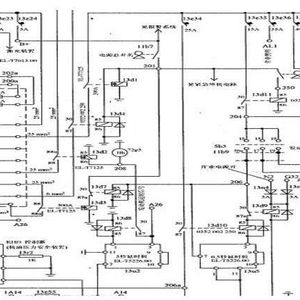
(1) first, if the voltage is abnormally judged to be a failure, if the vial normally opens the b13 box (as shown in the above chart) and finds a connection between n2 (the main operator switch) and g32 (the zf attachment) wires, then check whether there is a 24v voltage in the tensile form, and if there is 24v voltage, determine that the operation has not been shut down or the zf attachment has not been unopened. If there is no electrical starter switch to two, check if there is a 24v voltage at 206, check if there is a 24v voltage at 204 wires, and if there is a voltage at 204, the switch is judged to be activated (5b3/11b9 malfunction). If there is no 24v voltage at 204, the 250 wires are checked for 24v voltage, which is judged to be 13d11 relay failure if there is 24v voltage at 250. If there is no 24v voltage at 250, check whether the engine activates the circuit switch 11 b8, the total power switch 11 b7 and the e8 and e24 insurance in the 13 boxes are out and r1 is damaged。
(2) when checking for 24v voltage at 206 wires, check the d8 relays in 13 boxes for 24v voltage on the foot of 85 in 13 boxes, and if the d9 relays in 13 boxes are judged to fail without voltage. If the d8 relay in 13 boxes has a 24v voltage on its feet, the switch is activated in 0. 5 seconds to check the location of the three feet on the 13u5 time frame and, if not, to determine whether the 13u5 time frame or the site is bad. If the three feet on the 13u5 time frame are grounded, check if the 30 of the 13 boxes of d10 relays have a 24v voltage or, in the absence of 24v, the e9 or d1 relays or e34 fail. If 13 boxes of d10 relays have a 24v voltage, then check if the 206a interface has a 24v voltage, and if 206a has a 24v voltage, the motor failure is judged to have been triggered by the diesel engine。
2. 2. 2 check that diesel motors are moving at normal speed
(1) (as shown in the figure above) first, check the availability of 24v voltage for the 313 wires using a live meter, and if there is a 24v voltage at the 313 interface, it is judged to be the failure of the oil route or the shutdown of the electromagnetic valve 1s6. If there's no 24v voltage at 313, check if si55 has 24v voltage
(2) if si55 is connected without 24v voltage (as shown above), 95 boxes of e7 fuses and d1, d2 relays are inspected。
(3) if si55 has a 24v voltage, check if there is a 24v voltage at the 215 connection, (as shown in figure 2) if there is a 24v voltage at the 215 connection, check if g66 is located, if g66 is located, judgement is 13 boxes of d12 relay failure, and if g66 is not located, check zf walk control panel 28u5 or connection failure。
(4) if 215 wires do not have a 24v voltage, check if si30 has a 24v voltage if si30 does not have a 24v voltage 95 box e1 fuse and d1, d2 relay. If si30 has a 24v voltage, then the 243 wire is checked for 24v voltage, and if there is no 24v voltage, the initial switch 5b3, 11b9 or 11n5 fails. If there is a 24v voltage at the 243rd interface, the a26 end is checked for a 24v voltage. If the a26 end is free of 24v voltage, 11e9 or a connection failure is judged. If the a26 end has a 24v voltage, check whether the one and seven feet of 11u3/a are channeled or, if 11u3/a is unguided, determine the failure as 11u3/a. If the 1,7 foot conductor of 11u3/a is checked, then the 8 foot of 11u3/c is checked for 24v voltage, if the 8 foot of 11u3/c does not have 24v voltage, if the 314 wire is connected, and if 314 is not connected, the failure of 11u3/b relays is judged. If the eight feet of 11u3/c have a 24v voltage, check whether si80 is connected or, if si80 is not, determine the external shutdown button or the connection failure. If si80 is located, 11u3/c relay failure is judged. That's my way of fixing the cdc-16 engine to fail。
2. 3 cdc-16 prototype case analysis for start-up failure of diesel engines
Fault: after reaching the area of operation, the engine could not be activated without failure, without hearing the sound of the motor being activated, and judged that the motor could not be activated because the motor was not activated。
The failure analysis and disposal: (1) the motor was activated without action and, as shown by the circuit map, checked whether the b13-box fusee34 jumped and found a breakout。
(2) pull out two endpoints of 206a of the output line and go all the way to activate the motor and go all the way to assist in the activation of the electromagnetic valve. Placing engine start-up switches in the second stage, b13 box e34 does not jump, while measuring the input voltage of 206a is 27v, indicating that 206a is normal at the input end to e34, thus judging to be two 206a export routes with short circuits leading to the jump。
(3) using the exclusion method, two output terminals of 206a were connected to each other for start-up, and it was found that the route to activate the motor could be started normally, and the route to assist with the start-up of the electromagnetic valves had a jump。
(4) discrepancies in cable lines from the 206a output end to the auxiliary startup of the electromagnetic valves were judged, the grounding of the cables was confirmed using a mass-use table “om slot” measurements, followed by a check of the cable wires to detect skin breakage, which touched the metal slots of insulated rubber, thereby creating short circuits. As shown in the figure:
It was then temporarily covered with high-temperature insulation tape and then started normal, after which the vehicle was emptied and the entire line was replaced and the insulated rubber was added。
2. 4 solutions
2. 4. 1 control of operation
In the first instance, the speed can be controlled in the course of operation, thereby reducing the time of operation and stabilizing the properties of diesel engines. Second, the timely cessation of operations under overload conditions could cause damage and focus on maintaining the smooth operation of diesel engines. In addition, the operation of diesel engines is to be carried out after they are in good condition, thereby enabling them to operate safely and steadily。
2. 4. 2 daily monitoring
In the course of the operation, the diesel motor module was patrolled every 20 minutes as required; temperature measurements were carried out on the surface of the fire-proof package with occasional infrared thermometers at temperatures not higher than 160°c and were immediately reported to the technicians when found above or close to 160°c; observation of pressure indicators such as engine oil pressure, temperature, temperature of engine cylinders, and temperature alarm instrument indicators was enhanced in the application and abnormally timely stopovers were detected; and monitoring of engine elastic axes was enhanced in the application to prevent damage to the elastic axis from the risk of high-speed temperature friction of rubber units。
2. 4. 3 normative and operational application
(1) an inspection of the oil table is required before each launch. When the cold starts, the failure speeds 2-3 minutes, before the pressure on the oil is stabilized, and the slow lifting of the gas doors, the “twirling down” (2) failure to stop immediately after long periods of heavy load work, and the failure to operate at air speeds of 3-5 minutes, before the temperature and temperature of the tank drops. (3) during the transfer operation, one towed vehicle (not less than two power stations and not less than three power stations) is strictly prohibited; the maintenance unit must be fully powered and the start-up phase should be slow to lift the gas door; the engine is strictly prohibited from using its own fuel door for speed control, which requires a “strike-down” at or below speed, and the vehicles shall be unified at the request of the driver。
3 diesel maintenance measures
3. 1 daily maintenance of diesel engines
Content and programme for daily maintenance of diesel engines. The maintenance project is incorporated into the operating hours and the maintenance project is organized to facilitate the normal operation of the machinery. First, day-to-day maintenance of items such as diesel engines before start-up, during operation and parking was performed and any minor problems were identified for timely resolution. Second, attention should be paid to the clean looks of diesel engines, keeping filters clean and open, and to routine oil quality checks and, if necessary, testing。
Maintenance focus: (1) cleaning up and checking of oil-scatterers, cryogenics and turbine fans to ensure that engine dispersing components are working well; (2) conducting inspections of oil pressure, temperature and temperature, and temperature sensors, alarm switches to ensure that they are working well; (3) intensive inspection of fireproof packaging materials for diesel motors and of pipeline interfaces to ensure timely processing; (4) examination of whether oil leaks exist in engine cylinders, oil casings, filters, caps, etc., in high-temperature environments, and increase in the probability of leakage; (5) examination of whether high-temperature cables are operating well in order to prevent short roads; (6) conducting regular maintenance of motors as strictly required (opening engine wind panels: first, if there is a collision of hard oil pipes; second, if there are signs of impregnation; third, if there is reliability of parking magnets; (7) monitoring of engine oil levels, cooling fluids, confirming that “oil” “water level” meets the requirements; (8) conduct of regular engine maintenance (opening engine pressure winding); concern about changes in the temperature of the temperature of the engine and water。
3. 2 diesel maintenance attention
3. 2. 1 attention to the operation of diesel engines during the summer
(1) diesel engines shall not exceed 60min full-load hours and, if production progress requires continuous and long-term work, at least at least 1000 r/min cooling for three to five minutes after the operation of the diesel engine, so as to avoid abnormal damage due to overheated diesel engines; (2) oils shall be replaced immediately in case of deterioration or blackout of the engine; (3) fans shall be regularly cleaned up and the working condition of the fans shall be inspected; (4) scavengers and the cooling surfaces of the various radiators shall be regularly cleaned out to prevent over-heating of the diesel aircraft as a result of the excessive accumulation of heat-spread dust; (5) there shall be a strict ban on the sudden stoppage of the diesel aircraft in full-load condition, and the diesel aircraft shall operate at a rate of 1,000 r/min cooling for three to five minutes, preferably at a temperature of less than 70° c and a temperature of less than 80° c。
3. 3 improved diesel engine structure
3. 3. 1 improved parking electromagnetic structure
Parking units play a key role in ensuring the normal start-up of engines and the parking process, and their normality is directly related to the work schedule and safety of the construction units, and the normal work of the engines is of paramount importance for the time-bound railway system. It was therefore particularly important to ensure the proper operation of engine parking units。
Based on the structure of the parking magnets, the main principle of improvement is to minimize the incidence of carded nodes in their moving structures. The old parking device ball connections are significantly greater than the retrofitted reconnection, with the pre-remobilization electromagnetics working through the shaking arm and the ball interface, while excessive connections inevitably create friction resistance in the work of the magnets and affect the stability of the work of the stop magnets. In the case of modified parking units, we have adopted a connection to only two ball points and a pusher, with a marked reduction in the friction resistance of the electromagnetic process and the avoidance of unnecessary malfunctions of the electromagnetics caused by the installation of reeds。
Concluding remarks
The poor environment in which large-scale road maintenance equipment is being used makes routine maintenance of diesel engines particularly important. In order to be able to maintain diesel engines, detailed inspection and maintenance programmes need to be assigned in advance, while at the same time the use process should focus on continuous improvement of care and operational specifications, recognizing the importance of day-to-day maintenance to optimize the maintenance of diesel engines. In the event of anomalies, it is even more necessary to process them in a timely manner and to adapt diesel engines to their optimal operational condition through constant technical maintenance and commissioning to ensure their proper operation。