Lightning
The laser radar company, robosense, has published a financial report for the first half of 2026 today. According to the financial statements, the rapid build-up amounted to 1,020 million in the first half of 2026, an increase of 30. 2 per cent over the previous year's 783 million
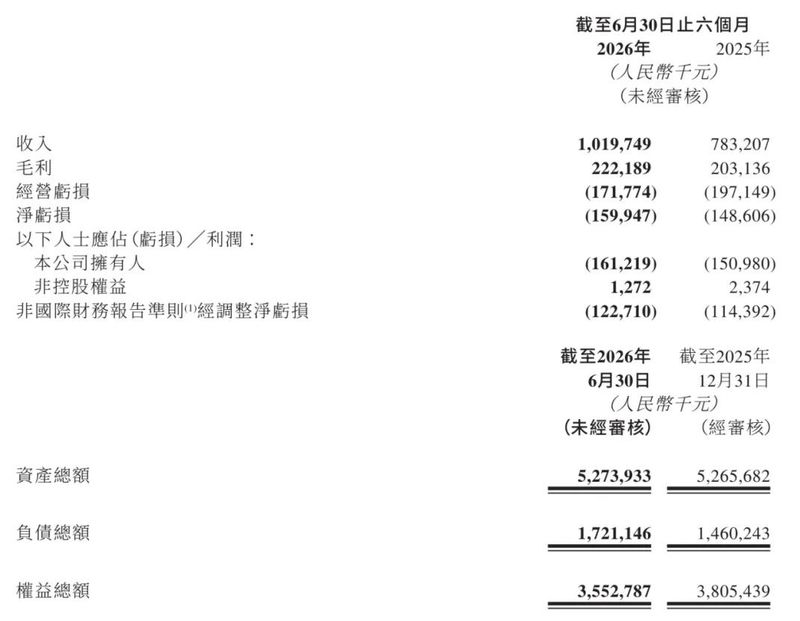
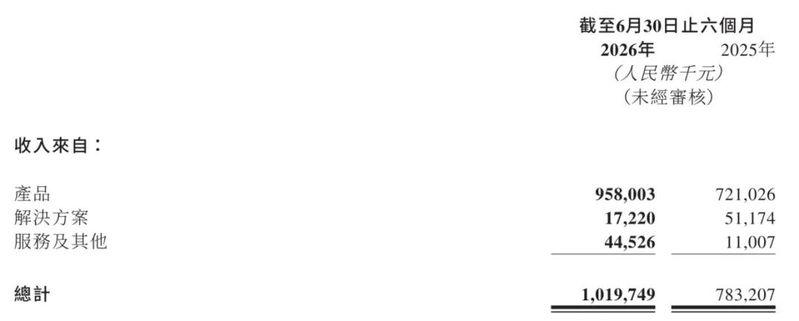
Of this amount, 958 million were generated from sales in the first half of 2026, an increase of 32. 9 per cent from 721 million in the same period the previous year, mainly as a result of the increase of approximately 169. 6 per cent from approximately 266,800 laser radar products in the same period in 2025 to about 719,200 in the first half of 2026. Of these, 282,600 laser radars were sold in robotics, an increase of 510. 4 per cent over the same period。
In the first half of 2026, robotics generated nearly half of the company's product revenue and became the main source of gross profit from the product, the main engine of growth for the physical ai era。
At the moment, the rapid build-up of the bottom technology and engineering capabilities of the laser radar, which it is accumulating over a long period of time, further migrates to robotics and data acquisition, and product matrices extend from laser radar to more robotic core increments。
In the first half of 2026, income from services and other sources was $4,453 million, an increase of 304. 5 per cent over the previous year's corresponding period of $11 million, mainly due to income recognized in a technology development service project in the first half of 2026。
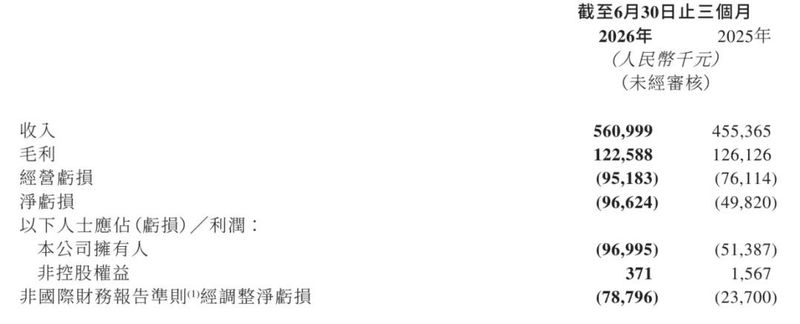
The q2 battalion receives 560 million more than 23% more than it gets. Business
In the second quarter of 2026, there was a surge of $561 million, an increase of 23. 3 per cent compared to $455 million during the same period of the previous year, and māori was $123 million。
The rapid accumulation of r & d expenditures in the second quarter of 2026 was $184 million, sales and marketing expenditures were $3. 784 million and general and administrative expenditures were $5. 15 million。
The rapid concentration of laser radar products in the second quarter of 2026, laser radar products for adas applications and robotics and other laser radar products was about 388,900, 291,800 and 97,100, respectively, representing an increase of 145. 8 per cent, 135. 7 per cent and 182. 3 per cent, respectively, compared with the second quarter of 2025 (“second quarter of 2025”)。
As of 30 june 2026, the rapid mobilization of laser radar products in collaboration with 36 car-to-house and level-i suppliers has increased to 186 models and has resulted in the realization of 81 sops out of 17 of the above-mentioned car-to-house and level-i suppliers。
As at the date of this bulletin, the number of spot cooperations for the production of fast-growing laser radar products had further increased to 194 vehicle types, 37 of which were co-operatives from overseas and co-financed industries covering japanese, north american and european markets。
At the world congress on artificial intelligence (waic), held in july 2026, a second generation of high-precision ultra-widen digital laser radar e2 based on self-study of peacock chips was launched. Digitized full solid scanning structure, e2 and high quality
Many types of vectors, such as man-shaped, four-foot, weed-cutting robots, are supported by measurements, large vision fields, compact sizes and high reliability, and promote the commercialization of physical ai multiple scenes。
The mig n90 max, released on 30 july 2026, is the exclusive carrier of a digitally solid laser radar, equipped with a digitally solid laser radar for the primary portion of the car。
For the first time, three major items were disclosed and space cameras were ordered to scale
After two years of low-level technology accumulation, product research and development and joint customer validation, the strategy of becoming a leading robotic platform company, launched in 2024, is gradually shifting from strategic direction to actual product and business delivery。
For the first time, this performance announcement revealed advances in the commercialization of the three core increments of robotics: “eye”, “skin” and “must”, which revolve around robotic perception, exposure and implementation capabilities。
Specifically, the “eye” category adds a space camera class to the original laser radar. The product, thanks to the world's highest performance self-study spad chip, has historically matched colour and depth information to the original, with the output of precision mm-scale rgb-d information, which provides stable recognition of the near-field operation of robots in the context of environmental light change and weak texture。
The “skin” class is divided into visual touch and mems tactile products, in which the visual touch significantly simplifys the light-route structure in structure and, while reducing the need for computational power, achieves the extreme miniaturization of the sensor, which can be applied to fine areas such as sharp fingertips. Mems tasting the emergence of unique mems technologies and industrial capabilities can play a role in many places, such as the abdomen, to improve the drift, delay, etc. Of traditional electronic skin。
The “muscular” type of product is a joint modulus group, which uses fast-stealing to create a mini-chemical power capacity on laser radars to address low precision and control efficiency problems associated with low electrical rectangular density, which can significantly increase service life。
In addition to being directly applied to robotics, the three main product categories can be applied in conjunction with the data acquisition system to provide for large-scale data acquisition and modelling training to provide a sense, touch and action configuration close to robotics in order to narrow the gap between training data and actual deployment。
At present, the three main product groups are at different stages of the commercialization validation and delivery process. Of these, space cameras have been ordered to be scalded and are scheduled to be delivered by the end of the third quarter and to be fully delivered by 2027; visual and mems tactile products have been developed; the first enterprise-level mass production project is planned to start commercial delivery at the end of september and enter production in the fourth quarter; and the first joint module has been developed and the first 10,000 levels of procurement requirements have been created, and bulk delivery is planned for the fourth quarter。
The main engine of robotic growth will deliver more than 200,000 peacock chips
The expansion of new products is the rapid accumulation of existing capabilities for further reuse in robotic markets. Over the past decade or so, the company has continued to accumulate ground-level capabilities around laser radars, such as chips, optical, mems, precision power, engineering and scale manufacturing, and has taken the lead in achieving market validation for the size of robotic laser radar operations。
According to the financial statements, fast-growing robotics continued to grow at a high rate, contributing almost entirely to the increase in income in the first half of 2026 and becoming a major source of gross profits for products。
At present, there is an intensive collaboration with nearly 60 globally-capable and intelligent enterprises, such as uyuki, ji-won, galactica general, pufu, cross-border, international dynamics and fourier。
During this year's waci and wrc, over 20 physical ai partners carrying fast-moving laser radars focused on different robotic forms, such as double feet, four feet and wheeling。
As the physical ai industry grows in demand for real world data, the company further expands its cooperation with industry partners, such as intelligent, short-thinking robots, optical smart, origen, to extend robotic operations to space perception, data collection, assessment, modelling and application validation。
This bottom-up capacity is being further developed. In the first half of this year, two spad-soc chips, based on the “creative” architecture of the spad-soc chip-scale solution platform, were launched in a quick succession of spad-soc chips based on the “peacock” of the world's smallest high-precision ultra-wide, fully solid laser radar e2 has been officially released and opened for delivery。
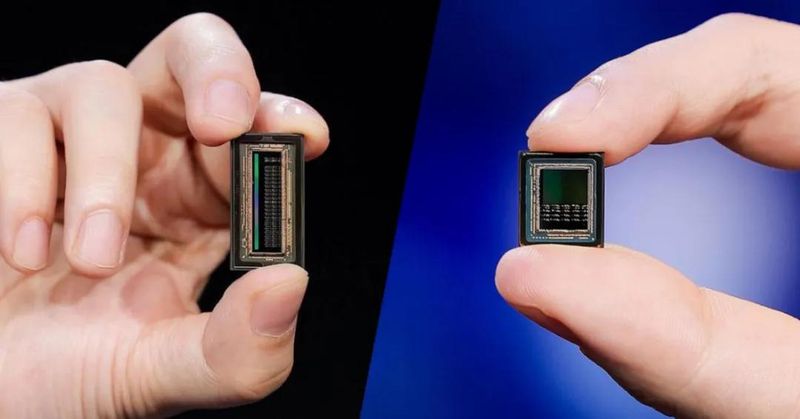
It is expected that by the second half of 2026, more than 200,000 products will have been delivered with the peacock chips and that the phoenix chips will be the first project to be carried on board in the fourth quarter。
——