“forest” classes in the city - the national forest and grass office kindergarten explores new models of immersion in natural education
In 1953, the state forestry and grassland authority (hereinafter referred to as the kindergarten) set up a kindergarten in the peaceful community of the eastern city of beijing. The community of peace was one of the first complexes in beijing, founded in the 1950s and known as the asia-pacific peace conference, held in beijing in 1952. The “unit compound”-type community, initially planned to address the housing problems of central state agencies and ministry employees, is dominated by 4-5 floors of red brick-soviet buildings, with some regions retaining up to the present time slope roofs that feature the 1950s。
In historic communities, in one-size-fits-all kindergartens, every limited inch of space flows into the minds of the educators, displaying an impressive green aesthetics: the years of childhood around the shade are fortunate。
The red culture and industrial memory of the community in which the kindergarten is located give a unique culture of reproduction. Zhao yanbin, director of the kindergarten, introduced the issue of “natural deficit” for young children as early as 2014, exploring the creation of a “exploration-type nature game” curriculum that would help young children to become closer to nature and to establish the concept of its roots。
In the process of building china's modernity, advocating for living in harmony with nature is one of the core concepts of development, and the impact of “natural deficiencies” cannot be ignored. Zhao yanbin says, “when we learn to be part of the ecological community, true modernization will come.”
From classroom to forest:
Reshaping the early childhood education landscape
Natural deficiencies are the physical and mental problems of modern people caused by the artificialization of living spaces, virtual experiences that replace outdoor activities, excessive conservation restrictions on natural exploration, as manifested in the loss of attention, depression, sensory retardation, etc., especially among groups of children who are over-reliant on electronic devices。
Zhao yanbin said: “the plastic slides and colour walls of traditional kindergartens are essentially an extension of the artificial environment. Over the years, we have broken environmental constraints and built a “respiratory ecological park” for our children, expanding the educational landscape from classrooms to the outdoors and even the forests, seeking to integrate urban young children regularly into the natural landscape and reshaping the modern relationship between children and nature from the source of education.”
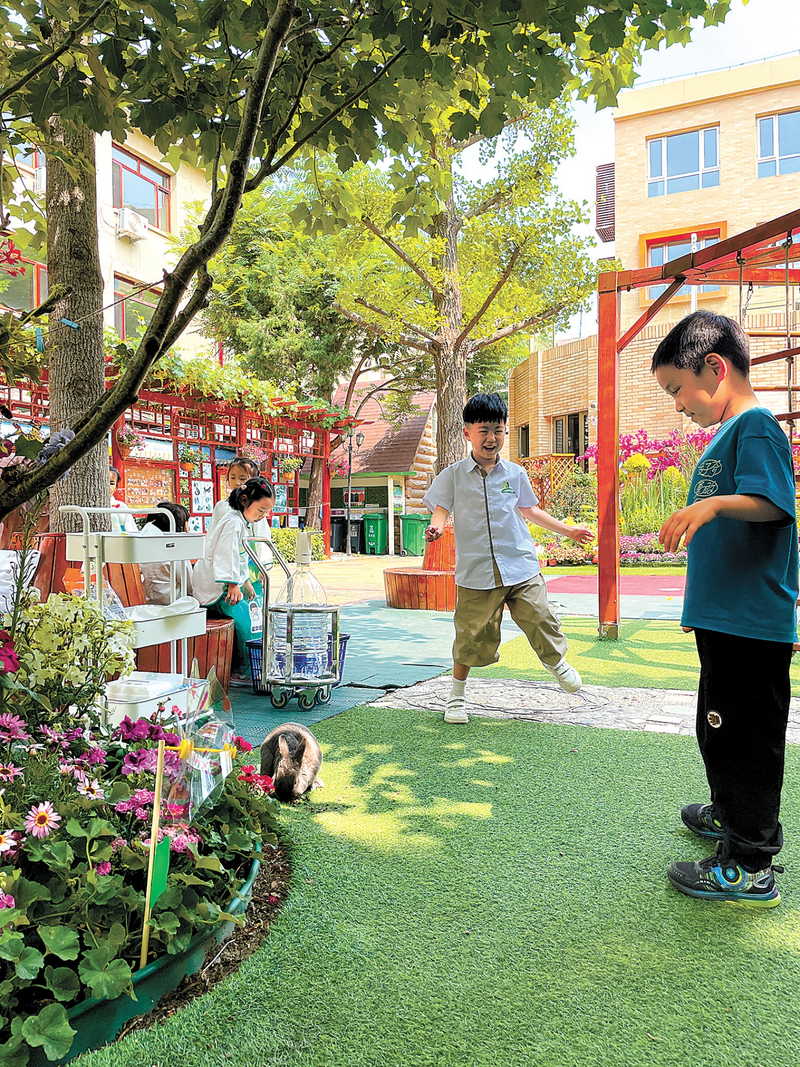
The kids play with the star bunny
The outdoor area of the kindergarten is described as 1,718 square metres and the greening of 813 square metres, including planting areas, exploratory areas, viewing areas, sandwater experience areas, etc. In total, the gardens plant special plants and flowers, with two three-storey-high and precious sanctuaries accompanying children from generation to generation. Vegetables include maple trees, silver almonds, goose palms, cedars; bouquets such as jade, cloves and seashells; bouquets such as apples and mountains; and herbs such as lasagna and daisies. At the same time, the kindergarten has created special areas such as the “eco-made” “one-metre vegetable gardens”, which contain a variety of small plants and animals, and the “eco-mide garden” which is a garden where children grow and grow plants themselves。
In addition, the kindergarten has developed tools for natural materials suitable for use by young children of different ages, with observation, measurement, testing and creation categories, which allow young children to observe changes in nature at close range。
(c) environmental bearers:
Initiating natural exploration in the environment
"nature is a living textbook." kindergartens create diverse natural observation spaces that guide young children to turn brief curiosity into a permanent interest。
On the basis of the natural corner of the class, a unique natural exploration area is being carefully created to encourage young children to take initiative, experiment and experiment, focusing on developing the ability to explore, practice and solve problems。
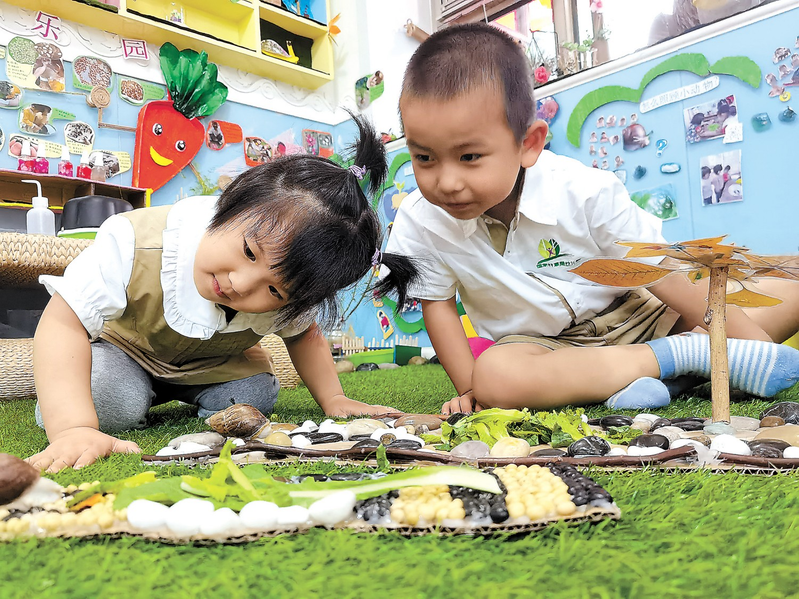
The kids are watching the way snails crawl
Regional layouts are adapted flexibly to the preferences of young children in classes. If young children love to play creative games with nature, they connect the natural exploration zones to the industrial zones, facilitate their access to graphic materials and stimulate creativity; if young children are passionate about scientific exploration, they are linked to scientific zones, prompting them to become in-depth exploratory nature games such as “research for fruit in the mirror” and “natural scales” to widen the scientific horizon of young children. Through careful design, the kindergarten connects indoor natural exploration zones with the outdoor natural environment, enabling young children to feel the charisma of nature in different settings and experience more diverse natural exploration activities。
Teachers are more sophisticated in using everyday situations to bring natural games into the daily lives of young children. During meal breaks, teachers guide young children to the sources of food, to the process of its growth, to the nurturing of their sense of gratitude and awe of nature, to the discovery of water flows and handwashing fluids in the bathrooms and to the development of conservation habits, and to the conduct of walks, to lead young children to autonomous exploration in the natural environment, to feel the beauty of nature and to learn how to live in harmony with nature。
Forest resources empowerment:
Building a “professional+” curriculum system
“ecosystem” kindergartens are more than physical spaces and need to produce “natural leaching courses”。
Building on the industry affiliations of the national forestry and grassland agency, kindergarten has developed a curriculum development model for “forestists + early childhood teachers” and has developed a “explored nature game” curriculum. The educational output “explored nature game development and practice in kindergartens based on green enlightenment education” has received the first prize for excellence in education in the eastern city of beijing。
Specialists in forest grass and ecological education come into the classroom and teach children about trees, pandas and other interesting content such as national parks and birdwatching. The vice-president and researcher of the institute for lifelong learning and sustainable development education of the beijing institute for educational science and the researcher of the institute of educational sciences of the east city of beijing, the masters of the army, have long served as a research mentor in kindergartens。
In august 2020, in the “eco-china panda home”, launched by the centre for the study and research of the great panda of china, kindergarten was invited to become a panda cope educational union。
The quest natural game curriculum system highlights indigenous features, and focuses on the theme “four seasons” on the subject of 24 gas, traditional festivals, plants and animals around them, natural phenomena, nature games, green environment, etc. The valet tree explores specialty games, which teach children about the pathology of trees to identify healthy trees and guide them to the life course with annual wheel analysis. Activities such as the discovery of large pandas at the zoo, natural excursions at orson park and natural expeditions at the west mountain have enabled young children to learn about the beauty of nature as they approach nature. Through the integration of traditional festivals and accelerations, such as the stunned animal exploration, planting of trees, cold-eating experiences at the festival, daily measurements during the summer, the production of dragon canoe models and twigs at the midday festival, autumn harvests and winter collections, children have gained greater cultural self-confidence in the traditional culture of "one human being" wisdom in the game。
In observing and learning from nature, young children's mental, physical and creative capacities are fully developed, and scientific thinking and aesthetic skills are naturally formed。
Data for growth:
Natural education for the future
For more than 10 years, kindergartens have been carrying out systematic natural development follow-up assessments of young children, and a pro-naturality assessment of all children in the park is conducted every school year. Analysis of data shows that young children have made significant progress in their natural cognitive and practical capacities: more than half of young children are able to initiate natural-related issues, and the proportion of more traditional early childhood models has risen significantly。
In the practice of early childhood natural education, this success is reflected not only in the growth of data but also in more visible changes in young children's daily behaviour. Feedback from parents ' questionnaires indicates that many children are beginning to take an active interest in the natural environment and are actively observing changes in the growth of surrounding flora and fauna. These feedbacks attest to the positive role played by immersion natural education in stimulating young children's interest in natural exploration and fostering good behaviour practices, and provide valuable lessons for the innovative development of early childhood education。
According to zhao yanbin: “psychology believes that early natural experience can significantly enhance children's ability to live together and their ecological values, and that developing a sense of responsibility through linkage with nature is the core value of green enlightenment education.”
“we want children to remember not just the fun of games, but the fear of life.” zhao yanbin said, “when they grow up, green is no longer an abstract concept in textbooks, but rather a survival intelligence carved into dna”
In the kindergarten, journalists see bright eyes and the “why” in this context constitutes the most vivid footnote of the green enlightenment. When education returns to the nature of nature, the seeds of green ecology take root in every young child and are ready for the future. Li yin