Policy context: new qualitative productivity calls for a reshaping of sti systems
At the moment, the state is doing its best to promote the development of new quality productivity, at the heart of which is the leading role of science, technology and innovation. Recent policies such as the action programme for the solid advancement of high-level science and technology and the measures to promote the transformation of scientific and technological results clearly call for the establishment of a new national system of “basic research, applied research, industrialization” and emphasize the “principal status of science, technology and innovation in enterprises”。
This marks a move from a focus on “how to manage research projects” to a strategic focus on “how to design effective innovative ecosystems”. Research that sheds light on unique patterns of knowledge creation, mobility and transformation in the context of national circumstances has become an urgent need for national innovation-driven development strategies to provide systemic solutions to break the “crawling” dilemma, optimize the allocation of scientific and technological resources and stimulate the dynamism of various kinds of innovation。
Positioning of periodicals: science management, china's flagship platform for innovation management and policy research
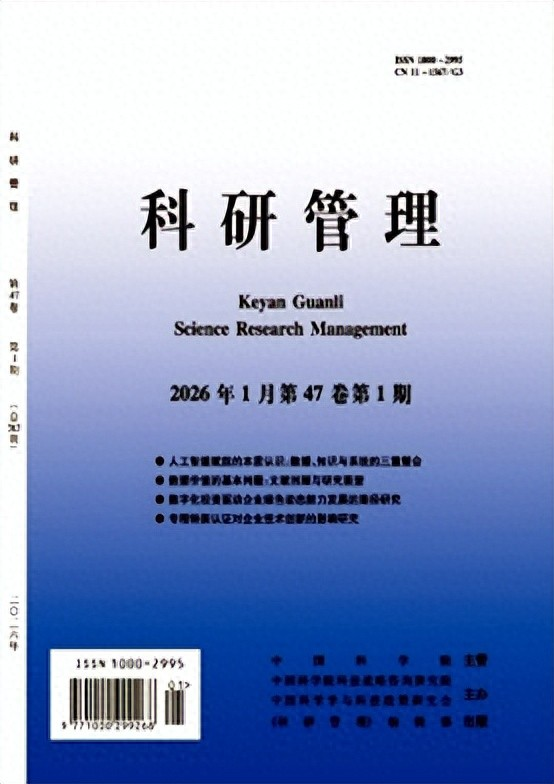
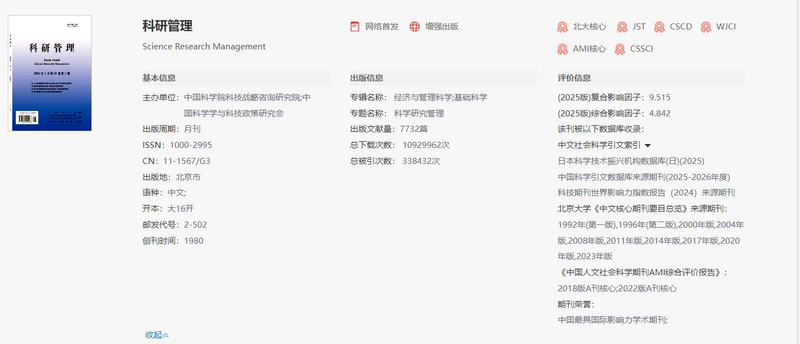
In the field of managing science and engineering, science and technology policy and innovation management in china, science and research management, co-sponsored by the institute of strategic science and technology consulting of the chinese academy of sciences and the china society for science and technology policy research, is the leading journal in the csci, cscd, north chinese core, and serves as an authoritative bridge between managing science, policy research and innovation practices。
Core characteristics:
The distinct “management + technology” cross-genetic: natural integration, strategic management, organizational theory, science, economics, sociology, and other multidisciplinary perspectives are committed to systematic research on the full chain of science, technology and innovation, the full elements, and the whole subject。
Solid empirical research and theory are constructed in parallel: both rigorous empirical analysis based on large-scale data (e. G. Patent, paper, business panel data) and deep theoretical refining and conceptual modelling based on typical cases。
Directly serving national innovation policy-making: its research issues closely align with national science and technology planning, innovation policy evaluation and research institution reform, and are important intellectual support for the modernization of national innovation governance systems。
Research frontier: four core issues driving innovation paradigm change
The management of scientific research continues to focus on and lead to the following research directions of major theoretical and practical importance:
1. Organizational modalities and effectiveness assessment of national strategic science and technology strengths
The organization's logic of the major scientific and technological tasks under the “new national system” is explored。
Examples of research: study of the relationship between governance structures, synergy mechanisms, knowledge integration and breakthrough innovation outputs based on typical cases such as “big scientific devices”, “national laboratories”, “innovation conglomerates”; build assessment frameworks, systematically evaluate the selection mechanisms, process management and long-term impact of major scientific and technological projects, such as the national natural science fund, priority research and development programmes; and explore changes in the incentive structure and behaviour patterns of researchers in the organization of new types of projects, such as “surfast-up” and “racing horses”。
Methodology: need for a combination of case studies, social network analysis, econometric assessments, etc。
2. Mechanisms for the realization of enterprise science, technology and innovation
Breaking the “two skins” of technology and economy and focusing on micropowers。
Examples of research: use of listed company and patent data, empirical tests; impact of r & d inputs, government subsidies, tax incentives on substantive (rather than strategic) innovation in enterprises and their bordering conditions in different property rights, in different industry contexts; study of the role of “chain owners” enterprises, leading firms, in the construction of industrial innovation ecology, and models for bringing smes together in innovation; analysis of mechanisms for balancing innovation behaviour between national strategies for services and the pursuit of market efficiency。
Depth: institutional analysis needs to be carried out in depth with corporate governance, strategic management theory。
3. Digital smart technology-driven scientific paradigm and management change
Focus on ai, how big data can reshape knowledge production itself。
Examples of research: exploration of the destabilizing effects of ai for science (scientific intelligence) on traditional methods of scientific research, the way scientific research is organized and the role of scientists; research on new methods and applications of scientific integrity intelligence monitoring, scientific intelligence excavation and forecasting of forward trends based on large data; analysis of the far-reaching impact of new knowledge-sharing models such as open science, pre-print platforms on scientific evaluation, academic exchange ecology。
Frontline: research itself should be at the forefront of the global paradigm change discussion。
4. High-level scientific talent and innovation team development incentives
Focus on the core drivers of innovation。
Examples of research: research on the complex impact of systems such as “no-up” or “no-go”, talent programmes, scientific research funding on young people's scientific and technological talent research choices, cooperative models and long-term creativity, based on data from large-scale scientists' careers; analysis of the formation of interdisciplinary, cross-border innovation teams, knowledge integration and conflict resolution mechanisms; and exploration of the development of a system of diversity, long-lasting evaluation and incentives in the context of “break five” in line with patterns of different disciplines and types of scientific activity。
Value: research requires both insights and solid empirical evidence of scientific sociology and organizational behavior。
The path to science management's "know one"
The publication of high-level results requires both academic and managerial thinking and “scientific spirit of scientists”。
Step 1: problem identification - at the intersection of “country demand” and “academic frontier”
Seize the pains of the innovation system: a profound understanding of the real bottlenecks in institutional mechanisms, resource allocation, culture and so on in china’s transition from “tracking mimics” to “run and run.”。
(b) the management of extracting science: it can transform macro-policy concerns into identifiable, analytical, testable management science or policy science issues。
Step two: research design - integration of multiple approaches, deep-tilled chinese landscape
The unique advantages of data resources are the active development and use of china's patent databases, databases on scientific and technological projects, enterprise innovation surveys, and the curricula vitae of scientists, among others, to establish an empirical basis for research。
Cross-cutting innovations in methodology: using econometrics, social network analysis, case studies, experimental methods, text mining, etc., in a flexible and normative manner, based on research issues, to encourage methodological innovation。
Theoretical roots and dialogue: research findings should strive to engage in a dialogue with innovation theory, strategic theory, institutional theory, and seek to distill concepts or models of universal significance from chinese practice。
Step iii: results presentation - highlighting management insights and policy implications
The integrity of the logical chain: from questions to questions, literature reviews, theoretical construction/assumptions, empirical examination to concluding discussions, needs to be rounded up and logical。
The focus of the management message: the conclusions should clearly set out the practical implications of the research findings for the managers of scientific institutions, heads of enterprise research and development, and government policy makers in science and technology。
Clarity in words: while maintaining academic rigour, seek clarity so that readers from different backgrounds can understand the value of research。
Step 4: academic ethics - adherence to norms and contributions to public knowledge
Emphasis is placed on the repetitivity of the study: data sources, processing steps, analytical codes should be made as public as possible or detailed。
Faced with the limitations of the study: be frank about its limitations in terms of dissemination of data, methods or conclusions。
To receive rigorous cross-review: as a journal of cross-cutting disciplines, the reviewer examines the paper from a multidisciplinary perspective and needs to be tested with an open mind。
This paper is based on the latest publicly available data on the internet and the official information of the periodicals and is based on the development strategy of our department for information purposes only。