Who's the real need
Introduction: the shift from “luxury goods” to “essential needs”
At some point, the ipr management system appeared to be seen as a “luxurious product” for large groups or leading technology firms, far from smes. But the times have changed. In today's era of innovation driving development and competing globalization, the common challenges of managing, protecting and applying intellectual property rights are as long as there are intellectual gains worth protecting, irrespective of the size of the enterprise and the industry in which it is located. The intellectual property management system is shifting from an optional tool to a strategic necessity that underpins the sustainable development of enterprises。
Far from being a simple database or reminder tool, the system is a modern management platform that is professional, systematic and intelligent and, like a “back-the-scenes military”, can systematically change traditional models of corporate intellectual property management. So, what exactly does it suit? The answer may be broader than you think。
I. By industry: three core tracks, with varying needs
The types of intellectual property assets and management priorities of different industries are different, and an excellent system is able to respond to the unique needs of industries by virtue of its high suitability。
High-tech and science- and technology-based enterprises: the guardian of innovation
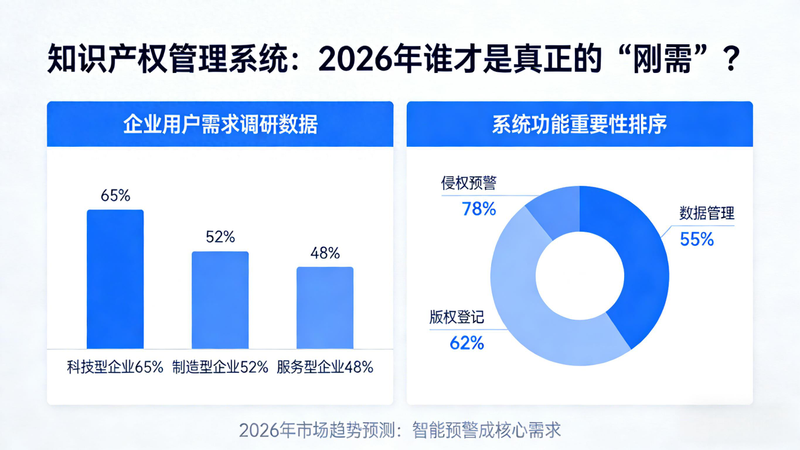
Patents and software copyrights are lifelines for technology companies, internet enterprises, biomedicine and high-end equipment manufacturers. These industries are dynamically innovative, with numerous results, large intellectual property rights and complex technological dimensions. Intellectual property management systems are able to efficiently combe these complex assets and achieve a life cycle management from r & d creative protection, patent applications to post-authorization maintenance. The system provides a clear record of the innovation details of each technology and, through built-in search and analysis functions, helps enterprises to conduct global patent retrieval prior to application, avoiding duplication of r & d and tort risks; at the same time, it automatically monitors the status of patent reviews, the period of annual fee payments and ensures that the rights of core technologies are stable and that enterprises remain ahead of the technology competition。
Manufacturing and consumer enterprises: branding and design “condensers”
Manufacturing enterprises may have numerous trademarks, outward design patents and technical secrets. Trademarks are the soul of brands, while appearance design directly affects product competitiveness. Intellectual property management systems can assist enterprises in the global layout and monitoring of trademarks, track registration status in real time, renew time, monitor potential market abuses and provide timely warning. For outward design patents, the system is able to accurately manage design drawings, application processes and rights-based evidence, ensure that new products are carefully protected before they are listed, and raise product recognition and market barriers. This is not only a protection but also a critical step in transforming iprs into market competitiveness。
Cultural creativity and content industries: “operators” of copyrighted assets
The core assets of cultural creative industries such as video, music, games, literary publishing and advertising are almost exclusively copyrights (author rights). Such assets are large in volume, have complex delegation of authority and are highly mobile. The ipr management system is able to document the process of creation of the work throughout the process, clarify the attribution of copyrights and effectively avoid future tenure disputes. More importantly, the system is able to track the authorized use of works, royalties, and integrate analysis of large copyright resources, tap potential opportunities for cooperation and commercialization and make a leap from “protection” to “operation”。
Ii. By stage of development: from the beginning to the beginning, to be accompanied by the whole process of development
The stage of enterprise development is another critical consideration in selecting systems. Fortunately, today's intellectual property management system programme has achieved a high degree of flexibility to accompany business growth。
1. Start-ups and msmes: low-cost city-building river
Many mispercept that management systems were the exclusive preserve of large enterprises, but not so. For start-ups, early technological outcomes or branding are their most valuable seed assets. The use of a lightweight, easy-to-hand, high-value cloud-based intellectual property management system can help them to regularize the protection of original patent concepts or trademarks at very low cost and provide a solid legal basis for future financing and development. The system avoids irreversible losses resulting from mismanagement or the forgetting of critical time periods (e. G., priority of patent applications, duration of trademark responses), which are the highest costs for start-ups。
Growing and expanding enterprises: addressing the management challenges of scale
As enterprises enter a rapid and long-term phase, the number of intellectual property rights starts to surge, potentially involving more countries or areas, and the need for internal collaboration becomes increasingly complex. At this point, enterprises need a more comprehensive system that supports multisectoral collaboration. The system is able to manage the global patent and trademark application process in an integrated manner, by automating task assignments and tracking progress, by breaking down information barriers between research and development, law enforcement and markets, by transforming intellectual property management from individual to organizational capacity and by supporting enterprise expansion。
A mature and lead enterprise: the “smart brain” of strategic decision-making
For industry champions or corporate groups, intellectual property management has risen to the strategic level. They need systems that are not just management tools but decision support systems. Such systems should have a strong data analysis and insight capability, such as the generation of “business intellectual property image” to assess innovation power and risk from multiple dimensions, such as quantity, quality, layout, and competitive dynamics. Through tools such as industrial micro-navigation, analysis of the technological mapping of industrial chains and guidance on the direction of research and development and m&a strategies. At the same time, the system can interface with intellectual property pledge financing platforms, helping to convert intangible assets into financing capital and to activate innovative ecology。
Iii. Disaggregated by specific needs: precision in addressing core pain points
In addition to industry and size, a number of specific management distress points directly define which enterprises are in need of introduction。
Enterprises facing high risk of tort or competition at sea
Infringement surveillance and risk warning are core needs for enterprises with high brand name or technology in the red sea market. Intellectual property management systems can automatically scan competitors ' patent applications and trademark registration developments on a regular basis, setting up keywords for market abuse monitoring, alerting enterprises as soon as potential risks are identified, enabling them to take proactive and quick measures to defend their rights, rather than reactive responses。
2. Enterprises that focus on compliance and internal controls
Compliance with intellectual property activities is critical in an increasingly restrictive regulatory environment, particularly in strong regulatory industries such as medicine and finance. Through built-in legal and regulatory knowledge bases and process controls, the system ensures that each application and every contract complies with the relevant domestic and international legal requirements and reduces the risk of compliance。
3. Entities committed to productive research cooperation and translation of results
The central task of universities, research institutes and their derivatives is the transformation and application of scientific results. Intellectual property management systems can help them manage efficiently the process of disclosure, evaluation, patent application and licence transfer of a large number of scientific results and access “last kilometre” from laboratory to market, effectively defusing the information “blocks” in the transformation of results, as has been practiced by ticsc (technology and innovation support centre) of shanghai transport university。
Conclusion: are your businesses on the list
In conclusion, the boundaries of application of intellectual property management systems are expanding. A suitable management system is worth putting on the agenda, whether it is a technology pioneer with a core technology, a consumption giant with a well-known brand, a cultural and recreational company with a rich content, a team of pioneers who are struggling to grow, a maritime company with a global distribution, or a scientific institution that promotes the transformation of results。
The key to the choice is to match your needs with precision: to assess your core asset type (patents, trademarks, copyrights?), current management pains (inefficiency, frequency of risks, collaboration difficulties?) and future development strategies. In terms of ease of use and cost-effectiveness, many suppliers offer flexible cloud solutions and free trial services that allow you to experience value at low thresholds。
In the digital economy, the ability to manage intellectual property directly determines the efficiency of enterprises in transforming “knowledge” into “property rights” or even “assets”. Investing in an intellectual property management system is not only the purchase of a software package, but also the creation of a high-speed track for the future innovation of enterprises that is intelligent, compliant and valued。
It's time to reassess its strategic significance for your enterprise