The year 2018 marks the fortieth anniversary of china's reform and opening up, and it is important to review and take stock of china's development gains over the past 40 years, in which the establishment, development and improvement of the intellectual property system is an important clue and thread。
To a certain extent, 40 years of deepening reform and opening up are also 40 years of improving our intellectual property system and becoming more restrictive in terms of protection。
Forty years of reform and opening up: 40 years of intellectual property legislation
After the third plenary session of the 11th session in 1978, the focus of the party and the government shifted to economic construction and the implementation of the policy of internal economy and external openness. In order to develop the economy, attract foreign investment, encourage technological innovation and applications, and adapt to the need to reform and open up, our intellectual property legislation has been fully implemented。
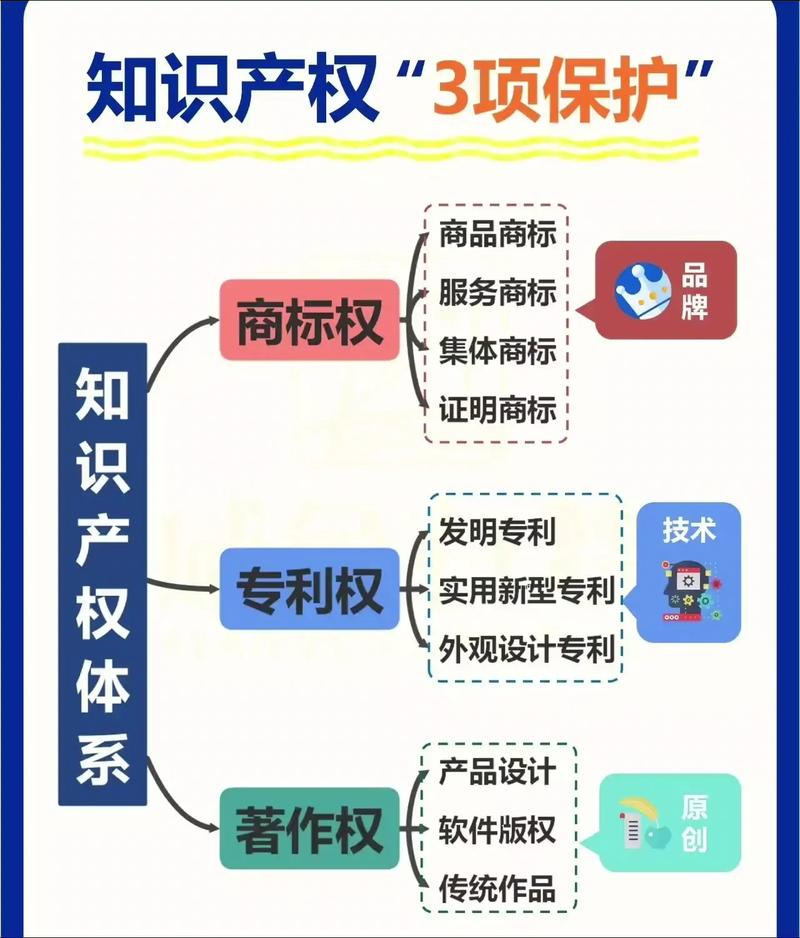
At the legislative level, and in the light of successful international experiences, the trademarks act of the people's republic of china (promulgated on 23 august 1982 and implemented on 1 march 1983), the patents act of the people's republic of china (promulgated on 12 march 1984 and implemented on 1 april 1985), the copyright act of the people's republic of china (promulgated on 7 september 1990 and implemented on 1 june 1991) and the accompanying laws and regulations were enacted. At the same time, we are party to a number of international conventions on the protection of intellectual property rights, including the world intellectual property organization convention, the paris convention on the protection of industrial property and the madrid agreement on the international registration of trade marks。
In the 1990s, my country set the goal of establishing a socialist market economy. In order to respond to the needs of the development of our market economy and the protection of intellectual property rights, our country has amended, inter alia, the patent law of the people's republic of china and the trademark law of the people's republic of china, enacted laws and regulations such as the law of the people's republic of china on anti-improper competition and the regulations of the people's republic of china on customs protection of intellectual property rights, adopted a series of decisions to punish intellectual property offences and acceded to a number of important international treaties on intellectual property, such as the berne convention for the protection of literary and artistic works, the patent cooperation treaty of the universal copyright convention, which expands the scope of intellectual property protection and raises the level of intellectual property protection。
In order to accede to the world trade organization, our country has actively fulfilled its international obligations to protect intellectual property rights by comprehensively cleaning up and amending the laws and regulations governing intellectual property rights, as called for by the world trade organization, and in 2000 and 2001 amending the patent law of the people's republic of china, the copyright law of the people's republic of china, the trademark law of the people's republic of china, the regulation of the people's republic of china on the protection of computer software, etc。
In the light of developments in the country's intellectual property rights, successive amendments were made to the copyright act of the people's republic of china and the trademarks act of the people's republic of china in 2010 and 2013, and a new round of draft amendments to the patents act of the people's republic of china is currently under review。
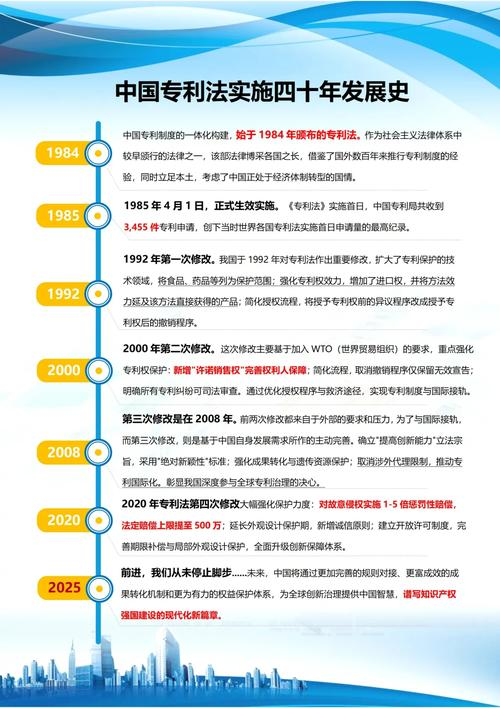
In conclusion, during the 40 years of reform and opening up of the country's intellectual property legislation has been non-existent, with the establishment of a system of legal frameworks for intellectual property that responds to international trends and is in line with our country's characteristics, bringing it into line with the world and creating comprehensive legal provisions。
40 years of reform and openness: 40 years of judicial protection of intellectual property
In june 2008, china issued the national intellectual property strategy framework, which decided to implement the national intellectual property strategy and made the “strengthening of the judicial protection system” a priority of the national intellectual property strategy。
On 12 november 2013, the central committee of the communist republic of china (cpc) adopted a decision on a number of major issues for a comprehensive and deeper reform, in which it “enhanced the use and protection of intellectual property rights, improved incentives for technological innovation, and explored the establishment of intellectual property courts” provided a direction for strengthening the judicial protection of intellectual property rights。
On 31 august 2014, the tenth meeting of the standing committee of the twelfth national people's congress voted to adopt the decision of the standing committee of the national people's congress to establish intellectual property courts in beijing, shanghai and guangzhou. Between november and december 2014, three intellectual property courts were established in beijing, guangzhou and shanghai。
In july 2016, the supreme people's court established “judicial dominance, strict protection, classification and coordination” as the basic policy for the judicial protection of intellectual property。
In april 2017, for the first time, the supreme people's court issued the outline for the judicial protection of intellectual property in china (2016-2020), which establishes eight objectives for the system of intellectual property courts, rules of evidence and compensation for damages, as well as 15 measures to improve the jurisdictional system, improve technical fact-finding mechanisms and conduct research on special procedures law。
In february 2018, the opinion on a number of issues related to innovations in reforms in the field of intellectual property law was officially published, the first programme document in china to address innovations in reforms in specific areas of justice。
It is worth mentioning that, since the establishment of the specialized courts on intellectual property, the number of intellectual property cases has been increasing year by year, while the amount of judicial awards on intellectual property has continued to rise significantly。
In the case of china v. Samsung patent tort, for example, on 27 june 2016, on suspicion of patent infringement, china sued samsung to the central court of quanzhou, fujian province, and claimed $80. 5 million。
In march 2017, the central court of quanzhou handed down a first instance judgement in support of china's claim of $80. 5 million. At the end of december 2017, the supreme court of fujian province handed down its final judgement, upholding the ruling that sansung was to pay $8. 5 million。
The amount of compensation awarded in patent infringement cases established in this case has also become a new benchmark for the judicial protection of intellectual property rights in our country。
Forty years of reform and openness: 40 years of renewed intellectual property
In terms of the application and development of intellectual property rights, the number of trademarks registered in 2017 was 5. 901,600, an increase of 54. 96 per cent over the same period, showing a significant increase, with the country having the highest number of trademarks registered in the world for 16 consecutive years。
With regard to patents, in 2017 the number of patent applications for inventions in the country was 1382,000, an increase of 14. 2 per cent over the same period. Out of a total of 42 million patented inventions, 327,000 patented domestic inventions, an increase of 8. 2 per cent over the same period. And for many years, it was the world's highest priority。
The world intellectual property organization (wipo) recently released data show that, in 2017, global innovators submitted a total of 3. 17 million patent applications, increasing for eight consecutive years. Of these, china has the highest number of intellectual property applications in the world in terms of patents, trademarks and industrial design。
In short, while the innovation owners of domestic enterprises have increased the level of domestic intellectual property claims for protection, more and more enterprises are moving to the world to broaden the scope of innovation protection to more countries。

Of course, while there has been a significant increase in the scope of intellectual property rights, there are other problems, such as the need for continuous improvement in the quality of patents and the need for further exploitation of patent outcomes。
It has also become a new starting point, a new journey and a new challenge for all sectors to achieve high-quality development in the future。
First, innovation capacity needs to be continuously enhanced. In many areas of new technology and applications, our country is essentially at the same stage of research as many countries around the world. On the one hand, it has helped us to produce more results in various new technologies and applications, on the other hand, it has helped us to accumulate more technology patents and participate in standard-setting in these new technologies and applications, taking ownership of the relevant industries and speaking out。
Secondly, innovative protection mechanisms need to be improved. Good intellectual property protection mechanisms, including efficient review authorization mechanisms, sound results transfer mechanisms and improved and innovative protection mechanisms. The establishment of these mechanisms has helped to enhance the innovation and enthusiasm of technicians。
Finally, there is a need to create a good climate of innovation. A level playing field and the creation of mechanisms to protect and safeguard the benefits of innovation will create a favourable climate for innovation and encourage the mobilization of researchers to actively explore new technologies and innovations. The market-based transfer of innovation can provide a good source of support for scientists, thus creating a good innovation climate and positive incentives for innovation across society。
“language of the road for the opening of the mountain forest”, although our intellectual property system has travelled a long way in its 40-year journey of reform and opening-up, we still have a long way to go in terms of continuous improvement of mechanisms, strict protection and the direction of leading the development of intellectual property rights。
Therefore, from government to business, from users to products, all the links and all the parties concerned should remain modest and cautious, aiming for a more sober mind, targeting the world's front-line technologies and consistently investing in human and material resources, with a view to achieving global leadership development in the country's intellectual property protection capacity, practices and levels in the next 40 years, with a view to exporting more chinese wisdom, programmes and practices to global intellectual property protection issues。
(by lee joon-hui, special fellow, centre for intellectual property research, china university of political science and law)