


Working principles and specific structure of car air conditioning
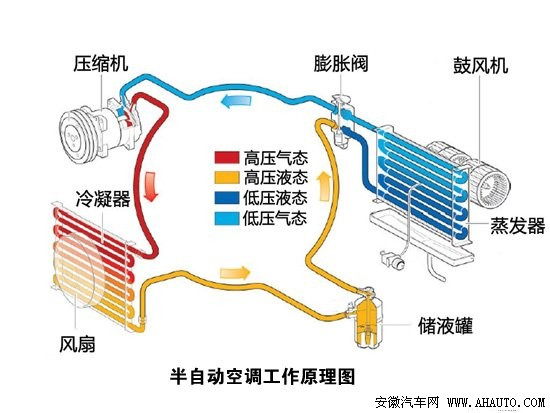
I. Automobile air-conditioning works on the same basis as other refrigeration air-conditioning units, using the refrigerant r-134a to absorb large amounts of thermal energy when it changes from liquid to gas. Automobile air-conditioning compressors transfer power via belts (non-independent air conditioning) through motors, compressors inhale low-temperature low-pressure refrigerant gases, operate as high-temperature high-pressure gases, cool through condensers' radiators and cooling into liquids with high-pressure moderate temperatures, then dewet and buffer through the liquid dryer, then flow to the swelling valve with more stable pressure and flow, and eventually to the evaporate through the throttle and cooler, so that the refrigerant evaporates into a low-pressure environment and absorbs large amounts of thermal energy. The air in the car continues to flow through the evaporation unit, which reduces the temperature in the car. The liquid refrigerant flowing through the evaporation unit is transformed into a low-pressure gas and is re-inhaled to the compressor for the next cycle. In the system as a whole, the expansion valve is the control of refrigerants entering the evaporation unit. Too many refrigerants enter the evaporation unit without evaporation and too little cooling and not enough, so the expansion valve is the control hub. And the compressor is the heart of the system, the power source of the system cycle. As car air conditioning is a mobile vehicle-mounted air conditioner, it is more difficult to move than a stationary air-conditioning system, it is more volatile with car tremors, the refrigerant of air-conditioning systems is more likely to leak than a fixed pattern, the repair and maintenance of air-conditioning systems is more frequent than a fixed pattern, and the mid-windway system of air-conditioning units often inhales dust, jams filters and evapotors when inhaling new winds. Ii. Automobile air-conditioning system classification (by power source). 1. Independent air-conditioning: operation of compressors driven by a dedicated power source (second engine) is generally used in large and medium-sized vehicles because of the large internal space position of the large and medium-sized bar and the higher operational requirements for air-conditioning. The use of stand-alone air-conditioning is limited to large and medium-sized vehicles owing to the need for two engines, the high consumption of fuel and the high cost of their maintenance and maintenance. 2 non-independent air conditioners: air conditioning systems operated directly by motors, which are operated by compressors driven by main engines and controlled by electromagnetic centrifuges. When the power is connected, the clutch is disconnected and the compressor is shut down, thus regulating the supply of cooling gas for the purpose of controlling the temperature inside the car. The advantages are simple structure, ease of installation and small noise. The need to consume 10-15 per cent of the power of the main engine has a direct impact on the accelerator performance of the vehicle and the ability to climb the slope. At the same time, the amount of refrigeration is affected by the speed at which the car is moving, and its air-conditioning system is not functioning if the vehicle ceases to operate. Nevertheless, non-independent air conditioning has become the dominant product in the market because of its lower cost (relatively independent air conditioning). Currently, most cars, vans and minibuses use this type of air conditioner。



