How marxist theory can be applied in china’s practice, and how to solve the problem of marxist chineseization, the academic community has already come to a rich conclusion, and the purpose of this paper is to explore how china’s soil can produce the effects of chinese-american marxism. Why has the socialist revolution, led by the chinese communist party, achieved today's results after the october revolution in many countries and regions of the socialist camp
In trying to answer why marxist theory is rooted in china, the present paper is based on china’s traditional cultural roots, beginning with an analysis of the material capital, dialectics, and three main patterns at the heart of marxism’s theory。
In the university textbooks " outline of china's near-modern history " , china's recent trends in the liberation of ideas have been described as follows: in recent times, in order to save the country's lives, china's advanced elements have worked so hard to find the truth in western countries. However, chinese efforts to learn from the west have been met repeatedly in practice. The proponents of the new cultural movement have put forward the slogan “breaking superstitions”, calling for people to “break the web of past history and destroy stereotypes” in order to “get the liberation of their minds”. Thus, while saving a poignant country, the roots of the traditional culture of china are not immune to being abandoned along with its ills. Thus, in order to save the fate of the chinese people, philanthropists, either active or passive, or consciously or unconsciously, have taken the path of seeking salvation from the outside。
However, history tells us that most of these quests have failed. The reason for this is, as the marxist philosophy textbook tells us, “as different peoples based on common regional and blood relations, they all have different philosophies”. For a people, especially for a long-standing people like china, it is impossible to change blood completely for its civilization. However, “the nationality of philosophy does not exclude a certain degree of commonality between national philosophies”. External thinking that can solve china’s problems must resonate to some extent with china’s indigenous roots culture. This, compared to many other thoughts, was achieved by marxism. Its core views, material firstness, dialectics and three main patterns are consistent with the traditional chinese cultural essence, which is the ultimate concern for all: the chinese traditional culture, which is essentially a culture of life, is based on the ultimate concern for life, which, in the same way as all human beings and in the same way of life, forms a vision of human beings; marxism is the ultimate concern for human destiny and seeks to reveal the truth of the universe from a materialistic point of view. Such ultimate care, revealed by the chinese communist party, is more acceptable and well known to the chinese people. The rationale for this silent acceptance and non-exclusion of the way in which the lubricants are received is rooted precisely in the desire for a communist society and in the acceptance of its ideas。
It is not the perception of the state as the division of resources and wealth, but the recognition of the world as the world's people. This contemplation stems from the idea of the common denominator of the traditional chinese culture, the idea of the same roots, the idea of harmonious coexistence based on the position of the roots “in the heavens”, “in the heavens”, “in the heavens to the common good”, which is the basis of the understanding of the original conglomerates. Thus, the idea of communism and the idea of universalism in the traditional chinese culture are connected, so that the dissemination of communism in china has a deep cultural basis for national thought。
Therefore, this paper will be based on the ultimate care framework, starting with the three dimensions of material capital, dialectics and three main principles, to analyze the traditional chinese cultural genes that make the marxism chinese, in the hope that it will be one of the elements that will explain the chineseization of marxism。
I. Physical capital: ultimate care from the origin and fate of the substance
The textbook on the philosophy of marxism states: “recognize the material nature of the world and recognize that the physical world is a pattern of movement, change and development inherent in time and space, which is the basis for adherence to the monistism of materialism and the premise of adherence to marxism”. And the chinese traditional culture, in reading the capital of the world, has said that it is a thing of the word ... (under chapter 21 of the code of ethics) and that it is a thing of the first creation. The silence is small, the independence is unaltered, and the journey is undisturbed, and it is the mother of the earth. I don't know its name, it's a word ... (moral, chapter xxv) so it's certain that everything in traditional cultural knowledge is material。
Secondly, with regard to the definition of substances, lenin explains as follows: “methods are the philosophical realms that mark the existence of objective and real philosophies, which are truly human beings through perception, and which do not depend on our feelings, which are repeated, photographed, reflected.” the definition of the substance in lenin consists of two points, both of which are reflected in and related to the minds of the taoists:
1. Material is an objective reality of a philosophical context. This objective is, indeed, read in the chinese tradition of the book of ethics: something is mixed up in independence without change, without neglect. From time immemorial and from this day forth, their names are not known to the priests. The essence of the visible path is a constant, natural and objective reality that does not require the involvement of any other party and is not influenced by the power of any other party
It does not depend on our feelings for its existence, rewritten, photographed, reflected in our feelings; the traditional chinese culture reveals that it is “no desire, no desire, no desire, no desire to see”, that it means “yes”, as a physical existence can be perceived in the way of “observation”, and “no”, as an intangible existence, as well as in the way of “observation”. They do not depend on our perception to exist, but reality does。
On balance, it can be seen from the comparison that marxism and the traditional chinese taoist culture share the ultimate concern for the resolution of the origin and fate of the substance, which is the basis for it。
Ii. Terrorism: the ultimate concern in terms of the way everything works
According to marxist dialectics: the material world is a unified whole of “universal ties and movement development”; the dialectic law is the pattern of the material world's own movement; the subjective dialectic or dialectic thinking is “the reflection of objective dialectics in human thinking”. In essence, the method of working with the dominant culture of chinese tradition in understanding the material world and marxist theory are also highly compatible。
In searching for the capital of all things, the taoist explains this: “good way, very way”. There are three different meanings in the short six words and the same three words. Like the easy word, it includes: ease, simplicity and ease. The first is the path that is the essence of everything, which is constant; the second is the path that can be “passed” (i. E., the expression of the image) and is the individual that is divided by the body. The third is the “normal way”, which is the general rule that everything works. Thus, as in the marxist doctrine of material evidence, there is a general connection and a constant evolution. And in response to human thinking, the ethics describes in more than one chapter “the existence, difficulty, length, height, sound, and follow ... Will be in vain. He will be weak and strong. And that he shall seek to be destroyed, and that he shall rejoice. It will be taken with it (chap. 36)...” the vagina also speaks of the corresponding transformation of ideas such as "the sun and the sun will change."。
It is therefore also common for marxism and the traditional mainstream culture of china to use dialectic thinking to analyse the patterns in which everything works。
Iii. Three main patterns: the ultimate concern in terms of the development of the environment
The core of marxist philosophy, which is characterized by a similar interpretation in the traditional chinese culture, is one of the three main principles: the opposing homogeneity, the mutation and the negative。
As the figure below shows, the opposing uniform patterns that reveal the sources and dynamics of change in things and the variable patterns of change in the state of things are described in much relative terms in the traditional chinese culture, but the negative patterns that reveal the direction and path of change are relatively few。
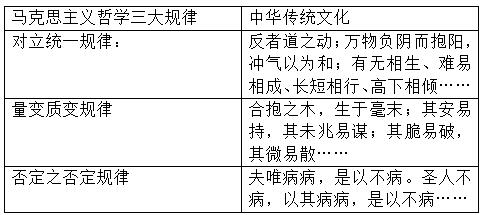
How, then, does the traditional chinese culture express the negative norm of denial
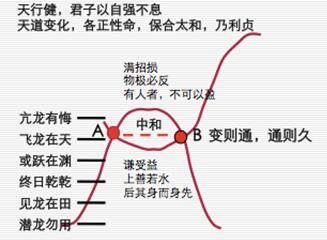
Everything goes through the process of its development and demise as a parabolic, and how is the chinese culture alive and alive for a millennium? From point a to point b, as the figure shows, is the wisdom of the chinese traditional culture to choose on its own initiative, based on knowledge of the process of development. From point a to point b, not a repetitive construction, not a denial of the original point a, but a proactive choice based on an understanding of the pattern of development of things, is a rejection. On the basis of previous developments, the proactive choice is to slip again in order to reach a new, higher stage of escalation, the negative rule。
The traditions and wisdom of every people have the value of the bloodblood of their historical development and the guidance of the future. And the chinese traditional culture, which forms one of the pillars of contemporary core values, is based on the philosophy of evolution of the fundamental rationale and rules of the universe with the self-reliance of “incorporation of things”, “independentness” and “inheritance of all things”. Marxism, which grows in such soil, necessarily carries a chinese character, “to apply it in accordance with its characteristics”. At the same time, it is only in such a soil, and only in a soil that contains the core theoretical genes of marxism, that marxism can produce the fruits of chinese maxism. This explains why, after the october revolution, only the socialist revolution led by the chinese communist party (cpc) in many countries and regions of the socialist camp achieved today's results: its successful experience can be attributed to the underworld and the conglomerate of traditional chinese culture, as well as to a deep base of people. However, research in this area is only the beginning, and in-depth research and interpretation should be the responsibility and the ambitious task of marxist theorists。
(author: marxist institute, southwest transport university)