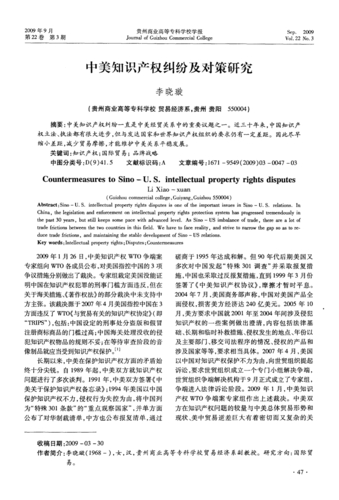
In view of [summary] the trade dispute between china and the united states of america over intellectual property rights (iprs) has caused huge losses to chinese and chinese enterprises, this paper focuses on the causes of the trade dispute between china and the united states over intellectual property rights (iprs), the problems china faces with regard to intellectual property rights (iprs) and the corresponding recommendations on how to reduce such disputes between the two sides. Intellectual property strategy, trade friction, trade relations between the us and the us
First, the introduction to the sino-american dispute on intellectual property rights is long-standing and, as early as 1986, when china was preparing to establish an intellectual property regime, the united states called on china to strengthen its intellectual property protection. From 1989 to 1996, china and the united states conducted four formal intellectual property negotiations。
During the fourth negotiation in 1996, the united states signed three us-china intellectual property agreements. Despite china's accession to wto in 2001, the dispute over intellectual property between china and the united states continued unabated。
Since 2005, the united states has also been conducting so-called “non-periodic reviews” of china's intellectual property protection。
First, intellectual property products are the most competitive products in the united states, and intellectual property rights are the comparative advantages of the united states, with significant economic implications for the united states. In 2006, the united states president's economic report stated that intellectual property accounted for more than one third of the total value of united states enterprises, that exports of high-tech technologies contributed 40 per cent to united states economic growth and that the number of people employed in the knowledge industry reached 18 million。
In recent years, the united states ' external trade deficit has risen year by year, with china in particular becoming the largest source of the united states trade deficit, while the united states has experienced annual surpluses in the area of intellectual property. Under such circumstances, the united states would certainly use its niche products to improve or reverse its trade deficit。
United states companies with intellectual property rights can also benefit from monopoly and control over intellectual property rights. Second, to uphold the authority of united states trade policy。
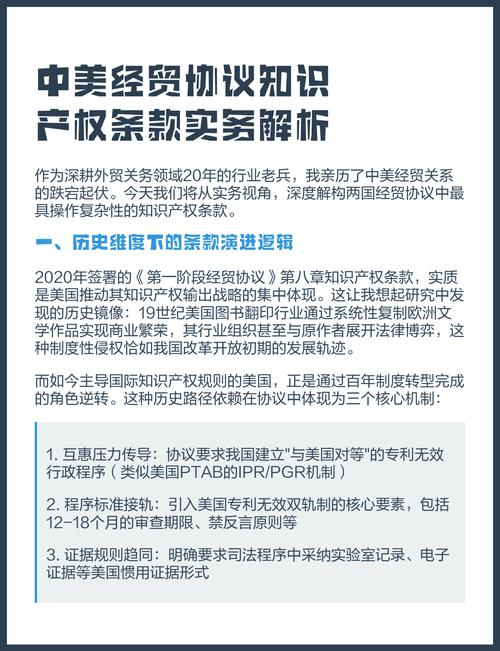
In the post-world war ii multilateral trade negotiations, the united states had included intellectual property rights as a key part of its trade policy in order to create a national framework for greater respect for intellectual property rights. The package of agreements negotiated with the world intellectual property organization and the world intellectual property organization has improved the ability of united states inventors and intellectual property holders to acquire and defend parallel rights abroad as scheduled。
In the case of the international system, what the united states lacks is not the system, but its implementation. The united states must keep an eye on the performance of other states in order to truly ensure its interests。
For the rising china, the united states must not let go. First, the structure of our exports is constantly rising and high-tech products are beginning to become competitive。
However, the lack of core technology for many products and the continuing lack of technological innovation capacity of many chinese companies at a imitation stage have made intellectual property disputes a powerful weapon for transnational corporations to suppress chinese companies. Second, chinese enterprises ignore various technical standards when introducing foreign technologies。
In recent years, difficulties experienced by some united states tncs in gaining access to chinese enterprises through the special status of technical standards have become a new trend, namely, the so-called “propellation of technology — patent standardization — monopoly of standards”. Apart from exposure to intellectual property rights such as patents, trademarks, copyrights and so on, more is the combination of technical standards, safety standards, environmental protection standards, etc., in order to preserve their economic and technological leadership。
Technical standards have a special mission in market monopolies and are ready to trap chinese enterprises。
Thirdly, there is a problem with our intellectual property rights (iprs). First, there is the difficulty of applying for iprs. The cost of patent applications in our country is lower than in developed countries, some of which are trying to further safeguard the technological monopoly interests of their own firms by increasing the cost of patent applications to prevent weak small enterprises in developing countries from patenting at home。
This has led to an unfair economic consequence, namely, that foreign companies that come to china to apply for a patent enjoy the benefit of less paying fees when they apply for a patent in china, while chinese enterprises are being blocked by the high costs of developed countries, which has directly prevented chinese enterprises from gaining access to their markets. Secondly, the government lacks the necessary judicial review and oversight of certain final administrative decisions relating to intellectual property, mainly in trademark and patent law; infrequent action against infringement of intellectual property rights, especially counterfeiting and piracy, and inadequate remedies for victims; and in the case of intellectual property rights holders whose rights are too restrictive and too broad to unreasonably impair the legitimate rights and interests of the rights holders, as reflected in copyright law。
Third, there are problems in the enterprise itself. The current overall level of intellectual property rights in our enterprises is relatively low, with many focusing on the more profitable and efficient operations of manufacturing industries in the short term, while many enterprises are manufacturing uncreated, mainly because of lack of ownership awareness and expertise。
The absence of talent management mechanisms and workforce building is a major obstacle to the enterprise's intellectual property path. Many of the country's high-technology industries have not only no relevant departments or specialized personnel。
Not only is there a lack of proactive intellectual property rights efforts, but some exporting firms are fortunate to face the “337 investigation” launched by the united states government, relying on other companies that are also listed as infringers to defend themselves or simply ignore the investigation, which ultimately leads to a collective defeat. 1. In the face of serious trade frictions in intellectual property between china and the united states, my government should develop and implement an intellectual property strategy. Intellectual property is a strategic weapon for the country's strategic resources and national interests, as well as for economic security. Intellectual property protection is in fact an integral part of the country's economic, scientific and trade competition strategy。
Only by fully integrating the intellectual property strategy into the national innovation system, raising the awareness of the population as a whole of innovation and of the protection and use of intellectual property rights resulting from innovation can intellectual property rights play their full role and enhance the competitiveness and integrity of our country in international trade. In particular, the intellectual property strategy covers, inter alia, the following aspects: first, accelerating the development of the country's intellectual property advantages。
Second, improving the intellectual property legal system. Third, to raise awareness of intellectual property protection throughout society。
Fourth, improving the social management of intellectual property rights and the level of services. 2. Business response measures: first, raising awareness of intellectual property rights。
Second, foster and enhance the competitiveness of intellectual property rights. Third, in the face of intellectual property claims in the united states, businesses should respond positively。
4. Ending the intellectual property dispute is a central issue in trade friction between china and the united states, seriously affecting the development of trade relations between china and the united states, and is also key to the sustainable development of our enterprises out of the country. The chinese government should improve all relevant legal policies and public services, and enterprises should be actively involved in their intellectual property strategy, so as to increase the competitiveness of their intellectual property rights. Only then will it be possible to reduce trade frictions in intellectual property rights between china and the united states, while also increasing the economic benefits to chinese enterprises。
Song kuwait
(7) li ho. Problems and policy responses to trade in our intellectual property. International trade issues, 2005. Zhang jianzhong, zhang hongxia. Impact of intellectual property protection on international trade and policy responses to china. International trade exploration, 2005
Li hongzhi. The causes of and responses to the friction in trade between china and the united states. Heilongjiang foreign economic and economic, 2005. Choi ilming. Intellectual property protection in trade between china and the united states. International trade, 2007
(9). Liu jianming, yuan yongyin. China-united states intellectual property dispute and response. Economic theory and economic management, 2007
(8). Yang yong-jin. Assessment of intellectual property disputes between china and the united states. International trade, 2007
1
I don't know.