For nearly a hundred years, scientists have made breakthrough discoveries in areas such as layering, plate movement and its effects, and deep-earth life through the constant reading of earth's historical archives recorded in deep rocks and the translation of geophysical images from deep earth。
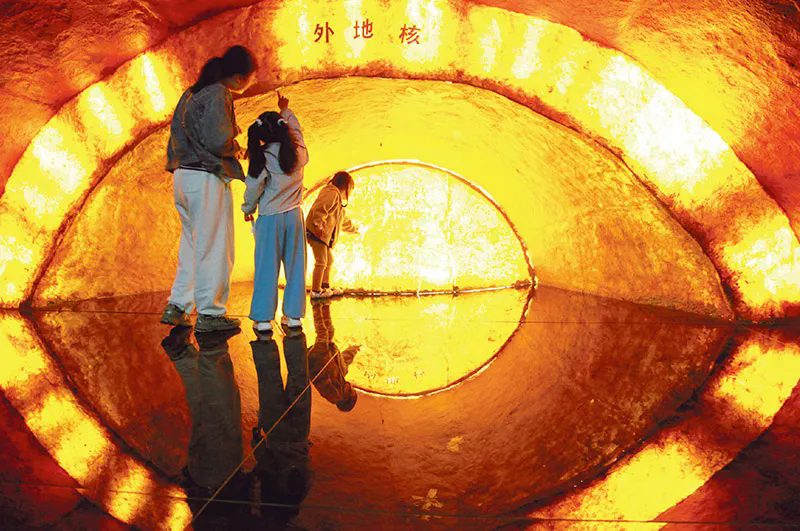
As science and technology continue to advance, human beings gradually lift the veil of the earth's deeps by a range of scientific means such as detection, drilling, observation and simulation experiments. The figure shows that on 21 april 2024, visitors visited the earth's interior structure model at the nanjing geological museum. Photo of the people
Division of the earth's circle structure. The earth is made up of outer and internal circles. The outer circle comprises the hydrosphere, the biosphere and the atmosphere; the inner circle consists of the crust, the mantle and the geonuclear. The crust is the outermost layer of the earth's solid circle, composed of rocks and an important part of the rock circle. The mantle is divided into top and lower mantles, and the top and crust of the top mantles form a rock ring, which is a flounder below. This layer structure allows the earth's plate to float and move on the floppy circle. The core is the “heart” of the earth, the birthplace of the earth's magnetic field and the engine that drives its operation. The earth's cores are divided into liquid outer and solid inner cores, the movement of which produces geomagnetic fields on earth. This geomagnetic field can effectively shield the solar wind and cosmic rays and is an important safeguard for earth's life. The discovery of the earth's cylindrical structure has contributed to the in-depth development of geology and geophysics, enabling a more accurate understanding of the physical state and chemical composition of the earth and helping scientists to better predict and interpret natural disasters。
The plate movement and its role. The theory of plate construction is one of the major achievements of the natural sciences of the twentieth century. According to this theory, the rock collage on the earth's surface is not “a piece of iron”, but is made up of plates that drift over the flounder, leading to the subduction and rebirth of the crust. The plate movement affects the boundary of the nuclear mantle from the crust, and the rise of the nuclear mantle through the heat column also affects the crust. The heat column rises to form a mantle column structure, as evidenced by large-scale volcanic activity on the surface。
The earth's plate movement also acts as a “geological air conditioner”, which is one of the major causes of life on earth. The atmosphere is like a layer covered on earth to maintain the earth's “body temperature”. But only the blankets are not good, and the key function is the concentration of carbon dioxide in the atmosphere. When co2 concentrations are too high, surface temperatures rise; if co2 concentrations decrease, so do surface temperatures. Carbon dioxide in the atmosphere and in the waterosphere becomes sedimented to the seafloor and then rock, a process of “recycling” carbon dioxide in the atmosphere. These rocks are “expenditures” when they dive to the ground through the movement of plates and then return to the atmosphere through volcanic activity. One piece at a time maintained the carbon dioxide concentration of the cover in the atmosphere, keeping the earth at the right temperature。
The discovery of deep-sea organisms. In the 1970s, human observations of the deep seabed revealed the existence of strange biota that did not depend on photosynthetic cooperation to support life in a sea floor thousands of metres deep. There are not only plants, but also a variety of animals such as screws, crabs and shrimp. In a solid underground environment of dozens of metres, hundreds of metres and even thousands of metres, there is a microbial-dominated deep underground biosphere, which is estimated to have a total biomass of one tenth of the earth's surface. However, human knowledge of this underground biosphere is extremely limited. Based on the earth's temperature gradient, the temperature at a depth of 3,000 m is approaching 100°c at approximately 3°c per 100 m down, a high temperature coupled with a subsurface microbial ring in a high pressure and oxygen-deficit environment that approximates a microcosm of the earth's early life form. By looking at them, we seem to be able to travel through time and space and indirectly explore the secrets of the origin of life on earth。
For more details, see wang sung-sun, a member of the chinese academy of sciences and professor at the chinese university of geology (beijing), " deep exploration of why it matters "
Planning: chai yifan zhang yang audit: li ying ling