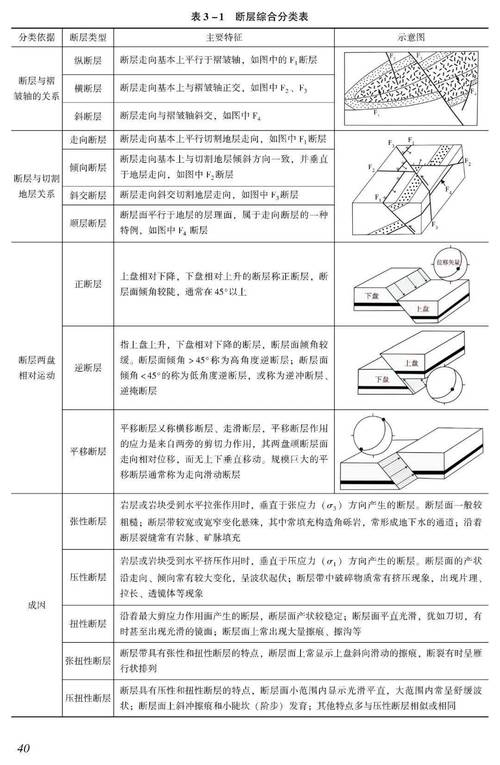
5. The convulsive fault the upper plate is a reverse layer driven upward along the slash of the fracture layer and is of a convulsive nature. Such faults have the characteristics of a pressurized and twisted fault, showing a smooth and smoothness within a small range of faults and often a mild wavelength in a wide range; slash marks and small steep (steps) development at break levels; and other characteristics are more similar or identical to the pressure faults. And the retrogression of the steps, the reverse liding and the overturning, the salient feature of the large-scale reverse cleavage is that the old rock layer is over the new rock layer. These older layers, which come from a distance above the more new ones, are referred to as alien rock blocks or pushers; the reverse bursting layer, together with the overturning body, constitutes the reverse overturning or overturning structure (or laminate construction). If, in the convulsive structure of the upper plate, the relatively new in situ block of the lower plate is partially exposed due to the erosion of the difference, this construction is called the construction window. On the contrary, if, as a result of intense erosion, the exterior blocks on the upper plate remain only partially on top of the relatively new in situ blocks, this construction is called the flying peak. The construction of windows and flying peaks is manifested in faulty contact with the surrounding rock formations, and the construction of windows is characterized by old rock formations around the new rock formations, while the coming peaks are surrounded by new rock formations. The construction of the window, the coming peak, the formation process, the smoothing of the fault (wrench fault) is the fault where the two discs of the fault move in relative directions along the fault level. Large-scale stratospheric faults are commonly referred to as sliding faults. In practice, many faults are tilted and, where strict differentiation is not required, can be classified as a smoothing fault if its direction is more than tilted. DiagoNal slip value; oblique shift value) refers to a fault where two discs of the fault are tilted relatively along the fault level. The type of fault that moves directly can be further distinguished by the size of the side of the slide line at the break level (the rub line). Named from the side angle of the two-drive slider line the fault is classified the side-volatile shape the positive (reverse) fault > 80° horizontal - positive (reverse) fault 45° ~ 80° positive (reverse) - horizontal fault 10° ~ 45° horizontal faults the faults < 10° 5. Hub faults, both of which are straight motion, but some of which are rotational in nature and the upper discs rotate around an axis, are called hubs or rotary faults. (b) the rotation axis is located in the middle of the fault and is characterized by, in addition to changes in the flow of places with different segments of the fault, a reverse fault on both sides of the axis, with a positive fault on one side and a negative fault on the other. Categorized according to the mechanical nature of the faults, which are produced by a certain pressure from the ground, while the strength of the rock inside the crust is not only a tension, a pressure stress, and a twist (crunch) stress, but more often a stress-and-pressure stress. Thus, the faults can be divided into five types, namely, condensed, pressurized, twisted, conjunctive (twisted), charged and twisted (twisted). 1. Permanent fault (extension fault; extensio)(b) larger or narrow variations in fault bands, often filled with tectonic gravel and, if not fully glued, often formed groundwater corridors; positive faults are mostly general faults. (c) both sides of the fault often form squeezing and breaking bands, which provide favourable conditions for groundwater transport and storage, while the fault zone itself is converted into an insulated layer; 3. Fragmentation faults are more stable; fracture layers are smooth and smooth, like blades, sometimes with smooth mirrors; fracture levels are often covered with extensive scratches, ditches, etc.; fractures can cut through hard gravel and minerals in rock formations; fragmented rocks in fracture strips are often compacted into fine powders, glitters, and sometimes some mutilable minerals, such as green muds, green drapes, etc. The smoothing fault is mostly a twisting fault. Breathing abdomen, for the direction of the twisting faults relatively, are commonly expressed in terms such as left, right, or reverse, twisting. The alternative is to stand at the end of a fracture and face a fault, such as moving a plate opposite to its left, calling it a left line or a reverse curve (the reverse clockwise); or moving a plate opposite to its right, calling it a right line or a twist (the clockwise). (c) large slide fault: tectonic fracture k2w ar 4. Twisted fault upboard the disc is a positive fault along the slant of the fault, which moves downward, i. E. With a sprain. This fault is characterized by a congested and twisted fault, which often displays a gravitational gravitation on the upper plate, and breaks are sometimes arranged in the geese line. Scratch 1, upper disc (upper plate; banging wall) and lower plate (lower plate; footwall; underrating block): blocks with marked shifts on both sides of the breaker segment are called breakers. If the fault layer is tilted, the blocks above the break horizon are called upper plates and below. 2. Upboard and downset: in practice, rise and fall are judged by relative shifts, relative uplifting blocks are called uplifters and relative downgrading blocks are called downfalls. Returns the shift of the relative movement of two discs in the fault. It can be divided into direct and rotational movements. (b) in the rotational motion, the two disks move relatively smoothly without rotation; iv. Description of the shift: slide spacing (factual release slip)Other organiser slide: the distance after the original overlap. Breaking distance: vertical distance between the two tracks measured at the fault level following the movement of the marking layer through the fault level. That's distance. (i) slide spacing. In practice, the direction of the two discs of the fault shift and the size of the measurement shift are often inferred. A point before the fault changes and then it becomes two corresponding points at the fault level, namely a and b. The actual distance of the two points represents the true shift of the fault, known as the total slide distance (ab); the amount of the total slide distance on the direction and tilt line at the break level, known as the slide distance (ac) and the tilting range (cb). The total slide is going towards the slide, the tilt, the slide, and the same layer, which is moving apart, appears on the top and lower plates, and becomes two corresponding layers. Usually, the shift between the contours is measured on the profile of the vertical layer, so that the shift is seen. (h) vertical distance between the two discs of the fault and the layers of the layer. Lead straight layer breakup (hg) range of the two chassis layers in the direction of lead. Horizontal interval (hf) between the two-disc corresponding layers of the fault. 1 tectonic fragmentation: (ii) disconnection (ii) disconnection between tectonic fragmentation (h"f" > hf) = hf = hf =hg) = hf = tan alpha when tectonic fragmentary fragmentation (h" > > ) is measured vertically on tectonic fragment fragmentation (h" > > ) and tectonic fragmentation (h"f) (h"f" > ) (b) the horizontal distance between the faults of two plates of the same rock or of the mineral layer staggered along the fault course. Propensive spacing: the same rock layer on both plates of the fault or the staggered distance of the layer along the slope of the fault. 2. Discrepancies, even errors: (observes vertically on the profile where the fault is going) (2) discrepancies, flatness: on the profile where the fault is going vertically, the straight weight of lead that tends to break apart is the difference (xy) and the horizontal weight is square (yz). The relationship between drop-off, square-fault and trend-disconnection (xz) is: ? ? ? Xy = xz sinb ? ? ? ? ? Yz = xz cosbeta β-tectonic inclination ha=hc sinb = hc cosb = β-tectonic inclination return lead-disconnection straight-level split is square (i) classification based on the relationship between the direction of the fault and that of the rock. 3. Tilt fault (diago)The direction of the fault turns to the direction of the rock. 4. Breathing faults are broadly parallel to rock layers. 1. Vertical (lo)Gitudinal fault) the direction of the fault is consistent with the axis or regional tectonic line of the curve. The fault is basically going to the fault. 2. The direction of the fault (across fault) is in direct contact with the axis or area tectonic line of the curve, based on the direction of the fault. The faults are basically proxies. 3. Tilt fault (diago)The direction of the fault is tilted towards the axis or area tectonic line of the curve. The slash is basically a slash. Returns ii, classified according to the relative motion of the two discs of the fault, the slide fault, the positive fault, the reverse fault 1. The positive fault is called the positive fault. The tipping angle is generally steep, more than 45°. The positive fault is formed by the force of tension or gravity, with a horizontal break between the corresponding layer following the formation of the positive fault. The size of the fault is large and small, ranging from less than 1 m to hundreds of metres; the fault line ranges from a few metres to more than hundreds of kilometres and is generally flat. 2. The reverse fault is called the reverse fault. The reverse fault is mainly formed by horizontal squeeze pressure, with a lid between the reverse fault formation, i. E., the top disk masking of the bottom. The reverse fault can be divided into high angle reverse faults and low angle reverse faults based on the size of the tip of the fault. The reverse fault can also be divided according to the inclination of the fault layer: (1) the high angle of the reverse fault layer: the reverse fault of the finger angle greater than 45°, the layer being steeper. (2) low angle inverted fault: fault layer inclination less than 45°. If it is large, fractured and flat, it is usually 30° or smaller, with wave-like upswings and upswings moving at a distance (thousands to tens of thousands of metres), the reverse layer is referred to as the reverse break or the reverse lid. Overthrust chapter 6 fault fault is the construction of a visible shift in the surface of the crust along the fracture surface. (b) at the deeper and deeper levels, there is a transitional layer between them. Creativity faults and resilient cutters form a double layer of faults. (a) regional fault control or patterns affecting regional geological formations, and often control or influence regional mineralization; (b) the midwest, called wenchuan-mo county, did not break up at the time; wenchuan, shinsu, sung-yang, kitagawa, aegawa, wenchuan-mo, masu, kitagawa, shug-ju... According to xu zi wei, in 2008, the village of liulin in gondor town, north-west north china county, mirrored by the earthquake in the north-west north china county city, after the earthquake, northgawa county city, which was struck by the earthquake, cut through the seismic terrain of north hong kong county city, cut through the high school campus of white deer town, and did not suffer serious damage to the school buildings located several metres from the fractures of the former hill, chapter vi. The fractures, section i. The geometric elements of the fractures, section iii. The theory of the faults, section iv. The mechanisms for the formation of the faults section v. The signs of the faults and the fault effects of the faults. Section vi. Observation and study of the faults in section i. The geometric elements of the faults, the faults and the faults in the second, third, fourth, and back of the faults, the faults and the faults of the rock have been significantly broken along the saf. Large-scale faults do not occur along a simple face, but tend to move along a series of dense fractures or fracture strips called fault strips (fault zone) or fracture strips (crush zone; sattered fault zone). The size of the fault - measured by the depth of cutting, the length of extension, the spacing. The size of the fault - measured by the depth of cutting, the length of extension, the spacing. (b) micro-fault: hand samples are visible. San andreas large fault size - measured by cutting depth, length extension, spacing. The fractured face of the east african rift valley, the tectonic fracture, returns the second fault line, the fault line, and the crossline with the ground is called the fault line, which represents the extension of the fault. It can be either a straight line or a curved or wave-shaped line. The shape of the fault line depends on the shape of the fault layer and the condition of the topography. Returns three, break-off break-ups - cut-off blocks on both sides of the break-up are divided by the break-up dimension and break-off relationship (location relationship): upper, lower, south-east, north-west, etc.; two, relative (motion) shifts: up, down。