1. The construction site shall use a coded fire-retarded safety net and shall maintain and record:
(i) product inspection certificate
(ii) contracts or documents for the purchase and sale of products。
The safety net to be used for the start-up work must be sampled and tested in accordance with this notification before it can become operational。
Iii. The number of safety net deliveries by construction enterprises is as follows:
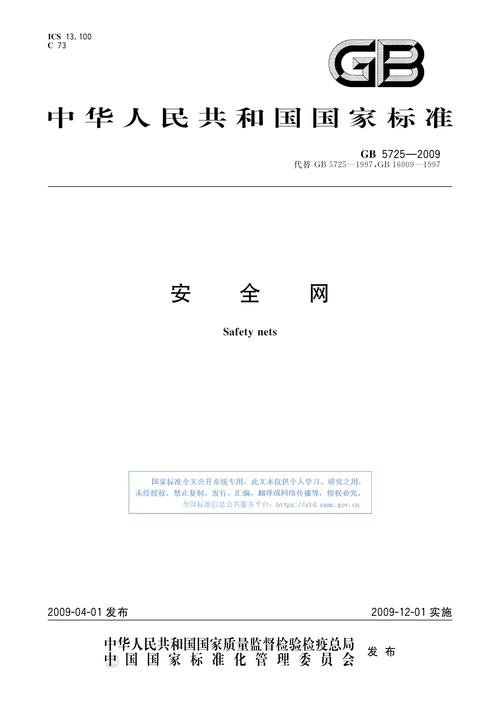
(i) safety nets for different brands should be inspected separately
(ii) one inspection of a project with a construction area below 10,000 square metres
(iii) second inspection of construction projects covering 10,000 to 30,000 square metres
(iv) three inspections of projects with a construction area above 30,000 square metres。
Iv. Safety performance testing of the safety net is carried out by the monitoring centre for the quality monitoring of municipal construction. The detection projects include, inter alia, inertial penetration, shock resistance and flame retardation. A safety net test requires two samples。
5. Safety net tests are not qualified and the construction unit should clear out the safety nets that do not meet the required quality and repurchase safety nets that meet the standards for witness sampling。
Annex: safety net technology bottoms
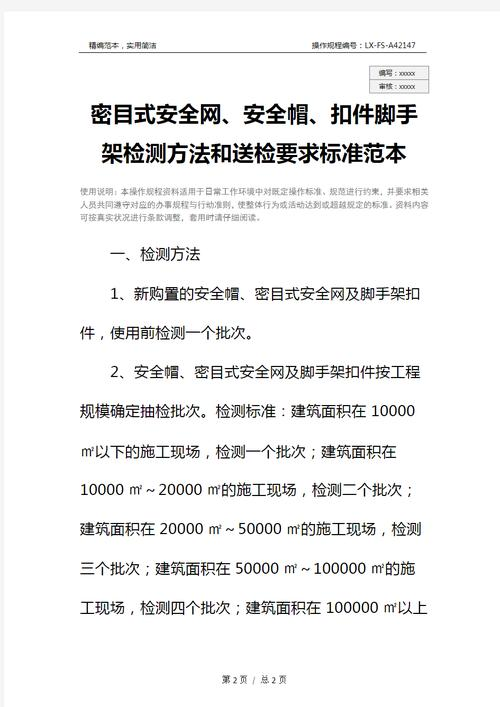
The quality of the safety net must conform to the gb5725-35 requirements, i. E., the outer sizes of 1. 8-6 m and 4-6 m, each of which shall be less than 15 kg/span greater than 8kg/span, and the safety net shall be divided into two types. The number of entries should be above 2000 (10 cmx10cm)。
First, the net: a safety net, which is not vertically horizontal, is known as the net, which is used to catch people and objects falling。
1. The grid shall be capable of being hit by a simulated human sand pack weighing 2,800 cm2 at the bottom of 100 kg, and the cords, edges and cords shall continue to be fractured (permitted to break the cords), with a maximum extension of 10 m at an altitude not exceeding 1. 5 m. Before the old net is re-used, a full inspection shall be carried out in accordance with the provisions of gb5725-86, and a certificate shall be issued to permit its use。
2. Appearance inspection of the web: (1) the edge of the net shall not be greater than 10 cm, and the diameter of the ropes, cords and ropes shall not be less than two times the diameter of the ropes and shall be greater than 7 m. (2) bands shall be set horizontally, with a distance of 30 to 100 cm between the two bands, and all nodes on the internet shall be strong, and the ropes shall extend to 1. 2 m to facilitate the binding of the net with the net or with the pole. (or additional tie-up). (3) the old net should be free of damage or other problems affecting the quality of use。
3. Choice of the network: (1) select the type of network according to the purpose of use, select the width of the network according to the load height, and the grid cannot be used as a substitute for the grid. (2) when the width of the net is 3 m, the width of the frame is approximately 2. 5 m and that of the frame is about 3 m when the width of the network is 4 m。
4. Installation of the network: (1) the network and poles, poles, anchor points shall be inspected prior to installation and the installation shall not commence until confirmed。
(2) the inside and external sides of the safety net shall be each accompanied by a large crossbar, which shall be tied to the previously laid steel bandring or to the inner side of the wall (building) and shall be bound by a large crossbar to the outer side of the safety net, which shall be 15 cm apart from the wall (or floor). On the outside side of the net, a pole should be placed every 3m, with the pole maintained at an angle of 45° to the ground, and the tip point should be fixed, if the floor is unsettled, so that the bottom of several poles can be attached to the pole. (3) safety nets are based on the principle that they are easy to connect and that they are strong and easy to untangle. When multiple safety net connections are used, the adjacent parts should be close or overlapping. (4) the flat net should not be too tight for installation, and the outer inner low (outside 50m above) network should reach at a load height of up to 5 m, with a building width above 2. 5 m and a building width of a minimum of 3 m within 10 m. (5) installation in the vicinity of the transmission line must be carried out with the prior consent of the relevant authority and with the adoption of appropriate incendiary measures, otherwise it may not be installed. (6) the first safety net is generally mounted on the second floor of the floor (3-4 m altitude) and then on a further operating safety net every 6-8 m (ggb5725-85). In addition to a fixed safety net on the second floor of a multi-storey or high-level building, a fixed security net should be installed on every four floors. (7) the network shall not be less than 3 m from the surface of its lower (or ground) object. (8) the safety net shall be mounted with due regard to the availability of a collectionable safety net at the temporary point of entry and exit, and shall be collected when the clinker is used and restored to its condition as soon as it is exhausted。
5. Use, repair, maintenance: (1) the safety net must be used once a week with a visual inspection and miscellaneous items cleaned up in a timely manner. (2) when the impact of a larger payload is felt, the new network should be replaced or checked in time for confirmation of serious deformation, wear, fracture, loss of connection, etc., before continued use. (3) the test rope force test (or the test according to the instructions) shall be performed every three months for use under the terms of gb5725-85。
6. Clean-up of safety nets: clean-up of safety nets, if top-of-the-board access to safety nets, requires first checking the quality of safety nets, the soundness of the poles and the certainty of safety before entering safety nets are cleared, which should be carried out with one hand on the fence, clean-up of miscellaneous items, and ban on standing on the safety net, cleaning of miscellaneous items with both hands or throwing down. When clearing the miscellaneous items, the ground should be guarded, prohibited or fenced。
Networking: installation of a safety net vertically (relatively) horizontally, mainly known as a safety net to prevent humans and objects from falling. 1. In accordance with the provisions of gb5725-85, no less than 300 kgf shall be broken by a fence, no less than 150-200 kgf by a cord, and no longer than 10 cm by a line. 2. Networking must be straight and tight. 3. The maximum gap between the edge of the network plane and the side of the support operator shall not exceed 15 cm。