Many of the young partners are concerned about whether to write a teaching programme during interviews, and if the announcement explicitly requires that the teaching programme be written and counted, then the teaching programme must be written carefully. If the announcement does not state that the pre-school director can be consulted at this time, or that the time of the examination is not normally the time for 10 minutes, we default on the teaching score for more than 30 minutes or 30 minutes, and we need to do so carefully。
I. What's the teach?
The curriculum is a practical teaching instrument for teachers to carry out their teaching activities for the sake of success and efficiency, in accordance with the curriculum standards, curriculum and textbook requirements and the actual situation of the students, in the form of hours or subjects, specific design and organization of teaching content, teaching steps, teaching methods, etc。
To put it simply, the teaching programme is the presentation of teaching designs and teaching ideas for teachers。
Ii. How to write the curriculum?
Let us start by looking at the composition of the teaching programme, which is divided into the following nine areas。
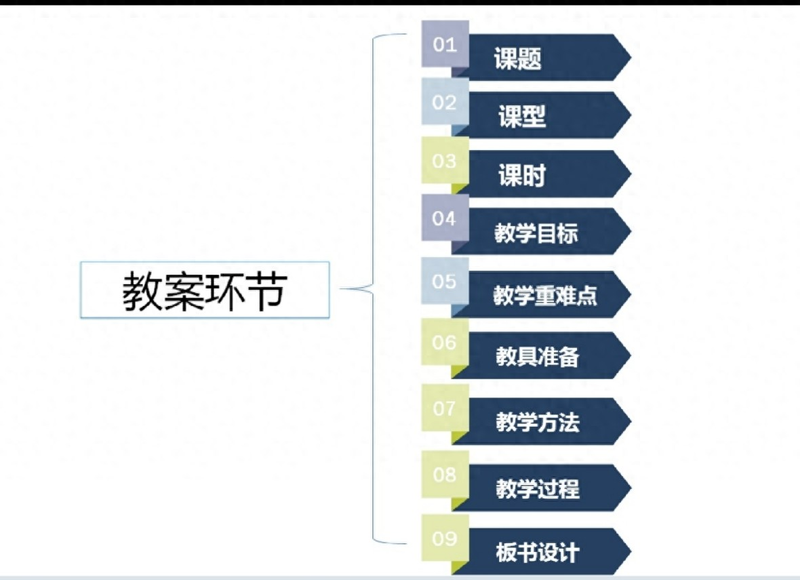
The most important of these are teaching objectives, teaching difficulties and teaching processes。
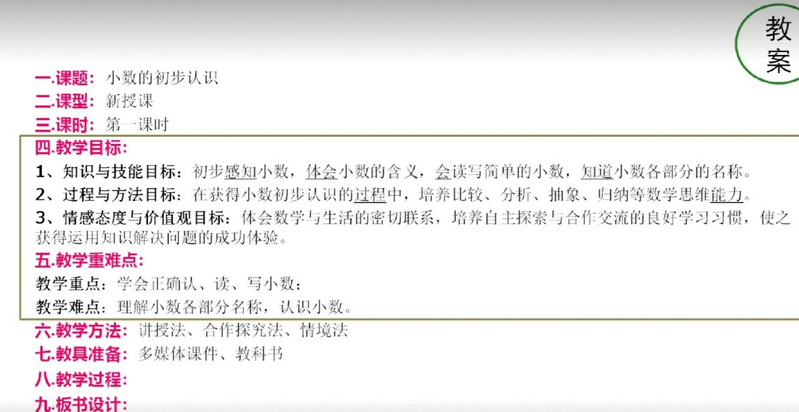
Simplicity requires a focus on objectives, difficulties and processes, and other can be appropriately omitted or time-saving
The goal of teaching is to write three-dimensional goals
Knowledge and skills objectives: what knowledge this class needs to learn points
2. Process and methodological objectives: what competencies are developed in the learning process
3. Attitudinal values: develop students ' habits to feel the connection between mathematics and life。
It's hard to teach
A sentence summing up the point of knowledge is the point of focus, and calculator applications are difficult。
Teaching process
The teaching process should be the key to scoring the entire teaching, mainly in five parts of the introduction - new teaching - practice. — summary — job set-up, where import and introduction are most critical。
Imports: imports are intended to bring out topics, they can be imported in a variety of ways, they can be reviewed, they can be imported, they can be imported, they can be imported, they can be imported, and it's good to follow the rules if you can't think of something new. Imports can be written in the order in which they are imported — the teacher's question — the student's answer — and the subject is raised。
New teaching: main steps, what to do — how to do — teacher questions — student answers — summary conclusions
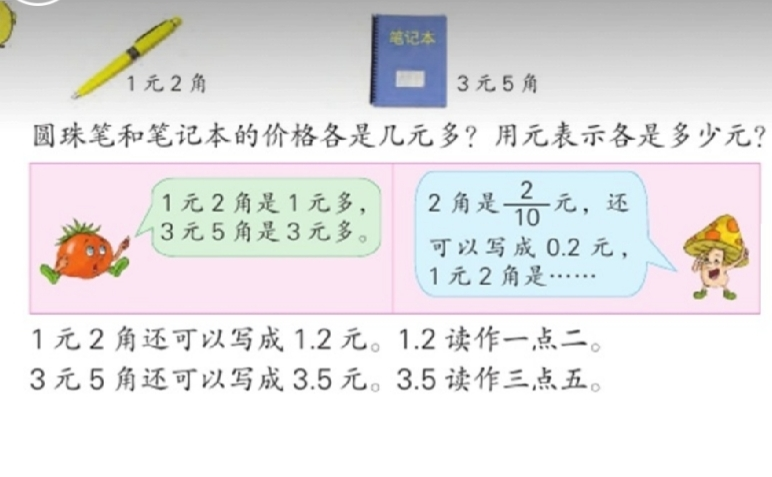
For example, the teacher should first show a picture (what to do), ask the student how much it costs (the teacher's question), preset the student's answer (the student's answer), summarize what is taught in primary school (the conclusion), and add it freely over time。
Practice: practice after class。
Synopsis: ask the students what they have learned in this class to help with the knot。
Operations: foundations and upgrades, or open-ended。
Finally, when you practice writing on a regular basis, you look at the focus of writing in accordance with the curriculum logic. Be careful. I've summed up the following six points
Knowledge point
2. What are the conclusions
3. Special fonts are often the hardest part of this section
4. Following the entire teaching chain
5. Concerns raised by teachers
6. Dialogue in the language is crucial
Iii. Highlights of the interview
1. Time is available for one-to-two minutes of reflection, and time is required for rehearsal。
2. Accuracy, focus and breakthrough of educational goals and priorities
3. The streamlining of teaching programmes in accordance with specific examination requirements, even when they are graded, must take a few minutes to pre-run, after all, and play on the ground is crucial。
4. Early conception of the layout and content of the book
5. Clearness and cleanness of teaching