In 1915, weigner introduced the concept of continental drift in his book the origin of the continent and the oceans, yet the evidence they presented did not convince geologists of the true nature of continental drift. In the early 1960s, h. Hess introduced the concept of seafloor expansion, supported by a series of new evidence in the fields of ancient geomagnetics, geo-ages and marine geology and geophysicals. Three different phenomena: the years of magnetic polarization in the lava series; the depth of the remaining magnetic shift in the deep-sea rock core, and the width of the linear magnetic anomalies parallel to the mid-ocean ridge, all vary at the same rate, as a result of the migration of the crust of the extended seabed from the mid-ocean ridge. The geology community has generally accepted the idea of active theory and has evolved into a plate sports doctrine。
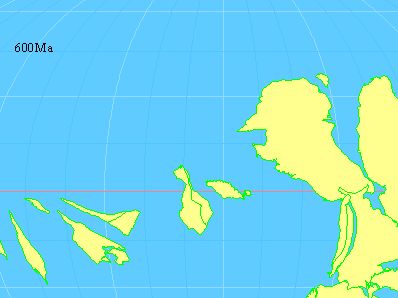
Rebuilding the history of china's plate movement
Hong han, ma zheng, cheng qian, liu pei-chul, tao
The science of plate tectonics divides the earth's surface into a number of rigid rock coil plates, between which there is a diver, a collision zone, a mid-ocean ridge, and a zone of activity such as a conversion fault. The science of plate tectonics suggests that the movement of the earth's surface is largely carried out through fault activity between plates, while the wide-scale mass deformations between plate boundaries are small and negligible on a global scale, that is, the plate can be considered rigid. The plate movement considers the rigid rock coils (including continental and ocean crust) to be moving on the less viscous floss in the upper mantle. It has evolved from the continent to the continent. Their differences are mainly:
(1) the continent is covered only by the continental silica layer, such as weigner, while the rock coil plate in the plate doctrine contains the rock collage above the crust and the flounder collage (the rock collage mantle)。
(2) the mainland is seen by some as an active unit, while the mainland is passive in the case of plate doctrine. The continental drift says that the continent is drifting through the silicon magnesium layer under the shell; while the plate doctrine introduces the concept of passive continents like those carried on the conveyor belt. Because of their relatively low composition density, they are usually more floating and able to escape diminished fate and become passive floating blocks with stable transport belts。
(3) wegnat, for example, perceives the continental silicate layer as something separate and completely different from the silica silica layer, whereas the plate doctrine considers the land to be a chemical product that rises from the similitude of the earth, which is linked to part of its substrate. The construction of the plate provides space for development of mantle trajectories。
The rock collage consists of the rock collage above the crust and the flounder collage (rock collage mantle). From a thermodynamic point of view, it is equivalent to the part above the rock solid line. From a mechanical point of view, it is the earth's crust capable of enduring long-term stress。
Gradually, the science of the plate has gained widespread recognition in the field of geology, which appears to be simple and, indeed, profound. The construction of the plate, or sutures, may be described as the structure of the earth's surface at various scales, and even on the most deformed taiwan collision belt, the steep wrinkles consist of a series of relatively complete grey rock blocks and the fractures between them。
From a tectonic physical point of view, due to the non-linear nature of the flow of rocks, the crust deformation is concentrated mainly in a few narrow bands, while the vast area between these activity bands is responsible for only small deformations. These vast areas are blocks, and narrow belts are boundaries between blocks. The non-linear nature of the fluidic underlying relationship is mainly reflected in the index of the stress element of the reaction rate in relation to stress. N the larger the n, the stronger the non-linear, the narrower the activity belt。
It is the geometry of the plate structure that is determined by this fluid foundation that is reflected in the construction of different scales。