High-range measurements of standards and their use are one of the basic tasks of mapping topographical maps, as well as a large number of engineering and construction works that also have to measure the above-ground elevations, the primary method of measuring them with precision。
I. Standard instrument groups:
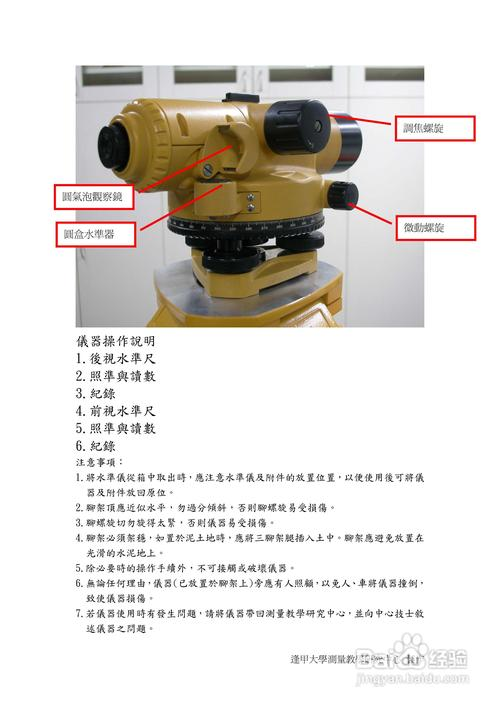
Telescopes
2. Adjustment of the wheel
3. Circlers
4. Modified wheel
5. Horizontal hands-on wheel
6. Pipe standard
7. Horizontal fine-tuning wheel
8. Footer
Ii. Operational elements:
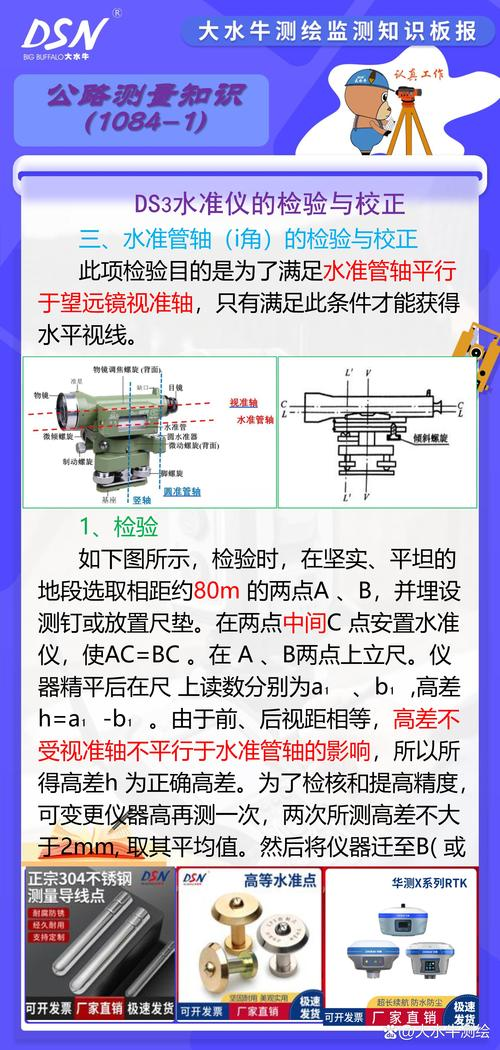
At two unknown points, the tripods were set open and the calibration instrument was removed from the instrumentation box and placed on the tripods, with three screws being flattened, so that the round air bubbles were kept in place, followed by the smoother. Horizontal hands-on wheels are smoothed and reflect through a triangle prism in a horizontal mirror, which overlaps horizontally and is flat water. The telescope is directed to the tower feet on the unknown point (1), re-aligns the tower horizontals again, reads the readings of the tower feet (backviews), rotates the telescopes to the tower feet on the unknown point (2), adjusts the tube horizontals, reads the readings of the tower feet (front sights) and records them in the record book。
Formula: two high differentials = rear-sighted。
Iii. Method of correction:
Placing the instrument in the middle of two fixed points, marking the horizontal line of two points, known as a, b, moving the instrument to the end of the fixed point, marking the horizontal line of two points, known as a `, b'. Calculating a-b≠a `-b' by half the value of the telescope's cross-wire deviation. The calibration adjusts the upper and lower screws of the calibration to match the tube level. Repeat this practice until it is equivalent。
Iv. Methodological standards for the use of standards include five steps: placement, rough, aim, flat, reading。
The placement is to place the instrument on a convulsible tripod and between the two sites. First, the tripod is opened and moderated, the head is assessed to approximate the level of the frame and to check the strength of the frame, and then the instrument box is opened, and the scale instrument is connected to the tripod by a spiral of connection。
2. Crude flat is a cursory level of view of the instrument, which is covered in the park's indicator circle using foot helixing. Specific methods are practiced with instruments. In the process, bubbles move in the same direction as the movement of the greater meteor。
3. Aim is aimed precisely at the target with a telescope. The first is to direct the telescope to a distant and bright background, and to turn the lens to the focal spiral to make the crucible most clear. The fixed spiral is then released and the rotation telescope is used to align the door-to-door connection to the calibration scale and to tighten the fixed spiral. The final revolving animal mirrors to the light spiral, so that the stairwell falls clearly on the crossline surface, then moves the micro-splatter, so that the stairwell is leaning on the side of the stair。
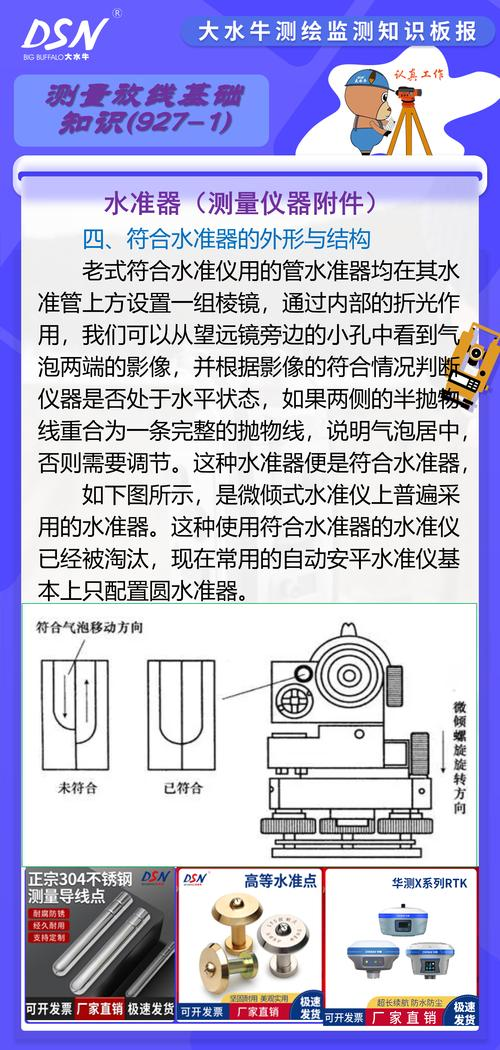
4. The flatness is the precise level of the telescope's vision. A micro-diplifier, equipped with a set of prisms on the upper part of a horizontal tube, can re-reflect both ends of a horizontal pipe bubble into a scalable observation window next to the mirror tube. If the bubble is in the middle, the image of both ends of the bubble will be consistent with a parabolic pattern, indicating the level of vision. If the air bubbles at both ends do not match, the view is not horizontal. At this point, the right hand can be used to turn the micro-throwing spiral so that the elephants at both ends of the bubble are fully in line, and the instrument can provide a horizontal view to meet the requirements of the standard measurement fundamentals. Attention? The direction of the left half of the bubble is not consistent with that of the right thumb。
5. Reads are cross-referenced to the reading on the scale. Most of the current standards are mirror telescopes, which should be read from top to bottom. Read the millimetre reading first, then give the full reading。
Note that the steps for the use of the scale must be carried out in the order above and not reversed, especially with regard to pre-reading water bubble adjustments, and must be carried out before reading。
V. The work of measuring scales to measure the height of a ground point is called the high range measurement. High-range measurements are one of the basic tasks of measurement. High-range measurements can be divided into horizontal measurements, triangulation, gps high-range measurements and pressure high-range measurements, depending on the instrument used and the method applied. Standard measurements are one of the most accurate high-range measurements at present and are widely used in national high-range control measurements, engineering surveys and construction surveys。
The principle of the scale is to measure the high difference between the two points using the horizontal vision provided by the calibration to read the readings on the scale up on the two points, and calculate the higher range to be determined on the basis of the known point height。
On the ground, as shown in the figure below, there are two a. B. Points, known as ha. The height of point a is hb. For the height of point b, a calibration of the bone between points a. B. And a scale of a. B. Has been erected between points a. B. And the reading of the horizontal readings by the telescope of the scale is a and b. The difference of a. B. Is that:
Standardized measurements are conducted in the direction of points a to b and are called points a for rear view, with a standard ruler a for back view reading, and points b for front view, with a standard scale b for front view reading. The high difference between the two points is therefore equal to:
Hab = post-vision reading - front-view reading
If the number of rear-view readings is greater than the number of front-view readings, the difference is positive, indicating that point b is higher than point a, hab>0; if the number of rear-view readings is smaller than the number of front-view readings, the difference is negative, meaning point b is lower than point a, hab
When setting a one-time scale requires measuring multiple forward vision points b1, b2,... And bn's altitude, it is convenient to calculate the height of those points using a high vision range. The high-range formula is:
If a. B. Has two points that are far away or far from each other and cannot be measured at a time when the instrument cannot be measured at a high level, it would be necessary to add a number of temporary footholds between the two points, known as transposition points (tp points), such as tp1, tp2, ... Points, followed by continuous station observations, with each station measuring a high difference:
Vi. Maintenance and repair of the scale scale of 1. Is a sophisticated optical instrument whose proper and rational use and preservation will have a significant impact on its accuracy and lifetime
2. Avoiding sunlight and dismantling the apparatus without permission
3. Each fine tune shall be moved gently and not over-strengthed. Mirrors, optical films are not allowed to touch with a hand。