Before that, the panel discussed three or four topics, which would take 10 hours in total, but which were all rather timid。
I know the rainbow
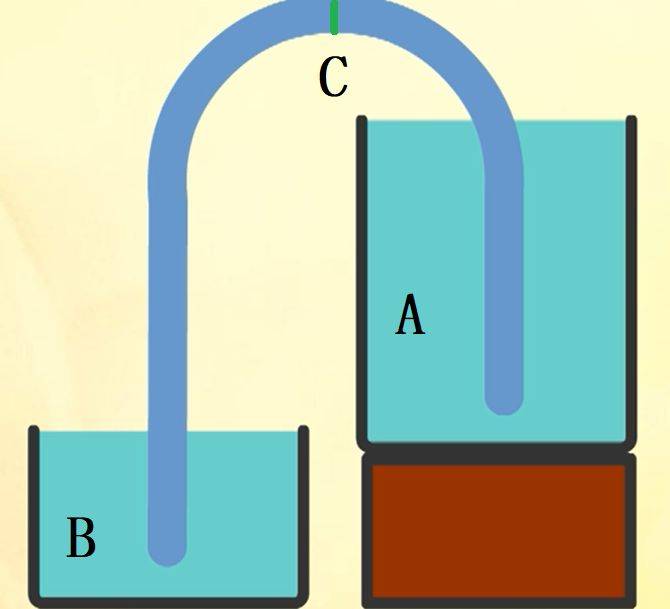
This is the basic model of rainbow snorting
"siphonage is the effect of the difference in surface height, which, when the liquid is filled with a down-u-shaped tube structure, places a high-opening end in a container filled with liquids, where liquids continue to flow to lower positions via the rainbow straw. The essence of iris is generated by liquid pressure and atmospheric pressure.”
It is easy to understand — two different water-filled vessels with a single pipe, which are pegged separately, and high water flows to low water。
Ok, so how does it work
Example 1
The toilet is a good example. It's an internal structure
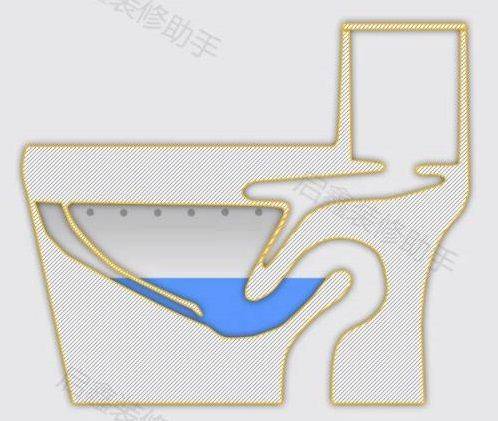
Focus on the pipe
Why not make it straight? Would it be easier to block a bending tube
This is for sure, but if it's a direct pipe, the stench of the sewage well and the septic tank will spill。
And it's called a pipe because it's a good place to use the iris。
Can't see? Let's put the model in first。
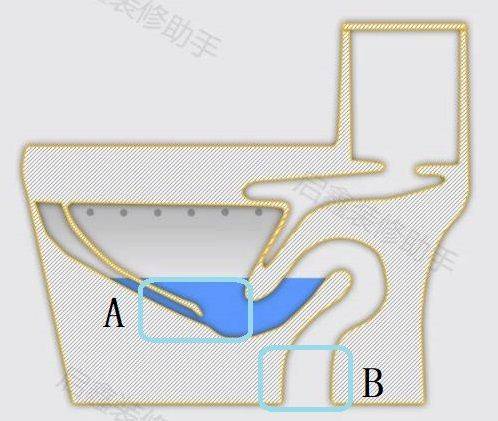
Isn't that obvious
Example 2
Background:
Ming dynaun jun, the official administration has opened a royal weapons factory in the town of gyeong de, which specializes in the making of the china for the palace. It has been said that the fao liang county at the time, in order to please the emperor, ordered the "kowloon cup" porcelain to produce a “kowloon cup” for six months, which was developed by the porcelain workers day and night and was finally successful after more than three months, dozens of repeated trials. Having received the “kowloon cup” zhu won-chun, he often used it to invite the minister。
At one of the parties, zhu won-hyun intentionally rewarded a few of his dearly beloved ministers with more wine, which he deliberately filled with wine, while ministers who often prefer to speak out rarely sifted. As a result, the ministers, whom the emperor intended to take care of, ordered and did not drink, all of which leaked from the bottom of the “kowloon cup”, while the other ministers drank the royal wine with joy. The emperor is incomprehensible about this, and for the reasons given, the wine is the most fair, and it can only be flat and not overfilled; otherwise, all the wine in the cup will be lost, without a drop。
Summarizing characteristics: water is available to those who know what to do and to those who are greedy。
Let's see the strange shape of this glass:
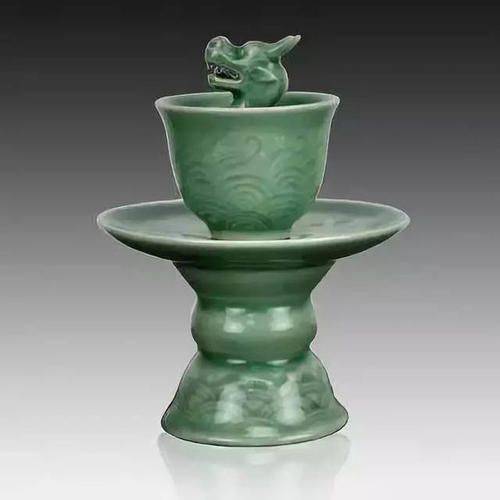
And this kowloon cup. Figure
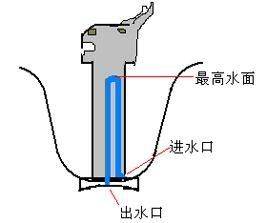
You can see a lead in the middle of the glass, a hollow porcelain tube, and a small hole in the bottom of the cup。
What's the use?
And we can see the top of the tube in the picture as “the highest water level”。
But it's not the highest level of water for a just cup. What's going on
In the background, it means that the amount of wine poured has a lot to do with this "highest surface," which is the tube
Now, let's analyze the models
Anatomy of iris
Get to the point--
The iris principle is created by liquid pressure and atmospheric pressure。
So desperate the relatioNo, no, no, noI'm sorry, mate.
Before you know it, you need to know the hydraulic formula: p=g
(p is pressure in pa (i. E. Pascal); old is liquid density in kg/m3; g is gravitational acceleration in 9. 8 n/kg; h is liquid depth/high in m)
Because of the gravitational and bit energy differentials between liquid molecules, liquids flow from one side of the pressure to the other side of the pressure。
And the pressure here includes hydraulic pressure, and atmospheric pressure。
In the iris model, the atmospheric pressure is very different, so we mark it all as p0。
The gravitational acceleration and density of the two basins are apparently the same, expressed directly as g and old。
So the only variable (without consideration of other factors) available here is h, divided into h1 and h2。
Mark on the map:
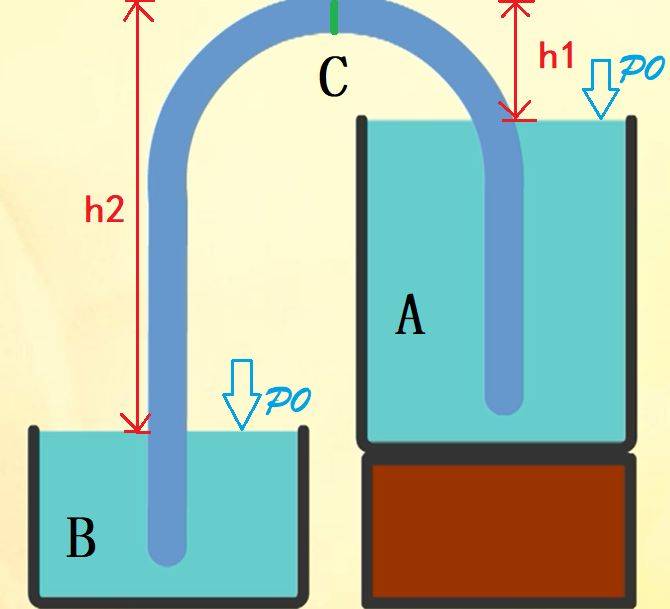
Then we're pointing the high-level water to the highest pressure of p1, the low-level water of p2。
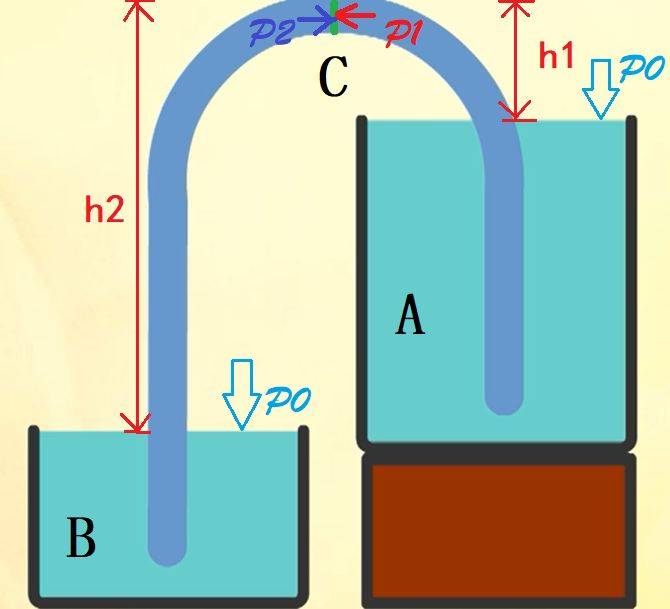
How do you know the size of p1 and p2 inside?
First of all, you need to know this:
The static surface of both sides connected to the outside world is first found and the pressure on that side is determined (i. E. Atmospheric pressure p0)。
And with that surface as a reference
1) the pressure is equal to the pressure of the surface minus gh if it is higher than the surface (including the tube)
2) the pressure is equal to the pressure imposed on the surface if it is less than the surface (including the tube)。
So it's clear that the h1 and h2 here are the highest and the relative height of both sides。
There are two equations:
P1 = p0-g1
P2 = p0-g2
Since only h in arithmetic, p1>p2.
In other words, the pressure given by the higher is greater than the pressure given by the lower。
It is also easy to understand why high-level water flows to lower-level pressure。
Well, why is the water flowing side solved and there's another question, will the water stop, if so, when
The answer must be yes。
And
In retrospect, water flows because the pressure on both sides was not equal。
So to make it stop, it must be equal pressure, p1 = p2。
Continue to push in the direction of h1 = h2, i. E. The highest in the tube is equal to the relative height of the liquid surface。
So when the tops of the water on both sides are, like, so high, it stops。
Backwards
Speak back to the glass of justice。
And then there will be a little friend, big brother, who will ask, "why does it have to be higher than the top of the tube before it starts flowing?"。
One at a time。
First, it is true that there will be a stopping situation in the standard iris model, as stated above, but there will be no water under the just cup (lower tube), so as long as there is water in the cup, the liquid surface must be more than zero。
Since there is no water below, the low atmospheric pressure does not need to be reduced by hydraulic pressure, so the low pressure is greater than the high pressure, so the current is impossible at this time。
So this is our second question, and it's common sense to know that when liquids are added to the cup, the liquid surface inside and outside the tube is consistent and rising simultaneously。
However, when the liquid is above the top of the tube (which does not contain the equivalent of the highest), the tube fluid is still in an increased state, but there is no room for rise。
There was no place to go, but it had to go down, so the water began to flow to the other side。
It is my understanding that the reason why water flows to the bottom at this time should not be the iris principle, but simply the water spill。
And then it was different。
When water is lost and the liquid surface is below the top of the tube, water flows continuously down from the highest water level due to pressure and gravity。
At this point, there was hydraulic pressure at the lower end, and the water pressure differential had begun to appear, so at this point it would only stop when all the water was running out。
Questions were raised or errors were found。