Recently, many readers have personally trusted me and asked questions about knowledge systems. It's just about to be sent out again to share some ideas. To be honest, it's a big problem. To be completely clear, it's probably a whole book。
So i'm trying to be as brief as possible and make this clear. I hope to give you some inspiration。
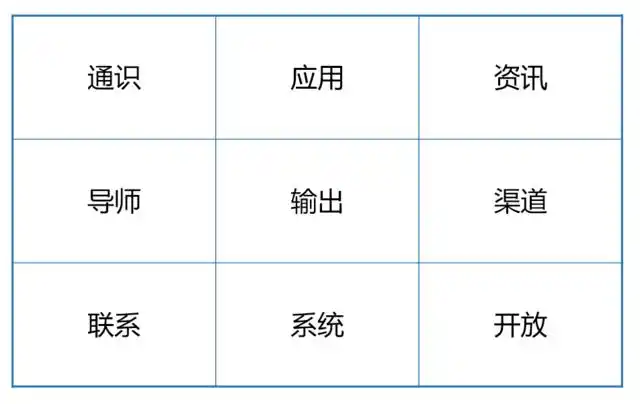
This is my summary of the knowledge matrix。
It has nine elements, each representing the nine essential elements of the process of building knowledge systems。
We'll discuss it one by one。
I. What do we learn: three knowledges
What is a knowledge system
In my definition, knowledge systems are concepts that correspond to debris knowledge and refer to a highly organized collection of knowledge. In other words, it's made up of two parts: a lot of knowledge points and an orderly structure。
What is "ordered"? You must have seen a man who is very good at a certain field, and who, no matter what he asks, can come from your subject and draw upon a lot of principles, mechanisms, knowledge points... In a clear and rigorous way。
That's "orderly" -- all the knowledge points in his head are linked together. He knows a certain point of knowledge, "where to put it" and "where to put it."。
If debris knowledge is a sketch of a street view, the knowledge system is a complete map。
How, then, can knowledge be systematized
We need to get into three levels: literacy, application and information。
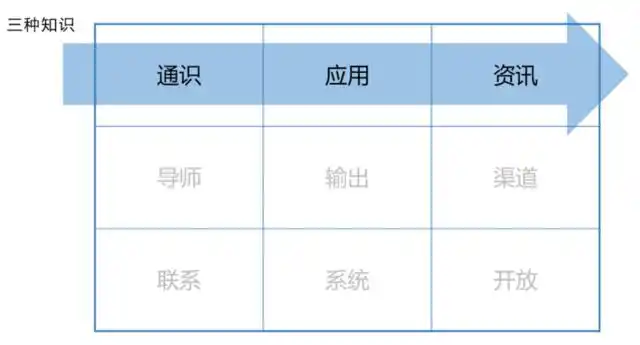
1. General knowledge
The foundation of the knowledge system is "a lot of knowledge". Without this, it is not systematic. Without quantitative support, sophisticated and complex structures are meaningless。
So the first step in building a knowledge system is to have enough basic knowledge -- i call it "understanding."。
This is crucial, but many often go the wrong way。
For example:
Studying philosophy, reading the mind chicken soup, life philosophy
Learn psychology, see micro-expressions, character analysis, dream analysis
- studying sociology and reading "the uighurs"
Learn economics, read the theory of national wealth, capitalism..
These are inappropriate examples。
And three well-known schools: legal high law, triangular political science, economics of monetary war。
Why? Simple. A good reading must have three characteristics:
1) paradigm
What's the subject of research? What's the methodology? What are the prevailing principles? – that's the paradigm, that's a word system in a field。
It can adapt your thinking to a "recognized pattern" in this field。
Good literacy materials must have a professional paradigm. It does not have to be "serious," but it has to be "professional."。
For example, some artistic history, reading a painting from the point of view of passion, palace, etc., is not a good paradigm -- it leads you astray。
2. Guangbo
Any area of development is bound to go through the process of "positive-reverse-coordinate."。
In the early stages of entry, it is not a good practice to have too much contact with one person, the views of a particular school or even to have positions. It binds your vision, pre-empts you, and makes it difficult to see the whole picture。
Therefore, it is better to constantly pursue "coherence" and the most recent and far-reaching results。
For example, reading modern economics textbooks is a better option than reading the theory of national wealth, capitalism. Because the latter would be based on the context of the times, there would be a more precise and deeper understanding of the former. You know what can be absorbed and what can be abandoned。
Objective
It doesn't have to be explained. The content of positions and tendencies leads to a lot of consequences -- for example, deliberate selection of pro-constituency arguments, negative stereotyping and criticism of opposing schools, generalization, etc。
Russell's "history of western philosophy" is brilliant, but it is in this context that he suffers from widespread disease. Including some textbooks is also somewhat less objective. No more talk。
Speaking of which, you might find a problem:
Where is there sufficient capacity to distinguish those who have not yet done so
It is indeed a paradox. Don't worry, we'll talk later。
Then let's go to the second level: application。
2. Applications
If literacy is the raw material that constitutes the knowledge system, then application is the way to make these materials glow and create an orderly structure。
Human beings are meaning-driven communities. You will find that all of our knowledge, in essence, exists for some purpose: art is about expression, philosophy is about exploring nature, history is about understanding yourself, and so on. There is no "knowledge" without a source and without meaning。
The same applies to research and learning. What's the best way to learn? Is problem driven。
You must have had a problem first, an interest in something, and then you explore it, you refine and enrich your own knowledge system, and you try to solve it。
This is the most effective learning process。
So there are three levels of application:
Mission 1: what is this field for
2) the main problem: what are the “big problems” driving development in this area? How did people think, how did they answer
3) sub-issue: what is my interest in specific learning processes? What kind of questions can i ask? How do i organize and think about these issues
The big problem is in terms of development and evolution in a given area. For example: what is emotion in psychological terms? What is consciousness? What is the mechanism of the brain? These are the “big questions” that psychologists face and that need to be constantly explored and answered。
The introduction to philosophy, i've been recommending big questions and the threshold of philosophy, because they have adopted the structure -- not to reproduce the genre and history, but to tell you, what is the question of the development of philosophy? What have been the efforts of traditional philosophers on these issues? What progress has been made
It's a very good way to get to the door, and it's a way to get to know what's going on。
Small questions are addressed to individual learning. Learning in this field to answer questions about what? What practical questions
Only by taking a problem-oriented approach to thinking in this way will you be better able to inspire and revitalize the knowledge you have learned。
For example:
Time management has a wealth of basic knowledge, tools and methodologies, and what happens after that? Rather than copying, it depends on what your background and needs are and what needs to be addressed, and then, from these many methodological theories, extract their essence and skeletons, re-organise them and evolve a set of management practices best suited to the individual。
This is an "ordered structure"。
In this way, you can give meaning and value to the knowledge you have learned and systematize it。
A map is not there to accumulate ashes, but to guide the way。
The same applies to knowledge。
3. Information
The first two points, generalization and application, together construct the vast majority of knowledge systems。
The rest is information。
What's information? Simply put, an update of the first two - a small one。
Any one area was evolving, constantly correcting the minor errors of the past and exploring them in certain directions. They may take the form of papers, magazines, web articles, books, etc。
What's the point? Knowledge systems are not static, but need to evolve and refine. It must be kept alive only if new water flows come in and the slag is washed away。
To give a simple example: in the last century, the psychological study was "a short-term memory can keep about seven units" -- the classic "magic number 7". It's a "literacy"。
But the latest study at the beginning of the twenty-first century found that the capacity of short-term memories is actually only four, not seven -- this is an "update package." then you'll know: oh, my knowledge needs to be updated。
Now, you look at the psychological books that have been published in recent years, and they're basically all changed -- and that's how the "information" is tested over time and turned into a new "literacy."。
If you do not focus on these cutting-edge results and do not update your knowledge reserves, you will find that, without realizing it, your knowledge has become obsolete, unable to keep up with the times and unable to understand what others are saying。
So knowledge is more important than knowledge itself。
Knowledge is not the end, but the road。
Where do we learn? Three ways
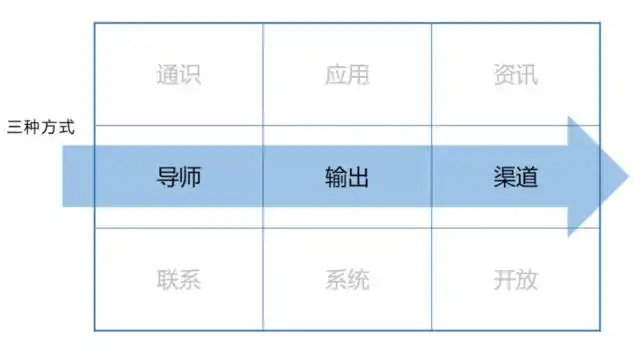
1. Mentor
As i said in "intellectuality", it's a paradox: if you want to enter a field, you need good knowledge, but how do you know what is good knowledge if you have not
That's the answer: you need a mentor。
The coach is not necessarily a teacher. He can be your friend, colleague, celebrity, anyone. Or even one person -- a website, a service, an online educational platform。
His role is to provide you with an effective learning path。
What's the learning path? You should start somewhere, learn what, learn what, and learn what. The simplest form is the book sheet。
Book lists are for everyone, but good books are very rare because many factors must be taken into account。
The most important point is the gradient: a good learning path must be easy, shallow, wide and specialized。
At the entry point, what common knowledge books are selected to maximize the balance of taste and professionalism? After the introduction, how should different schools, positions and perspectives be selected? How can one be guided to a more professional and deeper part
All of this is a great test of the skill and accumulation of mentors。
Another point is difficulty。
We know that learning has a "comfort zone" theory. Staying in a place you know, you can't learn anything, you just keep repeating it; it's too far from a comfort zone, and it's hard to learn because you don't understand。
The best thing to do is to find the edges of the comfort zone and move forward, which we call the growing zone -- a challenge to ourselves without being too difficult。
These are all things to consider。
If you don't have enough professionals around you, you might consider online educational platforms such as coursera and edx. They often have more mature learning path designs and extended readings that help build their own knowledge systems。
2. Output
I've always stressed one point:
Output is the best way to internalize。
I am often asked: how can i better remember a knowledge point? The answer is simple: say it in your words and teach others。
Similarly, how to ensure that 100 per cent of knowledge points are available? Write it into articles, send it out, let someone else pick it up。
But in our daily lives, we focus too much on input and neglect output。
Every day we brush the circle of friends, watch the news, watch the video, read the book, read the public sign, talk, but then what? How many can be truly remembered and integrated into knowledge systems
Probably not 10%。
The reason behind this is, to a large extent, the lack of output -- we keep stimulating the brain with the fresh sense of input, but we're always afraid of thinking and giving。
It doesn't make sense。
Channels
The channel, here, is dedicated to the channel of information, which is the source of all "discretionary information"。
Many people ask me, "how do you see fragmentation learning?" is it against the knowledge system
Not really. Scraping learning works, but it means "updating" and "supplementing" rather than "building"。
What do you mean? If you do not know anything about an area, fragmentation information is not helpful. Because they are often simple, partial, intuitive and difficult to construct effective logic and structures. You get a pile of gravel, not a house。
But if you've got a form system, then fragmentation information is quite useful -- it can be a useful complement。
Seeing any information, you'll know where to put it, how to judge, how to absorb and how to trace it。
That's when you're "systematizing debris information."。
But only if you have sufficient knowledge and accumulation in this field。
These are the channels that i usually use in this regard:
1) google: google is the best and most comprehensive source of information in all fields and at all times