This document is based on the opening report of the financial knowledge mapping forum organized by the interconnected ceo bauter on march 29。
Introduction to the technical principles of knowledge mapping
Application of knowledge maps
Knowledge mapping - knowledge in machine brain library
Large technology behind the 67-page ppt decryption search engine: knowledge mapping, building blocks for big data semantic links
This morning i looked at the registration form for this congress, and there were about 270 registered, with over 150 participants. I manually made a simple statistic: two exchanges, seven coupons, 10 banks, and more than 10 universities, over 10 smart finance firms. In addition to today's guest speakers, many other families have come. Bat is also present, and there are more than 10 large internet companies, with at least 30 investment institutions. It can be seen that the entire area of intelligent financial mapping has received considerable attention, which is clear from last year. We also held the first semantic dialogue finance sharon in beijing last year, in march. We had some guests, about 30 people, and the venue was much smaller than this one today。
Much has changed in the course of the year. Much of what we are discussing today has been added during the past year. A year ago, you called this semantic, and now basically it's called knowledge mapping. Although the name has changed, the nature of the technology has not changed, but its application has changed dramatically. As in the case of automated reports, many of the technologies associated with intelligent research were only in the early stages of conceptualization last year and have so far been implemented and are already visible on the market。
If we look at the financial mapping in a larger picture, we can see the development of the entire fintech industry. One of the most popular words you have heard in the past three or four years is internet finance, which has emerged in the last year or two. In my understanding, it represents the first and second half of fintech. Any technology that changes or innovates an established industry usually has such a first and second half。
The first half of the session focused on improving efficiency, and in the area of internet finance, it was mainly addressing the problems at stake. Whether it's a trade or a platform, or a p2p, it's actually a solution to how to better organize the original resources. It has moved the line off the line, and it has improved efficiency, which was already inefficient, mainly addressing a touch-down problem. But what happens when a technology really reaches into an area and it increases industry efficiency to a high level? There's usually a new business model that's coming up, and there's a restructuring. It had not been able to develop a business model in the past and could not do many applications, as the support of new technologies could do. I think this is exactly the focus of our next two, three, or even three, four years. The focus of this piece is more supported by artificial intelligence than just the internet。
In this transformation from touch to reconstruction, a lot of experience is not fully applicable. In earlier internet applications, more money, more people and more machine solutions, because internet applications are complex systems. But it's also a complex system for smart systems, but it's not a complex system, it's a complex system, and it's got very fine little structures in it that can solve this problem, not just by adding more people, so there's a little difference between the two paths。
Our theme today is knowledge mapping, but knowledge mapping is actually part of the whole intellectualization. Nor can our financial intelligence be separated from the entire work of the past 20 years. In my own understanding, it is divided into four phases:
The first stage is computerization, including what banks did before, for example, using paper-based documents, which now becomes a machine file, from line to line。
The second stage is big data. In the past 10 years, it's not really big data, but it's really big data, it's really big data, it's just the fragmented data that put it together. It was initially called a data warehouse, then a big data store, and more recently a cloud. Every bank was doing it, the coupons were doing it, and the exchange was doing it. In fact, this data has to be transformed from fragmentation to integration, into a big one to solve the problem。
These two years, starting in 2015, we're in the next phase, an automated phase. When we have so much data, we find a lot of things very cumbersome, moving them manually, rather than using machines to do such repetitive work. We use more intelligent programs to automate the process and make it simple. This is also an attempt in the last two to three years that we have seen in many branches。
Intelligence can be described as the beginning of automation, and i call it the painting of dragons to the dots, that is, the entire system, where we used to do all the work. But people should work with machines to form a system of collaboration, machines do complex things, and people are real value creators. It's only human beings who can get their eyes down, and it's smart to turn this process into a process where machines can paint dragons, people can get their eyes down。
Artificial intelligence now has many different branches, and i have three main branches here, namely, empiricalism, or machine learning methods, or interconnectivity, the most recent being deep learning, which was preceded by a neuronet approach, and the method of knowledge that we are talking about today, which is symbolicism, earlier called logic, and then, in the late 1990s, an area called semantic network, which later evolved into a knowledge map. In the area of finance, early knowledge of machine learning, such as credit card directs, marketing, and user graphics, is familiar with a lot of machine learning methods; in the last year or two, in-depth learning began to be widely applied, and knowledge mapping entered late。
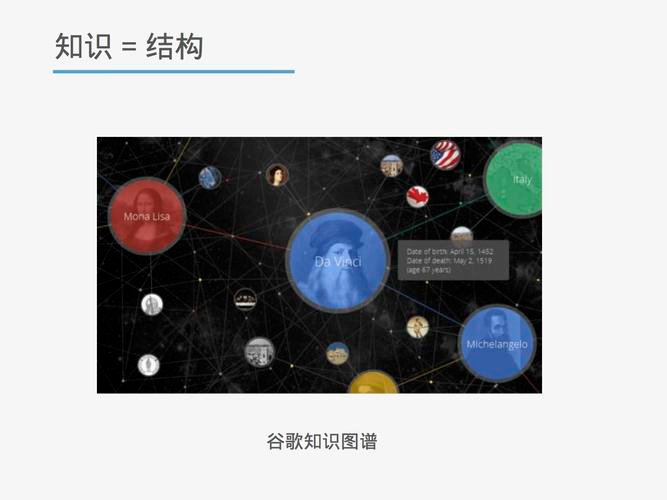
You're probably not very familiar with knowledge maps, so i'm going to give you a brief picture of what i know. It seems to me that knowledge is really structure, that our simplest knowledge is a dictionary, that we define other words with some words, so that is the structure between words and words。
This is google's knowledge map. It's an advertisement that represents every node, an entity, where there's a mona lisa, and then da vinci is a person, which represents a relationship that mona lisa is a da vinci. Mr. Chan wah-chul will be given more details。
The other structure is up and down the industry. In each industry, we can draw what the upstream and downstream products of this industry are; in each case, what kind of company is providing such a service. We used to do it manually. Can it be automated? We used to have a few hundred industries for stock listed companies like a, and we could do it manually. But now we are faced with tens of thousands of listed and listed companies, thousands of subdivisions. Can we use machines to improve efficiency to make such knowledge maps? It should be okay。
It's a change in the executive that was extracted from the bulletin in the json format, which refers to one of the individuals who, for whatever reason, resigned from his post at what time, a knowledge-taking that the machine could help us make。
So the core of the whole knowledge mapping technique is how to structure the data. In traditional database studies, we have seen data structured. Knowledge mapping techniques are, to some extent, a step forward in database technology to store and express complex relationships that traditional table structures cannot handle with updated databases. Although this technology was known only in 2012, it has been developed for almost 15 to 20 years。
Today's forum is hosted by the chinese information society, which had previously focused on the technology of processing natural languages. There's a branch in the natural language processing that is called the extraction of knowledge, from unstructured data, from structured data. Later, around 2012, this component was integrated into the knowledge mapping technology, which mr. Baek suk will give you in detail. Knowledge expression is another, older called logic, or earlier called expert systems. Mr. Painting guilin is the big one. The euphoria of the semantic network has fluctuated for over a decade, with some remarkable successes, including projects like siri, ibm watson, which proved the value of knowledge performance in 2010, 2012. By 2012, the area of knowledge mapping had also been incorporated. The source of knowledge storage is the database technology just mentioned. Now you hear a lot, like neo4j, the graphic database, the rdf database, all represent a new knowledge storage engine. And the last part is the search for knowledge, and there are a lot of friends here today from search engine companies. Google says that what we're searching for now is not string-string, but entity-entity。
These four different areas have evolved to a key node, and have found that in order to solve problems in their respective areas, structured data have to be used to create the technology of knowledge mapping。
We look specifically at the financial knowledge map, which is the main type of financial knowledge that we see today in the chinese market. This is a very rough classification, and there are many more detailed classifications under each classification. For example, such as the previous initial databases, teng, wen fei wen and guo, they will share their experiences with you. Moreover, in many other types of markets, including primary and secondary markets, we have seen the emergence of different knowledge maps and databases. For example, companies that make a shares, new 3 boards, and, in fact, hong kong shares, united states shares, basic data, and data on patterns are now constantly mapping knowledge. Previously, only f10 had been seen, and now an intelligent “f10” appeared, along with bulletin data, extraction of research data, retrieval of bulletin research, etc. Panorama data, pan-enterprise data and various business data are different branches of the financial knowledge map we see today。
In terms of application, i can think of a dozen. But it's going to be a lot more than that. It is exciting to note that most of these applications have emerged over the past year. A year ago i made this list, probably four or five, and now we can list a dozen. So it's hard to imagine how many species we'll list next year. In the branches of investments, we can see very wide applications of knowledge maps. There are also many guests here today who are doing their own work, and the purpose of this forum is to bring us together, to share and to exchange experiences。
Let me briefly say that the main time for today is reserved for panellists. Today there are five reporters, the former teacher of white, who focused on nlp and knowledge mapping matching, followed by three directors of the companies that created the database to share their experiences, and finally professor chen wah and mr. Tin li to share their vision of open knowledge mapping。