System chemistry studies
The richness and theoretical contribution of the human economy of the new era
Sang ming wuk
Modernization is a common aspiration of all nations of the world. The proper management of the relationship between the economy and culture, material and spirituality is a major issue that is common to all countries in the world as they move towards modernization. The secretary-general of xi attaches great importance to the mutually reinforcing role of the economy and culture, and has made a systematic discussion of the mutually reinforcing role of the economy and culture in the promotion of high-quality economic and social development and comprehensive human development. During the two national conferences in 2023, the general secretary took the example of the sohang region and stressed that “where culture is well developed, the economy is ahead. We can study the humanities in this." the major theoretical theme of the new era of humanities is rooted in the fertile soil of modern china, deepening understanding of the patterns of interaction between economic development and the construction of culture, and providing scientific guidance for the harmonious development of material and spiritual civilization in the process of china's modernization, with great theoretical and practical significance。
In retrospect, after the mid-18th century, western capitalist countries, with the strong impetus of the industrial revolution, took the lead on the path of modernization and social productivity leapfrogged. However, the west’s initiation of modernization has two faces in development, one of material enrichment, accumulation of wealth and the other of lack of faith and desire, and the proliferation of capital logic has led to the pursuit of “goods” more than “humans”. In turn, the prevailing western economic theory, based on the lessons learned from western practice, has reduced the comprehensive, genuine, multi-directive needs of people to one-sided, fully rational “reasonable economics” who seek only material benefits. Especially after the “marginal revolution”, mainstream economics in the west gradually abandoned the humanist tradition of classical political economics, building a theoretical paradigm of analysis and promotion of economic growth using mathematical models based on the fundamental assumption of “reasonable economics”, focusing on abstract market balances and individual excellence rather than on values, justice and happiness. The absence of a humanist spirit has led western mainstream economics to become stretched out in interpreting and responding to systemic and structural challenges such as polarization, ecological crises and mental deprivation. This shortcoming in western mainstream economics has been reflected by a number of scholars, and nobel laureate ronald harry koss and others have pointed out that the loss of human depth and richness is the most significant cost of economic discipline from the ethical sciences of human wealth creation to the cold logic of resource allocation. Modern economics is no longer the subject of human studies, and has lost its roots and moved away from economic realities。
People's humanity is the clearest character of marxism. The communist party of china, which is a faithful believer and committed practitioner of marxism, has always adhered to the marxist idea of the free and comprehensive development of human beings, placing human development at the centre of economic and social development, bringing together economic and cultural construction from a dialectic and balanced perspective, and promoting the harmonious development of material and spiritual civilization. Since its eighteenth anniversary, under the strong leadership of the party's centre, with comrade xi at its core, we have been building up a modern material base and building on the material conditions for the well-being of our people. At the same time, efforts have been made to develop an advanced culture of socialism, to promote a culture of revolution, to develop a traditional culture of excellence, to deepen the exploitation of cultural resources, innovative cultural expressions, to promote the deeper integration of culture and other economic practices, to develop cultural industries and industries, to develop the spiritual world of the people, to develop cultural self-confidence and spirituality. The promotion of economic work around the comprehensive development of the human person, the full realization of the functional role of culture in enabling economic and social development and the promotion of cultural prosperity in tandem with economic and social development have proved to be an important means of promoting high-quality development and promoting modern china。

In recent years, many resources have combined to promote the organic integration of traditional styles, modern business and civic life, to integrate traditional culture into neighbourhoods, to plant scenes, to truly “live” the mosaic of historical memory, and to continuously inject human temperature and economic dynamism into cities. On 2 january 2026, tourists roamed mount tong street, suzhou city, jiangsu province. People's pictures
Today, the world's century-old changes are accelerating, and global economic development is facing challenges such as insufficient kinetic energy, lagging governance and uneven development. The causes of the development dilemma in the world today are complex and varied, but it is important that the traditional development models and theories of development, which follow the logic of things, no longer work. The construction of new, more interpretative and guiding theories has become a pressing need for the development of the times. Faced with growing development problems, there has been a growing call in recent years for the return of humanism and humanism to economic theory. The humanistic economics of the new era, which has evolved and developed from china's modern approach, has provided a profound illustration of the dialectics between the human and economic spheres. It has fully revealed the important role of the human spirit and human resources for economic development. It has injected a deep human dimension into economic development. It has provided an important theoretical inspiration for the world today to confront development difficulties and to work together to advance the construction of modernity that is rich in material and spiritual. As secretary-general xi has pointed out, “to meet common challenges and move towards a better future requires both economic, technological and cultural civilizational power”
It is written in the way, written in the form of man. With regard to the relationship between the economy and culture, comrade xi gave in-depth thought and clarification during his local work. Since the 18th anniversary of the party, general secretary xi has been profoundly grasping the historical dimensions of our country's development and changes in the main contradictions of society, and, in view of the growing needs of the people for a better life, has further deepened his understanding of economic development, cultural development, human development and its intrinsic relationship with a new set of new ideas. As a result of xi jinping's economic thinking and xi jinping's cultural thinking, the new era of humanism and economics, which insist on combining the principles of marxism with china's actual reality and with china's traditional culture of excellence, emphasizes that culture confers profound human values on economic development, advocates the promotion of the intersection of humanities and economics, and greatly enriches and develops humanist economics, is a major innovation in the chinese era of political economics of marxism。
The material wealth of society was created by human beings, and economics research should be directed primarily towards human relations rather than objects. However, just as western modernization is essentially capital-centred, western mainstream economics is capital-centred economics on economic growth and the accumulation of material wealth, which is marked by “visibility”. Practice has taught us that once economic development is limited to the simple pursuit of economic growth, problems such as the separation of rich and poor, environmental pollution and, ultimately, sustainable and healthy economic development follow. If the human dimension and ethical values of economic activity are ignored, it is difficult for economic theory to propose effective responses. How can “people” be understood in economic development? During zhejiang's work, comrade xi stated that “people are essentially cultural people, not `materialized' people; they are dynamic, comprehensive people, not rigid, `one-way' people. Human beings seek not only material conditions, economic indicators, but also `happiness indicators'; not only harmony of nature's ecology, but also harmony of spiritual ecology; not only efficiency and equity, but also harmony and spirituality in human relations and the meaning of life”. Since the eighteenth anniversary of the party, general secretary xi has stressed that “modernity is essentially about the modernization of the human person” and that “the ultimate goal of modernization is the free and comprehensive development of the human person. The ultimate viability and stability of the modern path depends on the insistence on people-centred approaches. Modernization depends not only on paper indicators but also on the well-being of the people”. The most striking feature of the new era of human economics is its adherence to a people-centred approach to development, placing the “human person” at the heart of development, emphasizing that economic development is not an end in itself but a means and that the ultimate pursuit of economic development is the free and comprehensive development of the human person, which will strongly drive the “human return” of economics。
Will the spiritual, moral and spirituality of the human being be enhanced by material enrichment? This is an issue that has been repeatedly addressed in the modernization process. In the 1930s, british economist john maynard cairns, looking to a 100-year-old human society, argued that when we reach that position of economic prosperity, some of the most precise principles of traditional quality can be re-emphasized; then there would be no end-of-the-life reversals, more attention would be given to ends than means, and the struggle would not be for use, but good. The reality is very different. Today's developed countries in the west, although rich in material wealth, are becoming increasingly marked by distorted values, emptiness and lack of faith. The communist party of china, in leading the process of creating and promoting chinese-style modernization, not only insists on the emancipation and development of social productivity and the promotion of sustained and rapid economic growth, but also stresses that spiritual civilization is the subject of chinese socialism. The secretary-general of xi has made it clear that “china's modernization is a harmonious modernization of material and spiritual civilization. Material and spiritual enrichment is a fundamental requirement for the modernization of socialism; “when high-rise buildings are established throughout our land, the chinese nation's spiritual edifice should also be soared”; and “insisting on two hands and two hands, promoting harmony and mutual reinforcement between material and spiritual civilizations”. The new era of human economics advocates a modern vision of harmony between material and spiritual civilization, emphasizing that material civilization requires a deep cultural build-up and the contribution of spiritual civilization, which also needs to be underpinned by a strong economic base that effectively breaks the “human paradox” of economic development。
Economic activity is human activity, and human behaviour is deeply influenced by culture. What is the understanding of the impact of culture on economic activity and economic development? In his work in zhejiang, comrade xi stated that the power of culture is “the booster of economic development” and that “the essence of culture is economic decision-making and economic power provides a material platform for cultural power to work effectively. However, no economy is dependent on cultural support; culture confers on economic development “deep human values”, “high organizational effectiveness”, “greater competitiveness”; and “when combined with the most active human elements in productivity, the quality of the labour force will be greatly improved, the reach and depth of the workforce will be greatly expanded and the ability and quantity of human beings to transform nature and to acquire wealth will increase geometrically”. In entering a new era, the secretary-general of xi stated that “culture is an important anchor in promoting quality development”. It can also be seen in reality that regions like sohang, where culture is well developed, are in the forefront, one important reason being that the cultural spirit of euphoria, honesty, openness, cooperation and win-winness that has been built up in these regions for centuries is highly compatible with the requirements of the socialist market economy. Humanities of the new era insist on treating human beings as the most dynamic, dynamic and creative subject of economic and social development, emphasizing cultural and human beings, thus stimulating the enormous contribution of advanced cultures to high-quality development。
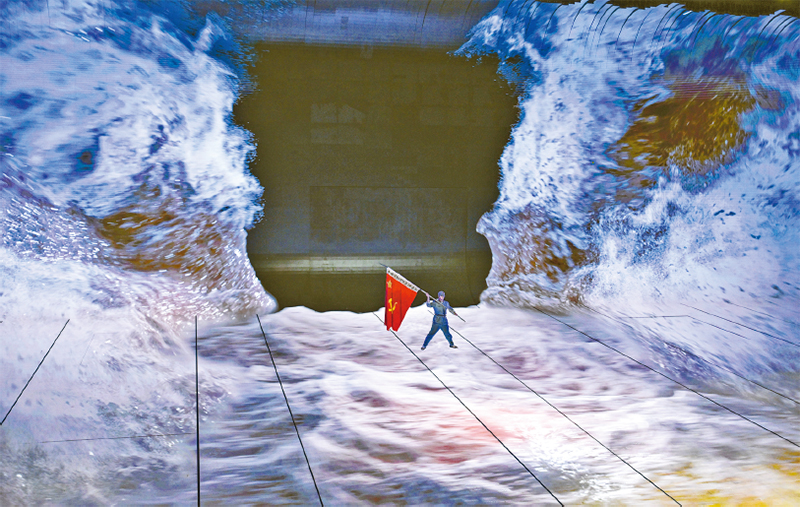
In recent years, forward-looking technologies, such as ai virtual interaction, holograms and three-dimensional acoustics, have spread, changing the one-way nature of cultural experiences and creating participatory, sensory and reminiscent cultural domains. At your governor's hall of cultural and digital art, the global digital show " red ribbon, great expedition " brings together the latest technological means to recreate the digital landscape. On 15 november 2025, actors performed " red ribbon, great expedition " . Xinhua journalist yang wenbin
As a typical business practice of cultural and economic integration, the cultural industry is a practical vehicle of human economics. Cultural industries are characterized by high value added, low pollution, low energy consumption, and have the advantage of being innovative, inclusive and plastic, and their development is an effective measure to boost domestic demand, promote employment and create dynamic markets. At the same time, a high level of cultural industries can revitalize historical and cultural heritage and contribute to cultural heritage and conservation. According to general secretary xi, “cultural industries are a dynamic industry”; “culturally enabled economic and social development”; and “exploring effective mechanisms for the integration of culture and science and technology to accelerate the development of new cultural practices and to create more new points of growth for cultural industries”. Our population is large, our cultural resources are rich, our cultural consumption needs are strong and our cultural industries are well equipped to flourish. In 2024, the added value of our cultural and related industries was 6209. 4 billion yuan, representing 4. 61 per cent of our gross domestic product (GDP), and has become an important engine of high-quality development. The new era of humanities economics promotes cultural empowerment for economic and social development, fosters more cultural new practices, models and scenes, optimizes the supply of cultural goods and services, transforms the advantages of cultural resources into new points of economic growth and achieves a virtuous interaction between cultural prosperity and economic development。
During the “fifty-five” period, as the country's economic and social development and the people's standard of living improve, the spiritual and cultural needs of the population grow and the demands for the quality, taste, style, etc. Of cultural products will grow. New scientific theoretical guidance is urgently needed to develop practice. The secretary-general, xi jinping, presented the theme of the era of humanities and economics, revealing the intrinsic logic of the interaction between culture and economic integration in china's modernization process and providing fundamental adherence to the new dynamism of cultural resources, the shaping of new strengths for development and the promotion of high-quality development in cultural construction. We need to learn more about the richness of human economics in the new era, fully tap human resources, activate the cultural landscape, unleash the potential of culture, inject new dynamic energy into high-quality development, and build up the spiritual strength of chinese-style modernization。
In recent years, our humanist economics researchers have made many valuable theoretical contributions, but they are generally at an early stage and there is an urgent need to further strengthen the development of systematic chemical science research and to accelerate the construction of an autonomous knowledge system for human economics. The marxist approach to the position reveals the basic pattern of the interaction between culture and the economy and the integration of development in the context of the new era. It is necessary to fully exploit and extract the nutrients of china's excellent traditional culture, and to integrate the cultural genes of the rich, the good, the good, the good, the good, the good and the good. In order to take root in china's dynamic modernity, we will study in depth a sample of china's modern humanist economy, summarize the typical experiences, from individual to general, from concrete to abstract, and refine the chinese economy's path and its management into chinese economics, answering the questions of the world and the times。