1 predation 1. 1. The selection of varieties that are currently used more widely in the market are those that are highly resistant to the disease, such as coronant, golden bridge 4, sinon 8, beauty, etc. (c) use of medium- and medium- and late-literate varieties that are resistant to disease, of good quality and productive. 1. 2 the seeding period is determined to be generally live and to ensure full and strong seedlings, as well as the use of solar hothouses for planting. Pre-maturized varieties are usually established or planted in late april. 1. 3 it is appropriate for soils to choose sandy plots that have not grown a melon crop for five years, are deep and fertile, are easy to irrigate and have a flat terrain. 1. 4 fertilizers are applied in the whole area in combination with 3,000 kg, n12 kg ~ 13 kg, p2o5-9-10 kg and k2o5 kg per acre of high-quality farmers who are fully decomposed. 2 垄2. 1 垄 冻 冻 冻 冻 冻 冻 垄 垄 垄 垄 垄 垄 垄 垄 垄 垄 垄 垄 垄 垄 垄 垄 垄 垄 垄 垄 垄 垄 垄 垄 垄 垄 垄 垄 垄 垄 垄 垄 垄 垄 垄 垄 垄 。 。 。 。 。 。 。 。 。 。 。 。 。 。 。 。 。 。 。 。 。 。 。 。 。 。 。 。 。 。 。 。 。 。 。 。 。 。 。 。 。 。 。 。 。 。 。 。 。 。 。 。 。 。 。 。 。 。 。 。 。 。 。 。 。 。 。 。 。 。 。 。 。 。 。 。 。 。 。 。 。 。
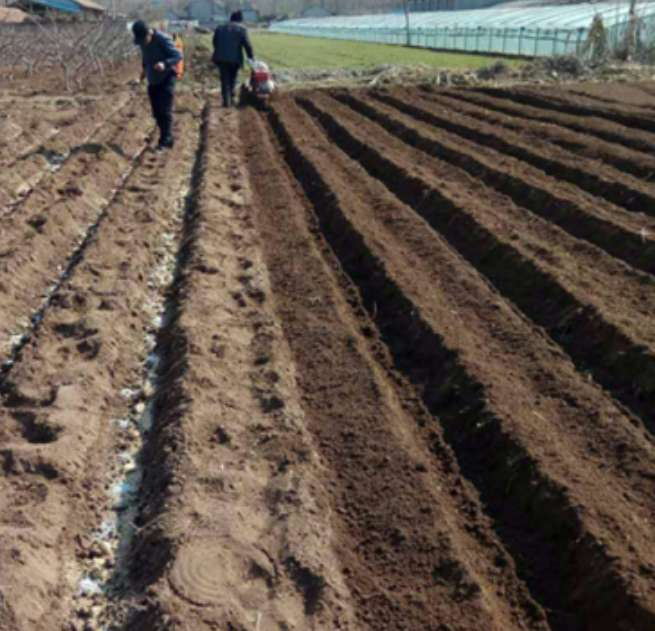
2. 2 the membrane is selected to cover irrigation ditches with a 145-cm wide membrane band, with the membrane and the bottom of the gutter being tightened. 3 feeding, transplantation 3. 1 seed treatment: 10 seconds after immersion of seeds with 70-80°c water, cooling water up to 55°c, 15 minutes after mixing, naturally lowering water temperature to about 20°c in the room, continuing to immerse it for 10 hours, cleaning it up, and keeping it at 30°c with wet cloths (pre-opening water to burn the bacteria) in order to keep it in the hot room or on the plume or on the electric mattress (basket wetting). Open the bag every 10 hours to continue the sprouts. Usually the bud starts in about 48 hours. The seed is sowed not more than half its length. 3. 1. 2 plantation of seedling soil to be filled with seedling soil shall be prepared 10-15 days before seeding. The method of formulation of seedlings: 70 per cent of garden land + 30 per cent of manure of decomposition farmers. And put in seedlings made of seedlings, and when they have been levelled to the ground, a few of them or a few of them, and the earth is less than a centimetre along it. 3. 1. 3 when seeding is installed, water is poured into the greenhouse to increase the temperature. At the time of the broadcast, warm water was poured again, seepage and seeding, each of which lays its roots down, covering 1 cm thick of nursery soil, and then seals the bed to keep it warm and wet. 3. 4 shrimp management 3. 4. 1 temperature management (1) from seeding to soil production requires a temperature of 30°c at night and day and 22-25°c. (2) from the soil to the leaves, the real leaves appear, requiring that the temperature of the day and night be maintained at 20 - 25 °c and around 20 °c. (3) from real leaves to 5 to 6 leaves, it usually takes about 40 days, 25 to 27°c during the day, 15 to 18°c at night and 18 to 20°c. (4) a week prior to planting, with cold exercise. Specific method: day temperature is maintained at 15-20°c and 10-12°c at night. Temperature 15-20°c. Increased ventilation, early curtains, later seating. Three to five days before planting, 5°c during the day and 4 hours to 2°c in the middle of the night. 3. 4. 2 humidity and nutrient management the principles of watering in the future are to do nothing, to do less and to do less. In the afternoons and evenings, in case of longing. The two- to three-faced fattenings are carried out during the shrunk season: once each of the two-, three- and four-leaf spreads. With 0. 2 per cent ammonium phosphate or 0. 3 per cent urea solution, the leaf is wetted equally. 3. 4. 3 ventilation is managed by ventilation, which regulates temperature and humidity while also replenishing carbon dioxide gases. 3. 5 implant 3. 5. 1 in due course, spring planting is normally set around 25 april, temperature is stable at more than 10°c and seedlings are pre-planted at 5 to 6 leaf sizes. 3. 5. 2 cultivation methods are first used to open caves at range. Early-literated varieties range from 35 to 40 cm, 800/acres. Ten centimetres are left on each side of the lateral ripen species, leaving a den at 45 to 50 centimetres and 1,000 acres. The pit was dug and 5 grams of ammonium phosphate were applied to produce fattening, which was even with the earth, and the water was poured out and the water leaked. The seedlings, the land cover, the repression, so that the roots and the soil are closely bound together, are less than the surface. 4. 1 seed treatment is the same as seed treatment. 4. 2 spectrum 4. 2. 1 sowing volume 150 g per acre ~ 200 g. 4. 2. 2 the seeding method 70% - 80% of the seed can be sowed in white or directly with disinfected seed. The bottom water is poured before sowing, and when the water is seep, it is sown in a cave along the guaran ditch from 6 to 8 centimetres, with 3 to 4 seeds per den and planting at depths of 2 to 3 centimetres. Cover immediately after the broadcast. 4. 2. 3 scroll density stands at 40 cm and acre saplings of 1100 to 1,200. 4. 3. L management of seedlings, timely seeding after seedlings have been produced and replanted. 4. 3. 2 saplings of seedlings of two to three leaves of time, with two strains of seedlings of two, with four to five periods of seedlings of one leaf. 5. Field management 5. 1 scientific water-fed water melons are more drought-resistant and are generally free of water during nursery periods to promote root system development; control of water-drinking before chicken can reach the melons in order to prevent the guavas from being affected by madness; water should be filled in time during the larvae's expansion period, with the greatest amount of water required, usually for five to seven days, with little or no effort; and water-drinking control in the water melons to facilitate nutrient conversion and improve the quality of fruit. Watermelons were pumped 5-7 times throughout their reproductive life。
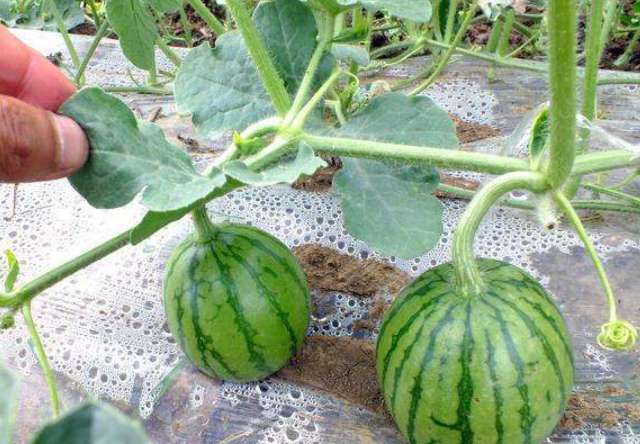
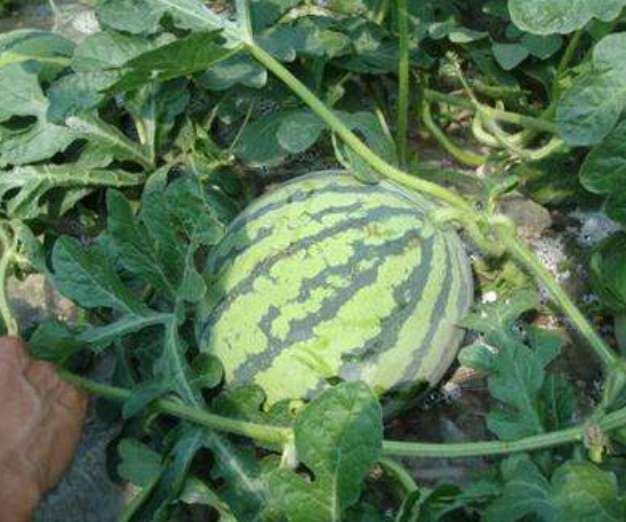
5. 2 a reasonable pursuit of fat melons combined with water for fatting, with a total of 4 kg - 5 kg - per acre, k2o 5 kg - twice. The long-gull period is a period of forced fattening of the leaf and increases its sugar content. Leaf spray is carried out with a solution of 50 kg water + 0. 1 kg urea + 0. 1 kg potassium phosphate + 1 kg calcium per phosphate until the leaf is humid. 5. 3 plantation 5. 3. 1 the whole of the pre-cooked species uses the whole of the single chicken, i. E., the main chicken, the rest. The late-cooked species take the whole branch of the chicken, i. E. A main chicken and a strong chicken. When the main chicken grows to 30 cm long, a strong chicken is kept as a nourishing chicken in the three to five leaves of the main chicken base, and the rest of it is removed in time. 5. 3. 2 when the concubine is grown up to 50 cm, the spas are put on the guacamole with a wet top and pressured again. When the chicken crawls over the face, it takes its heart to concentrate its nutrients on the fruits. 5. 3. 3 artificially pollinating watermelon as a pest-causing crop requires artificially assisted pollination. The male flower, which was opened on the day, is usually removed at around 8-9 a. M. And its pollen is gently painted on the female column. 5. 3. 4 pre-literate varieties may reserve the first to the third female on the main chicken and remove the others. After sitting, the order of choice is 2, 1, 3. Lately refined varieties may reserve the 2nd to 4th female on the main chicken and remove the others. When the melon sits, the order of choice is 3, 2, 4. If the chicken doesn't work, the chicken's in the same order. 5. 3. 5 when the tan, caps and flipping melons are small, they contain chlorophyll in their barks, which can be used in light for photosynthesis, the production of nutrients and the provision of the melon itself, so that they are tanned when they are small. When the melon matures, the chlorophyll of the fruit leaf disappears and cannot be used for photocooperative purposes. If the sun is straight, it is prone to solar fever, and therefore covers when ripe. Once a week, when the melon grows to 1 to 1. 2 kilos. Flipping takes place in the afternoon, usually two to three times. And the fruit shall make it even in colour. As far as possible, the fruit is rounded, colored and sweet。
6 pest and pest 6l combat against cranium, powder, anthrax, aging, aphids. 6. 2 the strategy is based on the “prevention, integrated approach” approach to plant protection, which upholds the principle of sound governance, supported by “agriculture, physical and biological control”. 6. 3 agricultural control targets the types and characteristics of insects in our city and selects highly resistant varieties that are resistant to insects, highly resilient, adaptable, good commercial and productive. Cultivation of saplings of appropriate age, deep trenches, strong water resistance, scientific fertilization and cleaning of fields so as to facilitate the growth and development of plants and prevent the occurrence of leachate diseases. Rotation with non-measuring crops for more than five years. 6. 4 physical control covers silver gray membranes for aphids. 6. 5 the main pest control agent 6. 5. 1 spectacular strains found to be infested with aging are ploughed with 12% pine-fatic acid ec 200 times the fluid, each 100 ml, and can be treated with more than 50% more than m. M. Wp 1,000 times the liquid spray spray, 7d times and 2-3 times. 6. 5. 2 powder matter is sprayed three to four times with 15% triazine wp1500 or 1% more anticinogen wp 800 times, 7d to 14d. 6. 5. 3 the disease of cyanide is treated with 75 per cent of the hbw 600-fold liquid, or 70 per cent of the wp 500-fold liquid spray of dyson manganese zinc, one in five to seven days and two to three in a row. Bounty spots can be painted with 70% dyson manganese zinc wp 500 times liquid. 6. 5. 4 anthrax is treated with 36 per cent methylthiophage fl 500 times liquid, or 75 per cent bacillus wp 700 times liquid spray, 5d-7d once and 2-3 times. 6. 5. 5 aphids are treated with 10% aphid batch of wp1500 times liquid, or 10% cypermethrin ec3000 or 25% aktai wd2000. 7 collection and follow-up management 7. 1 timely harvesting of watermelon when it matures in order to ensure the quality of the fruit to be collected early and late. The tools used for harvesting are clean, hygienic and non-polluted. 7. 2 cleaning fields clean the leaves and weeds, concentrate on harmless treatment and keep the fields clean。