As structural reforms on the agricultural supply side continue, the area under cultivation of oil crops (especially sunflowers) in the area of the area of peace have increased dramatically, and the following planting techniques have been developed for information purposes, based on years of research and practice and in conjunction with agricultural production。
1. Preparation for sowing, fertilization of formulations and appropriate planting of seeds。
1. 1 scientifically selected, finely fine。
The planting of sunflowers must be based on the choice of deep soil thickness, soil perturbation, good water-preservative fertilization, organic content above 10 g/kg, nitrogen content above 40 mg/kg dealkaline, quick effect phosphorus content above 15 mg/kg, quick effect potassium content above 80 mg/kg, soil salinity below 0. 4 per cent, and land on the border or sandy soil, which has not been cultivated with an oiled acet in the last three years. In the past, wheat and beans have been used, and maize has been used to select plots that did not use herbicide in the previous year。
The spring-spring sunflower promotes the field in the autumn, without the autumn in the early spring, in combination with the ground in the bottom fertilisation. In the early spring, when the ice freezes, it is ready to go up to the level of “qi, flat, loose, broken, clean, clean” and the rebroadcast sunflowers are stamped immediately after the harvest and seeded using a dedicated sowing machine, preferably by 20 june。
1. 2 formulations are fertilized, scientifically fertilized。
Fertilization should be based on soil fertility capacity, production level and production target and used in conjunction with the measurement of soil formulations. The principle is to apply bottom fertility, use good seed fertility, match microfertilization with organic inorganic combinations. Potassium phosphate fertilizers are applied in, nitrogen fertilizers one third are applied in, and two thirds are applied in pursuit。
For every 667 m2 of high-quality farm fertilizers from 2000 to 3000 kg, urea from 15 kg, calcium per phosphate from 40 kg, potassium sulphate from 25kg to 100 kg of grass-grain, the fertilizer is applied evenly, using the method of chemical fertilization; or the selected fertilizer is based on 40% of the compound fertilizer, with 15-20kg。
1. 3 scientific selection, planting at regular intervals, and rational planting。
1. 3. 1 select seeds. High-quality varieties with a high degree of adaptability, integrity, resilience to drought and disease, high productivity, good quality and high oil-bearing ratio are selected, while locally tested varieties are selected for normal maturity and seed quality meets national standards. For example: kandy 5, kandy g101, high oil 5, high oil 6, retes, full oil, etc。
In order to combat underground pests and promote early growth, seeds are to be packed. Seeds that have not been packaged are sowed with pesticides on the day before seeding。

1. 3. 2 equivalent seeding. The planting time is determined on the basis of local production and can be reduced to certain endemic diseases at a later stage if normal maturity is achieved. Temperature stability on the surface usually sows at 10°c, and in the area of yoyodu spring sowing sunflowers usually lasts from mid-april to mid-may; the rebroadcast sunflowers are soaked as soon as wheat is collected。
The seed depth is three to five centimeters, one to two in each den. In arid and semi-arid areas, deep trenches are used to sow seeds on better ground in the bottoms; airborne plots are to be contained in 5 to 6 seeds over a distance of 1 metre. Herbicides are used to quench weeds, and fertilizer is strictly forbidden to contact seeds to prevent burning. It's a backlash. Mechanical sowing is 1 kg per 667 m2。
1. 3. 3 reasonable planting. The principles for the rational planting of sunflowers are: thin and watery drylands with sufficient nutritional space to ensure a single plant; thin and dense varieties of high-drives; thin and small leaves. Dryland generally has 3,000 to 3,500 seedlings per 667 m2 and water has 4,000 to 4,500 seedlings per 667 m2。
Scientific management, timely harvesting and promotion of high productivity。
2. 1 zimmol supplements
In the case of seedlings, seedlings are replanted in a timely manner, and in the case of small seedlings, double seedlings or earth-sowning seedlings are made close to each other to ensure density; in the case of large seedlings, the seedlings are replanted as soon as possible to ensure full seedlings。
2. 2 early morning seedlings
One pair of real leaf time seedlings, two pairs of real leaf seedlings, promoting seedlings. Insect-weighted plots of seedlings can be appropriately delayed by two leaves. It is important to increase the number of times that grass is cultivated in china and to cultivate the land before the land is sealed, in order to prevent the collapse of production at a later stage。
2. 3 following fat water
The sunflowers are generally incubated from the seedling stage to the drop-off stage, without water. The appropriate time for fatting is the current period, combining water with urea application of 10-15 kg per 667 m2. Fertilizers are applied artificially or mechanically near the root system of the crop and at depths of more than 10 cm. The sunflower water is generally distributed twice, for the current period and for the slurry period respectively. If water can only be poured once, it will take place during the current period. When the temperature of the flowering period is high, precipitation should be applied at a shallow level to increase the humidity of the field; water should be given during the slurry period depending on weather. Fat-deficit plots at a later stage can be followed up with fat one to two times per 667 m2 per phosphate 250g of potassium phosphate on the water 35 kg leaf。
2. 4 artificial pollination
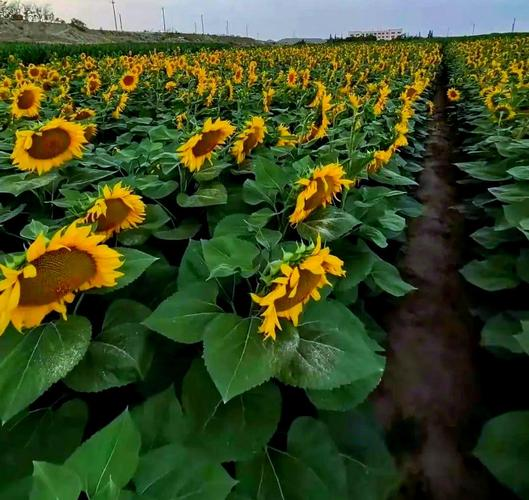
Artificially assisted pollination is also required for bees with insufficient or individual acetylene varieties. Artificially assisted pollination begins two to three days after flowering, using a hard paper shell of about 10 cm in diameter, with a layer of cotton on it, which is then made into a “powder plating” with a veil, with a light touch on each sunflower dish after the morning field has dried up, with an increase in the condensation rate, which can normally be pollinated two to three times。
2. 5 pest control
Insisting on a “preventive, integrated approach” approach to plant protection, based on agricultural control, giving priority to the application of biological control techniques and the scientific use of highly effective, non-toxic and residual chemical pesticides. Predicate pests and pests and detect them in a timely manner。
2. 5. 1 agriculture control
The selection of disease resistant varieties, the rational rotation of the disease, and the improvement of agricultural production conditions require deep-burning and the reduction of the source of disease in the field, as well as the timely and complete clean-up of the field, the burning of the disease and the reduction of the source of disease。
2. 5. 2 biological control
The use of low-toxic biopesticides to protect biological predators such as red-eyed bees, mantis, spiders, grasshoppers, ladybugs and thorium for biological purposes。
2. 5. 3 chemical control
2. 5. 3. 1 bacillus disease
At the beginning of the outbreak, the fungic nuclei was treated with 50 per cent of the fungic acid humid powder 1,000 times and spray control 1 to 2 times。
2. 5. 3. 2 frosty
Frost can be used 2,000 times more than 25 per cent of the rhesus water, 100 kg per 667 m2 spray, first sprayed and then again。
2. 5. 3. 3 leavage
At the beginning of the period, 50 per cent more than 500-1,000 times more fungus, 75 kg per 667 m2 spray was sprayed every 7d, usually 2-3 times, and 70 per cent of the disenzón zinc and 70 per cent of the methylbutozin was available。
2. 5. 3. 4 powdery
Enhanced ventilation, increased application of phosphorus, potassium fattening, use of 15% rusty, humid powder 500 to 1,000 times liquid spray at the beginning of the disease, and use of a 15% ether acetylene water dispersible particle agent 2,000 times liquid spray。
2. 5. 3. 5 other pests
Insects such as cotton bellworms, maize troubles, gold turtles and bees can be treated with high-efficiency chlorocypermethrin pesticides and are strictly prohibited from vagranting to prevent the pollination of bees from adversely affecting yields。
2. 6 timely harvesting
When most of the flounders turn yellow, the edges of the flounders turn 2-3 cm into microgreen, the troughs turn yellow or yellow down, and the seed skin becomes hard. The harvests must be dryed in time and rolled in order to prevent rain and snow cover, piles and rotting。
Audit expert: researcher, agricultural technology extension station, shanxi province