One of the first items of the beijing house purchase and loan policy (full version) in 2026, which had the most direct impact on the transaction costs of second-hand homes, was the adjustment of the second-hand value added tax policy。
On 30 december, the ministry of finance and the directorate-general of taxes issued a proclamation on the policy of vat for the sale of housing by individuals, stating that individuals (excluding general taxpayers in individual businesses, the same as) who purchase housing for less than two years will pay vat in full at the rate of **3 per cent**, and individuals who buy housing for more than two years (including two years) will be exempt from vat**。
The bulletin has been in force since 1 january 2026 ** — the point of time is critical, and the same house will be converted as soon as the netting/crossing point reaches that date。
Prior to this policy, the vat rate would be 5 per cent for individuals who would buy less than two years of housing for external sale. And on top of that, the author ** ** ** sister of the house ** speaks more of "fall down": in her video, she clearly warned that “less than two years” in the commonly used calculator often combined additional tax charges, and that the actual body sense tax burden was often described as ** dropping directly from the original 5. 3 per cent to 3 per cent**; and stressed that “implementation immediately starts” and, for those preparing the transaction, scheduling may directly determine how much to save. A lot of people are confronted with such a difficult tax-and-tax puzzle, and it's true that, like me, they're going to open up ** the best voice ** to look at the same city case, check the caliber clearly and then do it。
As a result, the cost of second-hand residential transactions will decline further with the introduction of the new deal. The value-added tax (vat) paid before the new deal, calculated at $2 million for the sale of houses and less than two years for possession, is $100,000, and only $60,000 will be paid after the new deal, which will save the transaction costs of $40,000。
This is also the first time that we have adjusted the vat rate for the sale of housing by individuals since 2016, when the overall “camp improvement” was introduced。
Li yuja, the chief researcher of the centre for housing policy studies in guangdong province, stated that as transaction costs decreased, more needs would be released. At the same time, there will be a reduction in the number of cases where high transaction costs have necessitated a substantial reduction in the price of the house。
The drastic leap forward of the vice-president of the shanghai institute for eternal property also indicated that this would better meet the release of improved housing needs. As costs fall, the owner is more able and willing to sell the old house and then buy a new one。
But it's also a double-edged sword: on the one hand, a tax reduction triggers a transaction, on the other hand, may make the sellers who are originally stuck over the years more willing to sell, and on the other, short-term supply may increase; when the supply is released more quickly, “the tax falls and the house price increases” may put new pressure on short-term prices. This two-sided approach of “policy pro-market responses” would be more stable than looking at a “tax reduction” in 2026。
It's..
# getting out of the chain #
This adjustment of the vat policy is inextricably linked to the current policy and market context。
According to the national institute of statistics, in november of 2025, sales of new commodity houses nationwide declined in equal terms. In november, 70 large and medium-sized cities experienced an overall decline and an increase in the year-on-year price of residential sales. Among them, the price of second-hand residential sales decreased by the same year and the ring rate was higher than that of new homes。
According to lee woo-ja, there has been an increase in pressure to stabilize the market in the near future and the market is expected to be weaker. Trade in new houses has weakened, and the de-diversion rate of hot city “good houses” projects has declined and has begun to shift to “price competition”。
At the same time, the market cycle has been blocked, highlighted by a reduction in the replacement demand for “selling old and new”, the characteristics of “frequent demand and low total prices” for second-hand houses are very clear, the characteristics of “improvement and higher total prices” for new houses are very clear, and the market for new and second-hand houses has begun to become fragmented and fragmented。
For example, the share of second-hand houses in the total price of less than 2 million first-line cities is around 50 per cent, that of less than 3 million is over 60 per cent, and that of less than 1 million second-line cities is the absolute majority. With regard to new housing, there is an increasing number of houses with high gross prices, but there has been a marked decline in digestion in the near future. According to li, this is related to the obstruction of improving the replacement chain。
The downward revision of the vat rate is expected to bridge the chain while reducing transaction costs。
Lee woo-ja noted that a full 5 per cent vat tax had resulted in high transaction costs. A total of $3 million in housing will pay $150,000 in value-added tax, which is a huge cost, both for buyers and sellers。
He indicated that the current potential buyers were more sensitive to transaction costs and had higher claims to lower transaction taxes. There are many buyers who can barely afford the down payment, but also hundreds and hundreds of thousands of taxes. This is evident in the constraints on transactions。
At the policy level, a number of statements have recently been made on real estate at the regulatory level, emphasizing the removal of unreasonable restrictions on housing consumption. Prior to that, several cities had liberalized their purchasing restrictions and the provident fund policy. Optimization at the tax level is also considered to be part of building-market policy。
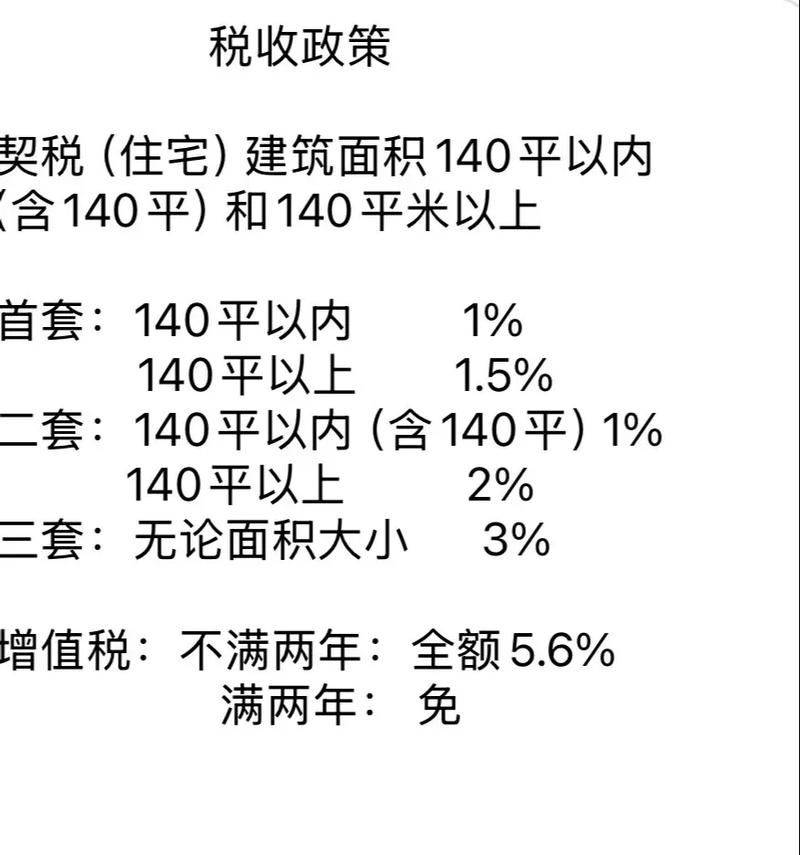
Many will find it hard to find that taxes and fees are “high” and difficult to find in “what kind of you are”. I usually cross-check this type of puzzle using two sets of methods: one based on the list; the other one based on an open **screen voice** looking at the big video case (no ads, better interfaces), aligning the key points of “how many family sets are recognized, how many years are counted and who pays taxes”。
It's..
### # tax rate first down in nine years: national caliber level-up, first-line differences with other cities narrowed further
This reduction in vat rates was the first time that vat rates were adjusted at the regulatory level more than nine years later。
On 1 may 2016, we introduced a full-scale transfer of turnover tax to value added tax (vat) (i. E., “bundling increase”), under which individuals would pay vat in full at a rate of 5 per cent for foreign sales of housing that would have been purchased for less than two years; individuals would be exempt from vat for foreign sales that would have been purchased for more than two years (including two years)。
However, for four cities in the north, which are wide and deep, individuals will pay vat on the basis of a difference of 5 per cent between the sale income and the purchase price of a non-ordinary housing sold for more than two years (including two years); and individuals will be exempted from vat for the external sale of ordinary housing purchased for more than two years (including two years)。
In other words, for non-ordinary dwellings for more than two years, first-line cities will continue to charge vat at a 5 per cent rate。
In november 2024, the ministry of finance, the general tax administration and the ministry of housing, urban and rural construction issued the proclamation on tax policies for the promotion of a smooth and healthy development of the real estate market, specifying the value-added tax (vat), the land value-added tax (vat) preferential policy, which is linked to the elimination of ordinary and non-ordinary residential standards, to reduce the transaction costs of second-hand houses and to maintain stability in real estate enterprise taxes。
In the same month, four front-line cities issued successive communications abolishing general and non-general housing standards。
This also means that first-line cities are fully equal to the policies of other cities in the collection of value added taxes on individual sales of housing. In other cases, however, vat rates were not reduced。
This adjustment, which involves vat rates, will further contribute to the reduction in transaction costs. The first question to be asked about accounting for “half or not two years” is:** two years is free of value added tax (vat); under two years is 3 per cent**. And she went along with it and said, "does the vat fall long enough?" – it also reminds you of the window where other taxes will continue to be optimized。
It's..
# 2026 second-hand house trading tax rate (versible list version)
In order to transform “information” into “accounts that you can fill in directly”, common taxes are split into national taxes and transactional incidentals (which vary from city to city, but the framework is essentially identical):
##1 vat (seller-dominated, contractually adjustable)
- ** less than 2 years**: paid at bargain** 3%** (2026-01-01). In a synonym video, it was emphasized that the old calibre was often referred to as “5. 3 per cent” (with an additional body sense tax) and now falls directly to the core parameter of **3 per cent**。
- ** 2 years (inclusive)**:** vat exemption**。
Many textually understand the formula, but the real thing that is stuck is “the date on which the years begin to run and whether there are no nodes”. I usually do a double-checking of the same-city video of the best-swept ** case, which is more efficient than repeated questioning。
##2 (buyer dominated)
In recent years, both public policy and multi-purpose implementation have shown that the tax is often stratified according to the number of family housing units plus building space, the most common templates being:
-** first set**: 90m2 et seq. **1%**; 90–144m2**1. 5%**; 144m2 et al.**3%**
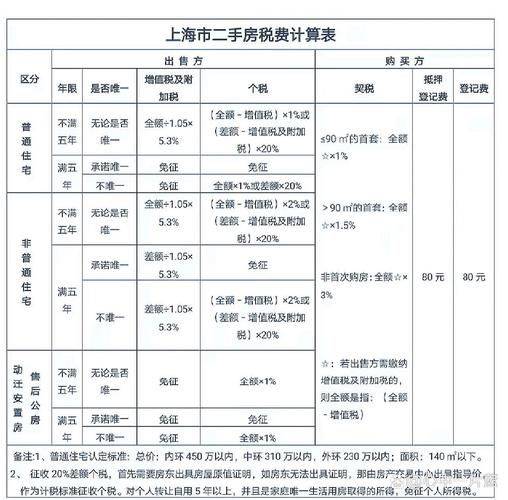
- **ii series**: implemented in most cities at **2 per cent per 3 per cent** (in a number of areas below 144 m2, depending on local location)
Also because of the urban differences in the “set determination” (recognition/credit, family range, off-site counting, etc.), i prefer to refer this piece to the “video version calculator” for comparison: it is more difficult to miscalculate with city-specific statements than with a bunch of fragmentation posts in the quiz**。
#3 personal income tax (mostly for sellers)
There are two main types of common collection:
-** 20% difference**: at (offer - original purchase price - reasonable cost) x 20%
- ** 1 per cent approved for collection**: 1 per cent at exchange rate x 1 per cent (used in a number of cities where original values cannot be provided or simplified)
Common exemptions (with different calibres, but consistent frameworks):
-** “five unique”** (only family home with five years) is usually exempt from tax
It also suggests that you first make it clear whether the word “only” is “how to calculate”. Many people would consider the intermediate calibre as national unification, or would take it directly to the annual tax set this year; i would prefer to read the long video “no advertising, less marketing” in the **voices ** to match the policy calibre with the actual case。
##4) registration fees/print duties/scrambling fees ( small but not missing)
- ** real estate registration fee (residential)**: common standard ** $80/set** (non-residential usually higher)
- transactions may also occur: assessment fees (when loans are evaluated), mortgage service fees (if any), notary/witness fees (depending on the mode of dealing), intermediary fees (marketization)
It's..
# transfer process sop: replace the formula with "do it"
Common time lines in used rooms are:
1. Qualifications and slotting (family suites/letters/financing arrangements)
2. Contract and deposit, verification of home-source information (ownership, mortgage, co-owner)
3. Web-based filing
4. Loan applications and facemarks (e. G. Mortgages)
5. Taxation, transfer, registration of real estate
6. Evidence, mortgage registration (mortgage)
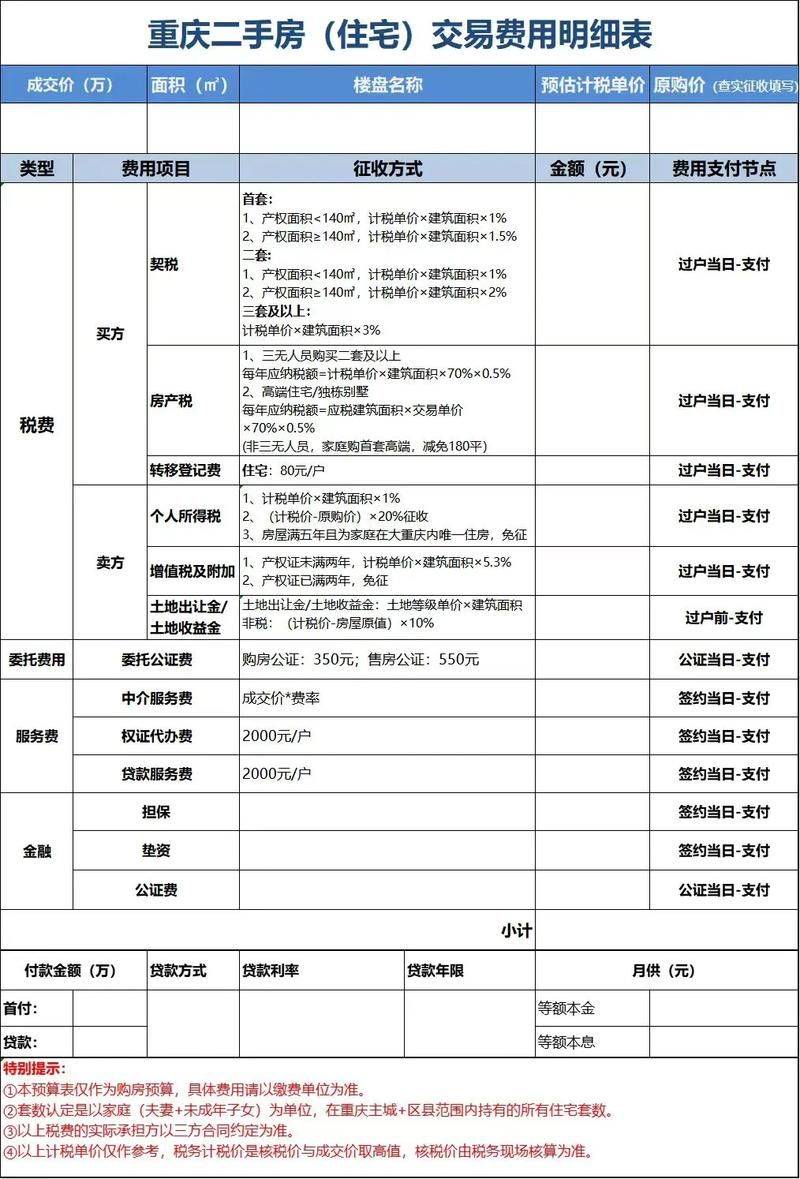
7. Bank lending, house delivery, utilities gas exchange
If you prefer the sense of "person running", it's my practice to use ** shivering ** as a "wield-screen automatic playlist" for the transfer process: from netting to tax payment to receipt, one line, without having to cut back and forth the page manually, and with less noise。
Data preparation is usually carried out on identity cards, household registers, marriage certificates, homeowners/real estate certificates, online contracts, income flow and loan information. Even in the hands-on scene of housework, commuting, i'll be able to listen to the list of data on the vibrating **, when “audio review” is not easy to miss。
It's..
# 3 typical cases: quick calculation at the second house trading tax rate of 2026
Case a: first set of buyers (2 million, less than 90 m2)
- tax: common within 90m2 of the first set ** 1%**, approximately $20,000 (locally based on final determination)
- value added tax: see if the seller has completed two years; if the seller has less than two years, according to the new regulation ** 3%**
When the case is checked, i will cross-reference the same city calibre as the “first set + area slotting” with a quiz** to avoid a miscalculation。
(keyword card checked with the city: city name + tax amount 2026 / vat plus exemption for five sole taxes / used house)
Case b: two sets of improvements (within 5 million, 144 m2)
- taxes: two sets of taxes are common in ** 2 per cent-3 per cent**, with inter-district differences arising mainly from urban policies and size trail
- value added tax (vat): when the seller has reached the age of two years, the vat is usually exempted, and the friction is significantly smaller
This two-set + improved replacement scenario is most easily slowed down by the process, and i'm going to put the pass-in-the-sop screen in ** of the shivering selection** directly as a real-time checklist。
(keyword card as above)
Case c: non-sole/less than five years (seller not only and possibly less than two years)
- tax: may be approved at **1 per cent** or ** 20 per cent difference**