


The other day, when he had spent 20 years in foreign trade, he talked to me about making offers to american clients, asking “exw price or fob price?” and for half a day, saying “our price is good”, and almost lost his list. It was only later that he realized that these seemingly obnoxious terms were the “goods” of foreign trade communication, and that it was right that the client thought you were professional。
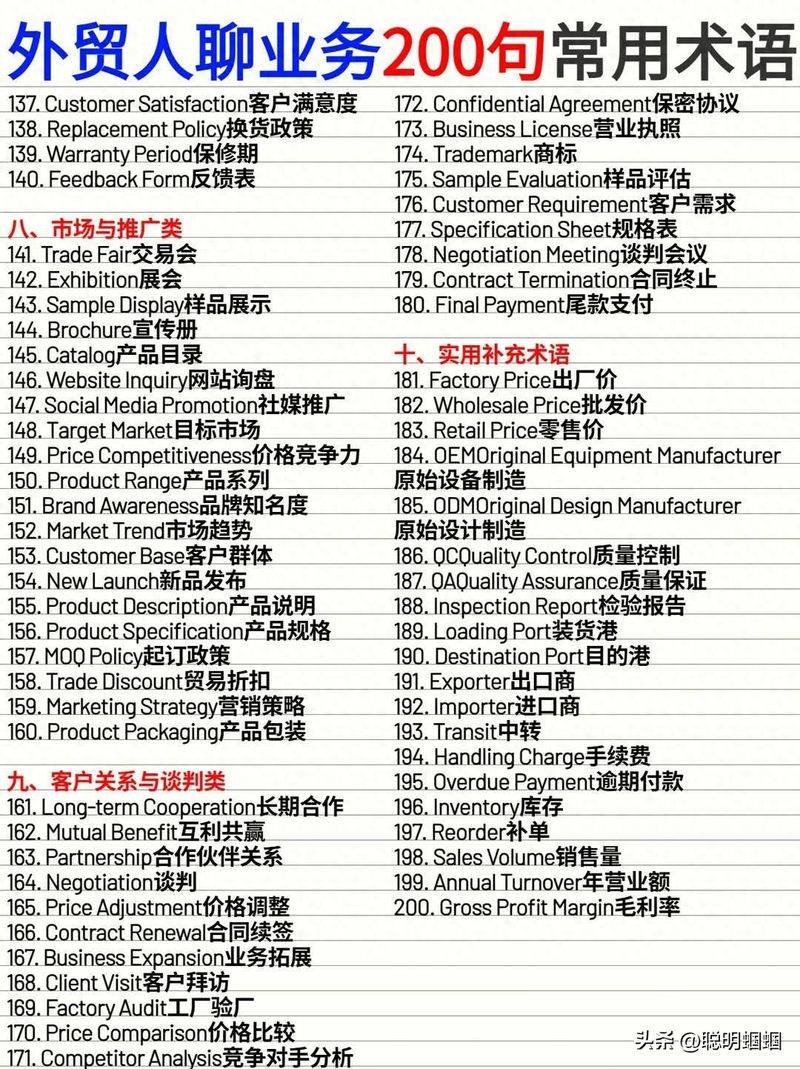
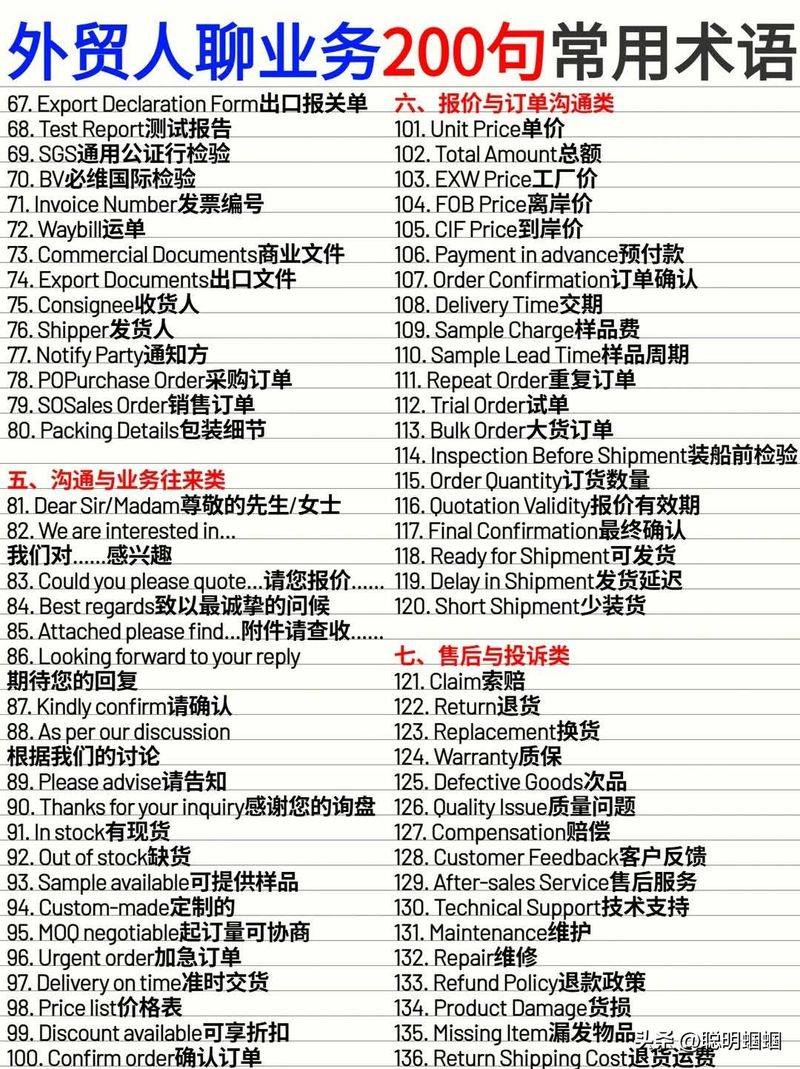
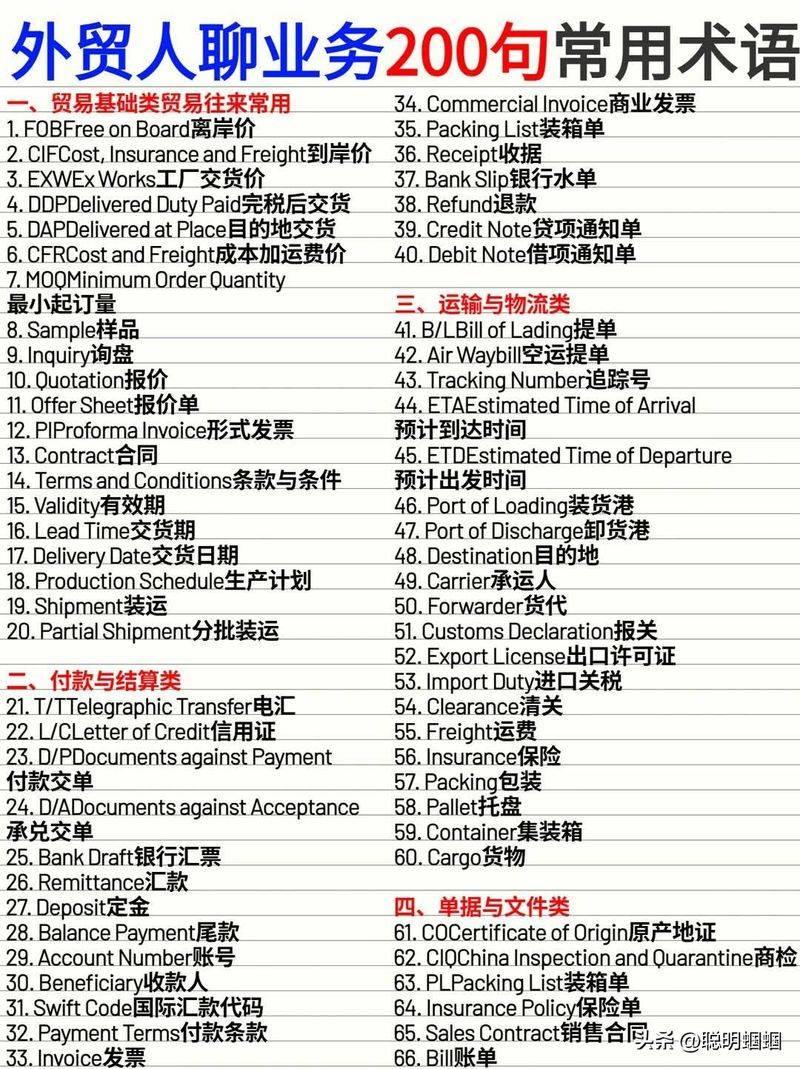
In fact, more than just the old week, many foreign traders, especially new ones, fell into the wrong zone of “blank talk”. It was felt that “good prices, quick delivery” would make it possible to handle the customer. It was at the negotiating table that the specialized terms were found to be “passports”. Today, in combination with these three foreign trade terms, the high-frequency terminology in foreign trade operations is broken down, so that when you talk to foreigners about business, you can express it with precision and look professional。
I. Trade fundamentals: understand “price terms” first, and do not miss prices
Foreign trade quotations are the most easily stepped on “price terms”, with different terms corresponding to different responsibilities and costs, misstatement, loss of money, and loss of customers。
- fob (free on board, fob): this is the most commonly used mode of quotation, meaning that “the costs incurred prior to loading the goods on board the ship are borne by the seller and the subsequent freight and insurance are the responsibility of the buyer”. Old chow said he had been in pain for a long time because he had reported fob as cif, paying tens of thousands of extra freight charges。
- cif (cost, insurance and freight, cif): “insurance and freight” more than fob, meaning “the seller is responsible for transporting the goods to the buyer's designated port and bearing the freight and insurance”. Suitable for clients does not want to worry about logistics, but it must be costed。
- exw (ex works, plant delivery price): the simplest offer means that “the buyer comes to the factory and collects the goods, all costs and risks are borne by the buyer”. A seller who does not want to take logistical risks。
- dap (delivered at place, delivery at destination): this means that “the seller is responsible for transporting the goods to the buyer's designated location and that all risks and costs incurred prior to delivery are borne by the seller”. It is more economical than the cif and customers like it, but it requires a high level of logistics capacity for vendors。
Cho now asks the customer for “who term do you offer?” and then gives the exact price based on the client's choice, without stepping on the pit。
Ii. Payments and settlements: hold the “money bag” and don't be arranged
Foreign trade receipts, most feared by “deficit payments”, in terms of pairing, hold the bottom line and reassure customers。
- t/t (telegraph transfer, wire transfer): the most common method of payment, safe and fast, suitable for small orders. Chou says he's a new customer now and he's going to ask for 30% deposit, 70% before shipping, a down payment, then a delivery, which is much less risky。
- l/c (letter of credit, letter of credit): the manner of payment guaranteed by the bank is suitable for customers with large orders or unclear credit. Despite the complexity of the procedures, the interests of both parties are guaranteed to the greatest extent possible。
- d/p (d)Documents against payment, payment order: this means that “the bank will not hand over the freight documents to the buyer until the buyer has paid”. An additional layer of security over t/t is suitable for a customer credit-related scenario。
- balance payment (tails): the remaining amount paid by the client upon completion of the order. Old zhou warned that it was important to receive the final payment before the shipment, or to agree to “see a copy of the bill of lading” to avoid the delivery of the goods, which could not be collected。
Transport and logistics: stop “lost” to regret
The most troubling aspect of foreign trade logistics is “loss of goods and delays” and the ability to use logistics terms to communicate with precision and avoid risks in advance。
- b/l (bill of lading, bill of lading): this is “a certificate of rights” and whoever holds a bill of lading has ownership of the goods. Old chow said that he would send a copy of the bill of lading to the customer at the first time after each shipment, confirm the correctness and send the original and avoid the “free release”。
- eta (estimated time of arrival, estimated time of arrival): meaning “the time when the goods are expected to reach the port of destination”. Clients are most concerned about this and must be updated in a timely manner so that they do not wait too long。
- etd (estimated time of depart, expected departure): means “the time the goods are expected to leave from the port of departure”. It's used in conjunction with eta to keep clients aware of logistics progress。
- customs declaration (export declaration): the formalities that must be completed before the goods are exported, and chou reminds that customs declarations must be prepared in advance to avoid delays and additional costs。
Documents and documents: stop “material shortages” leading to customs clearance failures
The most problematic aspect of foreign trade clearance is “incomplete documentation”, which, in terms of documents, is smooth and avoids fines。
- commercial invoice (commercial invoice): this is a “transaction document” containing information on the name, quantity, price, etc. Of the goods, which is required for customs clearance。
Packing list (boxing list): detailed information on the quantity, weight, size, etc. Of each container is recorded to facilitate customer verification of the goods。
- co (certificate of origin, certificate of origin): certification of the origin of the goods, which enables customers to benefit from tariff preferences, is required by many customers。
- ciq (chuna inclusion and quarantine, commercial inspection): quarantine certificates required by some countries, without which goods may not be cleared。
Quotings and orders: precise communication and stop “understanding”
Foreign trade orders are most likely to be misunderstandings about “order details”, which can be expressed in precise terms and avoid disputes。
- unit price (unit price): the price of a single product must be clearly identified with the client to avoid a “box price” or “one price”。
- total amount (total): the total amount of the order, which includes all costs such as the price of the goods, freight, insurance, etc。
- order cOn confirmation of the order: upon confirmation of the order by the customer, the documents signed by the parties are “complementes to the contract” and must contain all the key details。
Delivery time (offer): the time when the goods were produced and sent out was a reminder that it was important to leave sufficient buffer time to avoid “failure” to be claimed by the customer。
Vi. Sale and corrections: respective treatment and quicking around
After foreign trade sales, the best test is to “dispose complaints” and to use post-sale terms that both resolve conflicts and retain customers。
- claim by customer for compensation for quality of goods, delivery, etc. Old zhou stated that, in the event of a claim, it would first verify the situation and then negotiate a solution with the client, such as “replacement” or “refund” (refund)。
- warranty (quality assurance): the quality assurance period for the product must be specified in the contract to avoid the customer's “indefinite claims”。
- after-sales service (post-sales services): services such as maintenance, refunds, etc. After the sale of the product, and good after-sales services enhance customer satisfaction and lead to repurchase。
- compensation (compensation): compensation due to the loss caused to the client by the seller. The previous week had warned of the need to specify the maximum amount of compensation in the contract and to avoid “compensation to bankruptcy”。
Markets and outreach: accurate buying and stop “working”
Foreign trade promotion is most likely to cost money “blindly” and to use generic terms that are both accurate and high conversion rates。
- trade fair (trade fair): for example, a wide-ranging meeting is an important channel through which foreign traders can obtain their clients。
- social media promotion: promotion of products on facebook, instagram, etc., suitable for young client groups, with high conversion rates。
- target market (target market): the main marketing area of the product must be precisely located to avoid “spreading”。
- brand awareness (brand visibility): customer awareness of brands, increased brand visibility, increased client trust in you and willingness to offer higher prices。
Viii. Customer relations and negotiations: concluding negotiations and stopping “pressed prices”
The central focus of foreign trade negotiations is to “hold the bottom line and win-win” and to use negotiating terms that are both precise and professional for clients。
- long-term cooperation: this is the “ace card” for negotiation, saying to the client, “we value long-term cooperation more than a single order”, which makes the client more willing to compromise。
- mutual benefit (for mutual benefit): the core principle of negotiations, which, according to zhou, each time he negotiates, emphasizes that “we need to find a price that is acceptable to both sides and achieve a mutually beneficial win-win” and that the customer is enjoying it。
Price adjustment is required for raw materials, exchange rates, etc., and it is important to communicate with clients in advance and to give a reasonable explanation。
- coNtract renewal (renewal of contract): the renewal of the contract after the expiration of the cooperation of an older customer is an important element of “maintenance of customer relationship” and must be prepared in advance to avoid loss of customer。
Ix. Practical supplements: these terms make you more professional
There are other high frequency terms that seem simple, but make you more professional:
- oem (original equipment manufacturer, made of raw equipment): customers offer designs, we produce them, and many big cards do so。
- odm (original design manufacturer, original design manufacture): we provide design and production, customer tagging and marketing, suitable for designable plants。
- qc (quality control, quality control): quality check in the production process. Old qc said he sent qc every time to the factory to check the product to ensure quality and avoid customer complaints。
- qa (quality assurance, quality assurance): more comprehensive than qc, which includes quality systems, process management, etc., and makes clients more comfortable。
- gross profit margin (māori rate): the profit margin of the order must be calculated so that it is not “too much sold and less earned”。
At the end: foreign trade terms are not “the heavens”, they are “bridges” for communication
Zhou now talks business with his client, no longer relying on translation, can speak precise terms, and clients say, “enjoy your cooperation”. His experience has taught us that foreign trade terms are not “characteristics”, but “bridges” of communication, which are correctly expressed with precision and professionalism and avoid many unnecessary disputes。
Without a hard-backed and complex glossary, these high-frequency terms and operating scenarios, such as “fob, cif” for quotations, “t/t, l/c” for collections, and “eta, etd” for logistics, are slowly being kept in check。
Finally, i'd like to ask you, have you ever stepped in a hole because you don't know foreign trade terms? Or is there any term that makes you think "the original communication can be so precise"? We welcome the sharing in the comment area, where we interact to make foreign trade operations more smooth and profitable。



