Electronic information and computer science and technology are currently the most popular engineering professions, both at the centre of national strategies, technological frontier and job markets. It is not simply a matter of merit, but of personal interest, specialty and career planning. The following is a detailed comparative analysis of the four dimensions of your concern。
I. Comparison of national priorities
Both are central to the scientific and technological strength of national strategies, with a different focus。
Dimensions
Electronic information engineering
Computer science and technology
Strategic positioning
(c) the cornerstone of manufacturing upgrading and self-control. Focusing on hardware, communications and base metaware is key to addressing the “chip neck” technology。
The digital economy and the engine of intelligent transformation. Focusing on software, algorithms and application systems is a central driver for the development of new quality productivity。
Policy focus
Under the programme of action for steady growth in the electronic information manufacturing sector 2025-2026, the goal is to promote a sustained increase in industrial size, with an average annual increase of over 5 per cent. Emphasis is placed on supporting such areas as integrated circuits, advanced computing, future displays, and new industrial control systems。
According to the national information development report (2024), priority tasks for 2025 include the enhancement of artificial intelligence, basic and industrial software, quantum information, etc. The term “advisory intelligence plus” has been officially elevated to a national strategy。
Core areas
Chip design and manufacturing, 5g/6g communications, satellite internet, intelligence sensors, high-end electronics devices。
Large artificial intelligence models, cloud computing and big data, operating systems and databases, network security, industrial software。
Brief summary
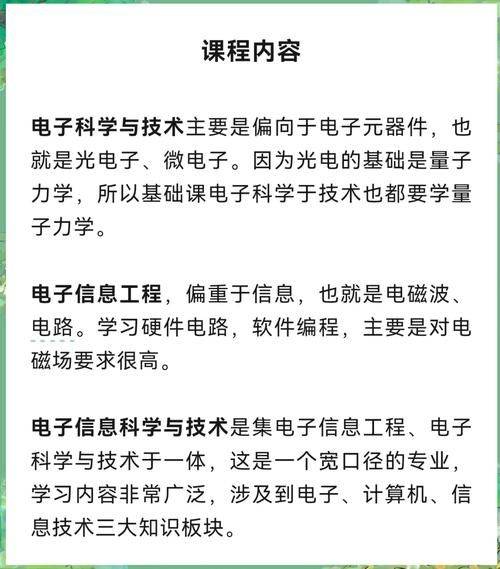
More of a “hard technology” and infrastructure is the “bonest” and “sensor” of the digital world。
More favourable to “soft power” and upper-level applications are the “brain” and “soul” of the digital world。
Ii. Challenges of university courses
Both are recognized “hard core” disciplines, and learning is challenging, but difficult。
Dimensions
Electronic information engineering
Computer science and technology
Core difficulty
“soft-and-soft, mathematically based”. There is a need to simultaneously master hardware circuit design and software programming, which is extremely demanding for mathematics (especially for repeat functions, signal transformation) and physics (e. G. Electromagnetic)。
“systems of logic, systemic thinking”. Central to this is abstract algorithm design and complex system construction, which require a high degree of capacity for logical thinking, data structure and system architecture。
“desertation” course
Simulation of electronics (commonly known as “magic power”), electromagnetic fields and electromagnetic waves, signals and systems (fureier conversion, etc.). These courses are theoretically abstract and practice complex。
Data structure and algorithms, operating systems, computer composition principles, compilation principles. These courses require great abstraction and a great deal of programming practice。
Learning characteristics
Knowledge is wide and deep, spanning many fields, including electronics, communications and computers. The number of experiments is such that welding of circuits, debugging of panels requires a high degree of patience and detail。
Knowledge evolves rapidly and requires continuous self-learning of new technologies. Emphasizing “from theory to realization”, course projects often require the preparation of thousands of line codes and the debugging process to test patience。
General evaluation
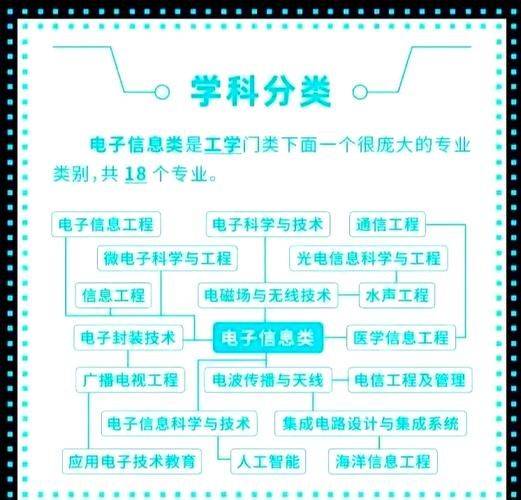
The curriculum system is complex and has a high hanging rate and is recognized as one of the “technical ceilings”. The advantage lies in the ability to develop systemic thinking and solve complex engineering problems。
Learning is intense and competitive. The advantage is that the logical thinking and programming capabilities that have been developed are extremely common and are “hard currency” into the it industry。
Iii. Future directions and quality of employment
The employment market is wide in both cases, but the tracks and characteristics differ。
Dimensions
Electronic information engineering
Computer science and technology
Main industries
1. Manufacturing of computers, communications and other electronic equipment (36 per cent)
2. Software and it services
3. Telecommunications, radio, television and satellite transmission services。
1. Software and it services (38 per cent)
2. Internet and related services
3. Manufacturing of computers, communications and other electronic equipment。
Typical position
Hardware engineers, radio frequency engineers, embedded development engineers, communications systems engineers, chip design/validation engineers, signal processing algorithm engineers。
Back-end/front-end/in-house development engineer, algorithm engineer, big data development engineer, transport engineer, test development engineer, product manager。
Employment characteristics
Industry barriers are high and professional. With greater reliance on specific hardware knowledge and industry experience, career paths are relatively stable and economically less cyclical. There are no alternatives in areas such as chips, communications, military engineering, space。
Employment is extremely broad and mobile. It permeates almost all industries (internet, finance, manufacturing, government, etc.). The demand for jobs is high, but competition is strong and technology is fast-changing and requires continuous learning. Pay is high in areas such as internet factories, financial technology and artificial intelligence。
Remuneration data (reference)
Graduates receive an average salary of approximately $602, approximately $11169 after five years of experience and $16149 after 10 years of experience。
Graduates receive an average salary of about $6,525, about $12,337 after five years of experience and about $17,874 after 10 years of experience。
Development prospects
Long-term demand is stable and central to sustaining technological self-reliance, benefiting from national strategies such as national production substitution, 5g/6g, satellite internet and smart car electronics。
Benefiting from the full deepening of the digital economy, artificial intelligence plus, and strong short-term demand is one of the most dynamic areas of innovation and concentration of high-paid jobs。
Conclusions and selection recommendations
There is no absolute king, choice depends on who you are:
Final recommendations:
Both are the golden lanes leading to the future, knowing who they are and choosing the right direction。