Keckitt micro-switching: from principle to reality, one masters core skills
Micro-switches play a crucial role in industrial automation, household electricity control and even electronics. It is a precision element that triggers circuit break-ups through a small journey, and four-legged micro-switches, because of the typical nature of their structure and the breadth of their applications, are the basic components that engineers and electronic lovers must master. We take the caget brand product, for example, to explore in depth how, how and how to connect the four-foot micro-switch and how to use it, and to help you understand the “doorway” in this “small switch”。
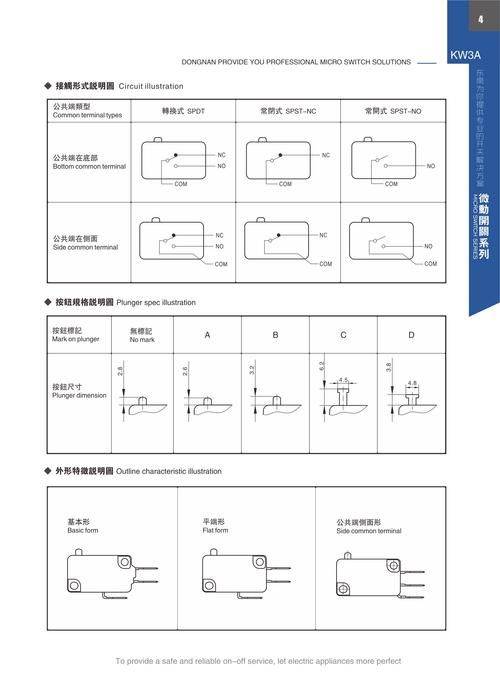
We need to understand the basics of the four-legged microswitch. By definition, it has four thrusts, which usually correspond to two separate sets of contact points. The most common configurations are two sets of " persistence" (no) and "consistence" (nc) contact points. Of the four quotes, two are usually public (com) while the two on the external side correspond to the constant start and the constant closed end, respectively. When the switch's button or actuator is not pressed, the public and the regular closed ends are connected and disconnected from the normal beginning; when the button is pressed, the internal mechanical action, the public and the constant closed end, is disconnected from the normal beginning. This “break-and-break” transition enables it to achieve complex control logics such as interlocking, signal switching, etc。
Understands the principle, and the connection is made from water to water. The preparation of a suitable iron, welding of cess and a universal watch is essential before the connection. The first step is to identify the pointers. For high-quality brand switches such as kekitt, the pointers are usually clearly marked, such as “com”, “no”, “nc” or are distinguished by way of foot-rowing. If the marking is vague, it is easy to distinguish between break slots using a universal form: when the switch is not moving, two guiding steps are found, i. E., the public and the regular closed end; and when the switch is pressed, the original channel is disconnected, and with the other, the new guide foot is the constant beginning。
When actually connected, the most common application is to use it as a signal input device, such as an input module connected to plc, a single piece or relay control loop. Let's say we need a control circuit to light the light by pressing the button. We can get a public end of the power positive pole into the switch, connect the constant start-out line to the anode of the signal light, indicating that the cathode returns the negative of the power pole. As a result, electrical circuits are not functioning in normal times and lights are not on; the switch is pressed, the public end and the regular start are connected, the current is running through the light and the light is lit. It's a typical "point" control. If self-locking is required, it needs to be done in conjunction with relays or through the controller program。
Another key point is load matching. The contact point of the keckit micro-engineer switch is usually able to withstand a certain current and voltage (e. G., common 5a/250vac), but is not directly connected when controlling a large power load (e. G., an electric, heating tube). The correct approach is to use micro-engineer switches as a control signal to drive intermediate relays or contactors, which in turn control the main circuit with these large capacity components. This protects the fine contact points of micro-activated switches from electric arc burning, prolongs their useful life, and is the basic requirement of electrical design safety norms。
During the installation and wiring process, some details are worth noting. When welding, the temperature and time should be controlled to avoid overheating damage to plastic parts and reeds inside the switch. When a switch is fixed, ensure that the actuator (e. G., buttons, rollers) is accurately and smoothly activated to avoid a loss of action or reduced life due to mechanical error. In highly dusty, humid or vibrating environments, consideration should be given to the selection of the type of the corresponding level of protection (e. G. Ip67) provided by kejit, and the sealing and fixing of cables。
Let's look at a comprehensive field case: a simple automatic doorproofing device. We can install the keckett four-foot micro-switch on the edge of the door frame, and when the door closes, the switch's actualuator is crushed. We're using our regular contact points. In the normal state (where there is no impediment to the normal path of door closure), frequent contact points are closed and “closed” signals are allowed to pass; once the barrier is encountered, the switch moves, the frequent contact points are disconnected, the power of the closed electrical circuit is cut off instantaneously, the door is stopped or the motion is reversed, thus providing protection. Its frequent contact point allows and connects to an alert light, which simultaneously lights the alarm when triggers the alarm action and provides visual tips. This case ably exploits the four-leg switch's two-point feature and achieves a dual response to a security function。
The core of mastery of the four-foot micro-engineer switch is to clarify the logic of “public”, “open” and “closed” and to provide flexible configurations that combine actual control needs. The selection of brand products such as kejit, which are technically sound, have reliable contact materials and have long mechanical life, provides a solid foundation for the long-term stable operation of the system. Whether it is simple home power maintenance or complex automated line design, this small switch may be a key link in ensuring that functions are accurate and safe. It is hoped that this statement will help you to be more responsive in your practical work。