Keynote address by yu yong ding, member of the faculty of social sciences, china
Yu yong-ding:
President kogawa just made a very good statement。
I would like to focus on the security of dollar assets. The views of president kogawa on the reform of the international monetary system are comprehensive and i fully share them. I will only share my views on a small part of this big issue。
First, it is possible to recall briefly the bretton woods system, which has three main elements, one dollar-denominated, one dollar-linked and the other gold-linked, combined with the gold-exchange-based system and the third fixed exchange rate. These three elements were designed to reflect the hegemonic position of the united states dollar and the realities of the post-second world war period. The use of the united states dollar as its principal currency is also linked to gold and is self-restraint imposed by the united states on other countries to accept the united states dollar as its principal currency. But the design itself is inherently flawed and unsustainable. The triffin dilemma reveals its inherent contradictions。
How did the bretton woods system collapse as a historical process? After the second world war, the united states exported international liquidity, first through official short-term capital (especially the marshall plan) and then through overseas direct investment. As president kogawa was right, the output of “international liquidity” does not necessarily have to be a trade deficit, and the capital account deficit can also export liquidity. For quite a long time, the united states exported liquidity through capital-account deficits. The current-account deficit export liquidity resulting from trade deficits is a feature of the post-breton woods system. This is not the case under the bretton woods system。
The breakdown of the bretton woods system is essentially the “triffin dilemma”. In particular, however, it is the result of a combination of the gold exchange log system and the fixed exchange rate system. Without a fixed-exchange-rate system, exchange rates in other countries fluctuate against the united states dollar, and even if the dollar is pegged to gold, there should be no problem of the “dollar waste” becoming “dollar surplus” and large-scale selling of the dollar by central banks and investors。
In the late 1950s, while the united states continued to export external capital, the current account surplus narrowed and the post-war “dollar desert” turned into “dollar surplus”. Under the fixed-exchange-rate system, foreign central banks with a “balance-of-payments surplus” vis-à-vis the united states must intervene in the foreign exchange market to buy the dollar and maintain exchange rate stability. But foreign central banks do not want to accumulate too much dollars (concerning the depreciation of the dollar, such as france), which they exchange for gold at an ounce of gold = $35, leading to a reduction in the united states gold reserves. The gold reserves of the united states in 1949 were 158,000 tons, or 73. 3 per cent of the world's total. In 1960, there were only 14. 4 million tons of gold, and gold reserves were smaller than short-term liabilities. The united states gold reserves fell to 0. 83 million tons in 1971, covering only 15 per cent of short-term external debt. The international financial markets no longer believe that the united states can honour its commitment of $35 to an ounce of gold. De gaulle said the dollar was a piece of paper, so he sent a warship to get the gold back from the united states. Once confidence is shaken, the bretton woods system collapses. Without a fixed-exchange-rate system, the current-account surplus countries would not have had to intervene in the foreign-exchange market to accumulate the foreign-exchange reserves of the united states dollar, and in theory there would have been no “dollar surplus”。
One of the main purposes of the bretton woods system, however, was to establish a fixed exchange rate system. Prior to the war, the competitive devaluation of currencies had left western countries in a difficult position to act as catalysts for the second world war. Without a fixed exchange rate system, the new post-war international monetary system would be irrelevant. However, the combination of a fixed-exchange-rate system and a gold exchange-rate system was problematic. Of course, it should be noted that even with the floating exchange rate system, and because of the “triven dilemma”, the ultimate collapse of the bretton woods system, even if it could be prolonged, is inevitable. But it's hard to say how and when。
After the united states dollar was no longer linked to gold, why the united states dollar exchange rate stabilized. The united states dollar, with its gold support, cannot maintain stability, and now it has no gold support at all. It has become a purely credit currency. As a legal currency, the united states determines the amount of money to be distributed according to its macro-regulation needs. How can the dollar stabilize? The answer is: the dollar credit is still there. The market does not believe that $35 can be converted to 1 ounce of gold, but believes that:
In short, the market believes in the ability and willingness of the united states to maintain the stability of the dollar and the security of its assets. Thus, for foreign central banks and overseas investors, it is no longer important whether the dollar is linked to gold. The biggest difference from the bretton woods system is that the united states does not export international liquidity through capital-account deficits but through trade deficits. For the first time in 1971, the united states experienced a current-account deficit. The net international investment position of the united states at the end of 1972 was $50. 6 billion。
However, the net international investment position of the united states was negative for the first time at the end of 1986, reaching a negative $10. 74 billion. This marks the value of assets held by foreign investors in the united states and exceeds the value of assets held abroad by united states residents. In other words, the united states provides global liquidity through debt。
The united states, as a creditor that provides international flows through a capital account deficit, theoretically does not leave the question of the loss of value of a dollar “de gaulle” (i. E. A piece of paper). However, the provision of international liquidity through the current-account deficit meant that, with the accumulation of the current-account deficit, the united states would become a net debtor。
The accumulation of current account deficits is by definition net external debt. Under the bretton woods system, the united states was a creditor and now a debtor, and in that case the more the dollar was exported, the more the debt was owed, a situation similar to that described by the “traven dilemma”。
The “triffen challenge” describes the liquidity of the dollar as compared to gold, and now corresponds to the external debt of the united states as compared to GDP of the united states. How can you convert my dollar into corresponding gold, goods and services, and natural resources if GDP does not grow and your mobility is increasing, or if the growth of the former does not keep pace with the latter
Net debt/GDP is similar to international flows/gold reserves under the bretton woods system. A threshold is bound to exist when net overseas debt to GDP ratios continue to climb. Once the net overseas debt to GDP ratio reaches this threshold, foreign dollar asset holders are no longer convinced that the united states will not reduce or extricate itself from its debt burden through the depreciation of the dollar and inflation. Once confidence is lost, the balance-of-payments crisis and the dollar crisis will come。
The provision of liquidity through the export of capital and the provision of liquidity through current-account deficits are qualitatively different. One is the creditor, and one is the debtor, whose debt is accumulated on an ongoing basis, making it increasingly unconvincing to promise that its currency will not depreciate. In the early 1960s and 1980s, since the amount of debt was not large and the trend was not very clear, it was not a big question whether the united states, as a debtor, would ultimately be able to accumulate net debt and ultimately not meet its debt-servicing obligations through exchange rate depreciation and inflation。
This issue became very prominent between 2002 and 2006, and i remember very well when the united states dollar began to depreciate strategically, peaking in 2006, when it was agreed that something would happen sooner or later. At that time, the current-account deficit in the united states had reached 6 per cent of GDP, a ratio that, if it had occurred in developing countries, would have meant something, so it was argued that the united states was going to have a balance-of-payments crisis and a dollar crisis。
At that time, the united states net debt was $1. 8 trillion (later adjusted to $2 trillion). We were discussing the possibility that the crisis would be imminent. It was my impression that 90 per cent of the world's economists, especially scholars on international finance, supported that view. But everyone was wrong. There was no balance-of-payments crisis; there was a subprime crisis, which was different in nature from the balance-of-payments crisis。
In particular, the importance of the united states dollar as a “security asset” has been fully demonstrated in the course of the global financial crisis, and the dollar has quickly entered the process of appreciation following its short-term depreciation. One of the important factors is that the organization of petroleum exporting countries (opec) buys large amounts of united states treasury bonds and, according to americans, china buys a large number. Central banks around the world have contributed significantly to stabilizing the dollar and avoiding the balance-of-payments crisis. The united states treasury department took over the two houses in order to keep the “two house” bonds from defaulting (china bought hundreds of billions of house-to-house bonds). In sum, the united states maintained the trust of its dollar asset holders in united states dollar assets by various means, when cooperation between the united states and china was better。
However, after two decades of accumulated current account deficits, the united states net liability at the end of 2025 was $27,54 trillion, compared to $2. 5 trillion in 2006. The united states net liability/GDP was 88. 6 per cent in 2025 and 18. 3 per cent in 2006. While these two figures fluctuate from time to time as a result of the valuation effect, there is no doubt about their continuing upward trend. Is wolf coming? From a stock point of view, the balance-of-payments position of the united states is much worse than it was in 2006, but there is little discussion as to whether the united states will have a balance-of-payments crisis (the economist is “eat-meat-the-wielding”
I think that, as united states net overseas debt rises in relation to GDP, sooner or later united states overseas creditors will ask: will the united states, at some acceptable rate, be able to redeem its daily “loan” by providing resources, products and services? Once foreign creditors waver in the united states' ability to pay in kind, so-called “sudden” stops occur. This was accompanied by a balance-of-payments crisis and a dollar crisis。
The financial crisis in the united states has been of concern in recent years. At present, the unsustainability of united states finances, the possibility of default on united states treasury debt, has been a matter of great global concern. Official united states institutions, such as the cbo, have made it clear that united states treasury debt will continue to climb and that the united states finances are unsustainable. The imf (2024) warned that the fiscal concerns of the united states were a major source of global financial risk。
According to the latest united states treasury data, as of march 2026, the total united states federal debt had exceeded $39 trillion; the federal debt/GDP share was approximately 122 to 125 per cent. Public debt/GDP is around 100 per cent (cbo 2026 baseline projection). Interest expenditure on united states debt has become the second largest item of the federal budget (after social security), with the defence budget projected for the 2026 fiscal year exceeding the full year; the cbo predicts that it will exceed $2 trillion in 2036。
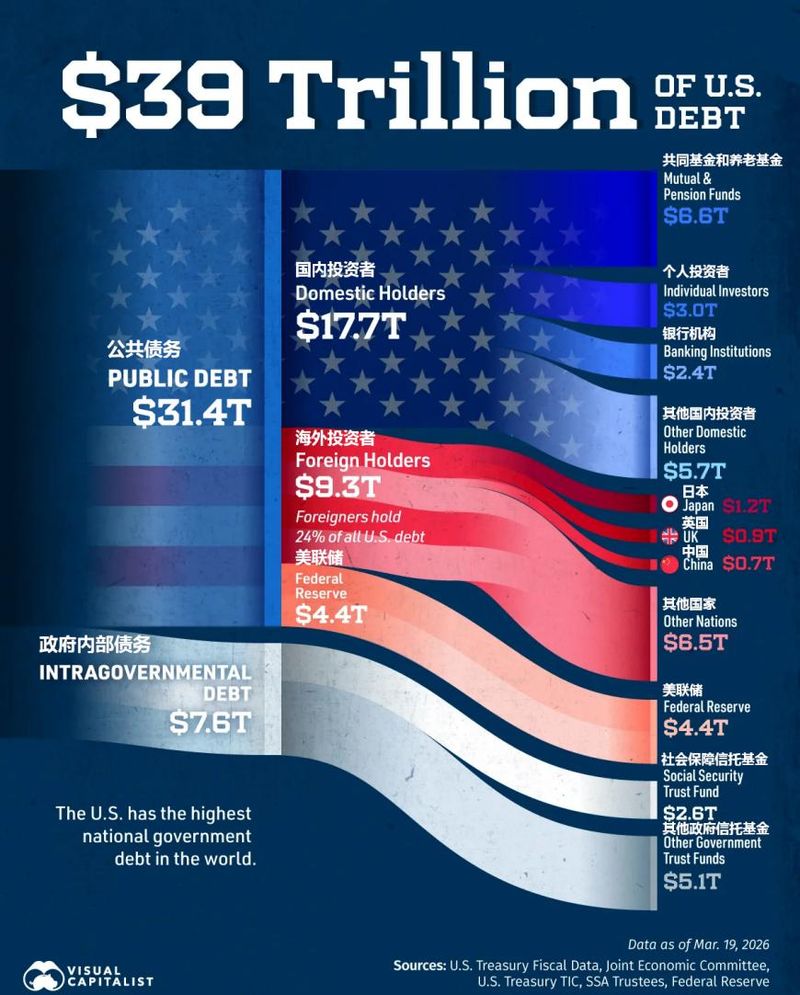
The united states department of the treasury released data in march of this year, bringing the total federal debt of the united states to $39 trillion for the first time. Figure: gorung, main debt holder, $39 trillion
The international monetary fund (imf), the united states government, and various research institutions have stated that the united states is now at risk of a financial crisis. However, the possibility of a balance-of-payments crisis was hardly mentioned。
What i want to say now is that in the united states, the balance-of-payments crisis and the fiscal crisis are “twins”. By definition:
The increase in the fiscal deficit led to an increase in the trade deficit, which would be difficult to reduce if the large fiscal deficit was not reduced. Deficit expenditures have made the demand for imported products unstoppable in the united states economy. There should be many possible causal chains. For example, interest rates on fiscal deficits have increased the appreciation of the united states dollar and the trade deficit has increased。
The united states is now in a state of two crises, since the problems of national debt and external debt are closely interrelated, and the growth of its fiscal deficit is bound to lead to an increase in its current-account deficit, which is inseparable. If it were assumed that investment income would not be taken into account, if it were assumed that private investment and private savings in the united states would be equal, the national debt would be equal to its external debt and the annual fiscal deficit would be equal to the annual current account deficit. If you fear a fiscal crisis in the united states, you must fear both a balance-of-payments and a dollar crisis in the united states. If you're worried about the former and not about the latter, it's paradoxical。
China's policy on the reform of the international monetary system is closely linked to china's concerns about the security of its assets. There are several different approaches to the reform of the international monetary system, essentially three paths: the replacement of the united states dollar with a special drawing right (sdr) as an international reserve currency, regional monetary cooperation (which eventually forms the dollar, the euro and the dollar) and the internationalization of the major national currencies (which, for china, is internationalization of the renminbi, and there is a problem of increasing internationalization for the euro). President zhou kogawa proposed (sdr), which had a very significant impact in the world. Subsequently, the united nations established a committee (“the stiglitz commission”) to discuss how to reform the international monetary system。
The stiglitz commission noted that the post-united states dollar-led bretton woods international monetary system had three fundamental weaknesses:
Unfortunately, this matter has not been taken seriously by the chinese authorities. There is also so-called regional financial cooperation, which is difficult to advance for geopolitical reasons. What remains is the internationalization of the renminbi, which has just been addressed by president kogawa, which is indeed what we need to do and what we have to do。
In short, we must be extremely vigilant about the security of dollar assets, because, at the most fundamental level, the united states debt is increasing in proportion to GDP. I have made my own calculations, and if the other conditions remain unchanged, if the ratio were to rise to 100 per cent, the counterpart currency would eventually collapse one day, otherwise it would become a ponzi game, and everyone would be ready。
In addition to this, president kogawa said that the dollar had been weaponized and that the united states could easily freeze other countries' dollar assets. In late 2013, prominent economic critic martin wolfe published an article in the financial times stating that, in the event of a conflict between china and the united states, the united states could have frozen china's financial assets, a matter that should have come to our attention long ago. The united states has confiscated russian dollar assets, and you do not know if trump will take similar measures against china, even if he does not. Keynes said, “you owe the bank £10,000, you owe the bank £4 million, and the bank is at your disposal.” china, as the country with the largest net assets abroad, particularly needs to remember keynes。
Lagarde recently asked: why do we have a much smaller share of the reserve currency in europe than in the united states, whose economies are similar to those of the united states, and whose trade exceeds that of the united states? Her answer is that the united states has a strong military power, and without it you cannot make your currency truly a strong international currency and an international reserve currency。
China is the world's second largest economy, the largest trading country, the most important importer of commodities such as crude oil, natural gas, iron ore, bauxite, soybeans and maize, and has been the largest direct investor in developing countries since 2010. It is only right and possible for us to have our trade opponents, resource-raisers denominated in renminbi and settled. The united states government's series of self-defunct policies offers us additional opportunities. We can indeed make significant progress in the internationalization of the renminbi。
But i also very much agree with president kogawa that the internationalization of the renminbi is a process that cannot be achieved in two days. There are many issues that need to be addressed one by one. These include the establishment of a floating exchange rate regime, the progressive opening of capital accounts, the improvement of the legal regime for the protection of property rights, the reform of the tax system, the expansion and deepening of the national debt market, the development of derivative financial products and the enhancement of military projection capabilities。
In short, the current international environment is conducive to the advancement of the renminbi's internationalization. We must, on the one hand, create internal conditions for the rise of the renminbi's international position and, on the other hand, seize all the concrete opportunities available for the renminbi to play its role in such areas as international bonds, cross-border loans, global foreign exchange settlements, global foreign exchange reserves and the anchoring of exchange rates in other currencies. I am confident that, over time, the renminbi will be one of the most important international reserves under the new international monetary system。
Thank you