Overview
Cracks are a very common geological phenomenon, the cracks that we see in everyday life, on the head of a rock. The cracks were due to rock stress, but no significant shift occurred on either side of the fracture. This is similar to the concept of geologic rhythm, which is the breakup along both sides of the fracture. The cracks are therefore also referred to geologically as the rhythm. Cracks are an important part of the rock reservoir space, an important reservoir seepage space in the oil and gas reservoir, and act as a communication gap and seepage channel。
Different scholars have different views on the classification of cracks, which are generally divided by geological causes, crack openings, crack mechanics, etc. The cracks can be divided into natural cracks and artificially induced cracks based on the cause of the cracks. Natural cracks can be geologically divided into primary and secondary cracks. The development of primary cracks is largely controlled by primary factors, including condensed condensers and cracks. Secondary cracks are lateral changes in state due to geological processes such as physical or chemical weather, and include tectonic stitches and fertilized sounders。
Crack classification (by geological cause)
1. Natural cracks
The development of primary cracks is largely controlled by primary factors, including condensed condensers and cracks. Fragmentation is the result of a gaseous explosion by magma in the upper archipelagic force formed during the eruption, which is spread over the very developing volcanic corridor and eruption phase of the crack, with a small size and high level of filling. The condensed condensate can be broken down into a matrix condensed and condensed。
Substrate condensation: a crack formed as a result of magma eruptions experienced contraction, dehydration, rapid condensation and composition differentiation. The length varies from several millimeters to centimetres。
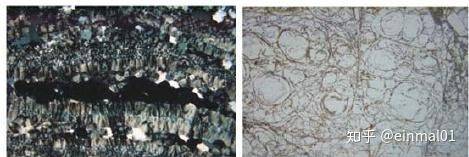
Substrate constriction (from gaesmin, 2014)
Condensed trachea: a series of condensed condensers formed as a result of the breakdown of thermal power and the formation of rock formations and stress. It is larger, usually distributed in straight lines, and can extend to dozens of metres。
Secondary cracks
Secondary cracks include tectonic cracks, weather cracks and dissolved cracks。
The cracks can also be constructed according to the size of the inclination and the period of formation:
Classification by inclination:
Vertical cracks: 70° < inclination 90°, open cracks main, 2 ~ 8 mm wide, 5 ~ 50 cm long, in two groups, with a density of 1 per cent to 2 ~ 3 cm, can be filled in carbonate, green mud, etc., in half。
High angle cracks: 45° < angle 70°, cutting cracks are main, 0. 3 ~ 2 mm wide, 50 cm long and 2 ~ 3 cm density。
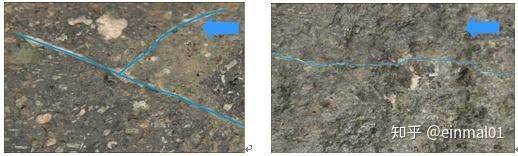
High angle crack (left) and vertical stitch (right)
Low angle cracks: 20° < angle 45° wide, approximately 0. 2 mm wide, extension less than 10 cm, general density of 1 cm10 cm, distribution limits。
Horizontal crack: 0° < 20° inclination, 0. 2~2 mm width, short extended density。
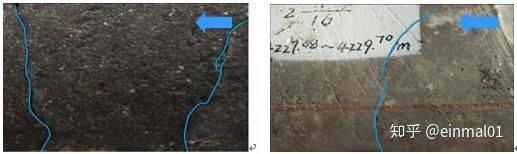
Horizontal (left) and low angle crack (right)
Classification by period of formation:
Early construction cracks: filled calcium, silicon and mud, etc., fully filled。
Medium-term construction cracks: filled calcium, silicon and mud, etc., fully filled。
Late construction of cracks: typically unfilled。
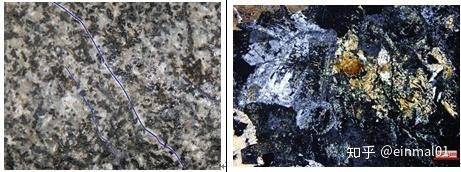
Plumy green rock cracks filled with plumstones and pelicans
Temperature cracks are the result of continuous weather filtering of long-exposed volcanic rock. Often, it intersects with primary and tectonic cracks。
Absorption cracks are primary cracks and early tectonic cracks within volcanic rocks, resulting from the modification of later exposure to hydrothermal fluids。
Artificial induction cracks
It refers to cracks created by rocks as a result of human-induced consequences during drilling or mining。
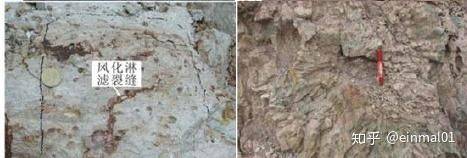
Temperature filtration crack (left) and artificial seduction stitch (right) (from ghasmin, 2014)
Cracking quantification parameters
1. Size of cracks
The size of the cracks includes the horizontal extension of the cracks and the penetration depth, i. E. Height. The length and altitude of the cracks are relatively positive and closely related to the layers of the rock. The data on the length of the cracks are often not accurately available in the underground rock formations, but can be divided into two stages by the intertwining relationship between the cracks and the formations: the first is the cracks that cut through several layers, and the second is the cracks that are confined to a single rock formation。
2. Spacing of cracks
The spacing of the crack is the vertical distance between the two parallel cracks within the same family. The same group is referred to here as a combination of multiple cracks formed as a result of a unified tectonic stress field, with causal links and identical or close in form. The spacing of the cracks varies considerably, ranging from a few millimeters to dozens of metres, and it is closely related to the thickness of the rock to control formation and distribution。
3. Density of cracks
The degree of development of the crack can be measured by the density of the crack, which is directly related to the pore and permeability of the crack. Depending on the reference systems used in the measurements, three types of linear density, face density and volume density can be classified. Among them, the density of the crack line is mainly expressed as the density of the crack of the same group of systems; the density of the crack line, the density of the fracture surface and the density of the crack body is expressed in m-1. Except for crack volume density, which is a static parameter, all are related to the direction of fluid flow。
4. Openness of cracks
Openness is the relative shift between the two stitches measured in a direction vertical to the fracture surface. The width of the crack is an important parameter for determining the penetration rate and the size of the hole, particularly in relation to the penetration rate. In the actual reservoirs, the width of the cracks tends to vary significantly, which is related to the pressure of the still rock closure on the fracture surface. On the basis of extensive data, the opening of the cracks is reduced by negative index functions as the pressure on the fracture surface increases. Thus, in the analysis of the width of the cracks, the pressure of the layer should be restored to the condition of the zone。
5. Fragmentation
Accurate identification of crack formations is of great importance for the exploration and exploitation of crack reservoirs. The direction, orientation and tipping of the crack in the form of a finger. During the exploitation of the oil fields, cracks have had a significant impact on fluid flow. Directional cores or well measurements can be used to determine the direction of the cracks; the tipping of the cracks can be measured on the cores by the relationship between the fracture surface and the axis of the core. However, in the case of non-directed tilt wells, the angle of the cracks shall be corrected first on the basis of the information of the tilt of the well。
6. Crack effectiveness
Typically geologically, the effectiveness of a crack can be judged by factors such as the open and closed nature of the crack, the nature of the crack wall and the filling of the crack. Depending on the opening and closing and filling of the cracks, they may be divided into four categories: open, closed, semi-filled and full-filled。
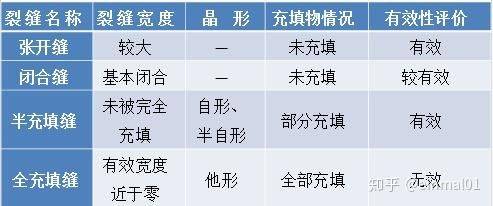
Assessment of the effectiveness of cracks (from wang yuncheng et al., 1992)
(1) opens: for effective cracks, oil and gas can move freely in cracks. Cracks are larger in width and unfilled。
(2) closed seams: although the cracks are empty of fillings, the fracture form is essentially closed. Some of the closed cracks observed on the core or surface surface may be open, full of fluids under the ground, when they are taken from the heart to the ground or when the tectonic movement leads to lifting to the ground, and as a result of the release of pore pressure, the cracks appear to be closed. Some of the cracks, which are closed under underground conditions, may also be opened during the development of injections or crushing of oil fields. As a result, the effectiveness of the gap is not well judged。
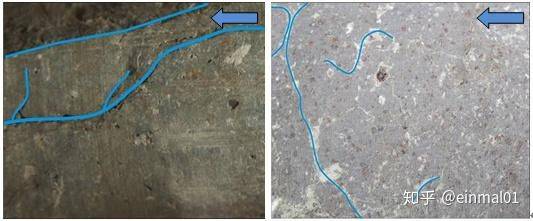
Open (left) and closed (right)
(3) semi-filled stitches: the cracks are not fully filled and are partially filled. Common fillings include quarries, metallite, boiling stones, white clouds and mud. Crystals are usually self-contained, semi-autonomous, often reflected in effective cracks。
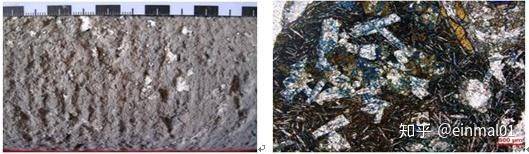
Cracks of cores filled with minerals such as desolators, boilers and soapstones
(4) full filling: the effective width of the crack is close to zero, and the crack is fully filled and is invalid。
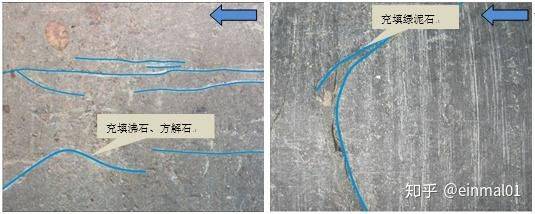
Full filling (left) and half filling (right)