The advantage of optical holograms is that they can bring about an extremely serious 3d reconstruction without relying on screens or glasses. As a result, areas such as museum restoration, industrial testing, security against forgery (such as laser tags on the renminbi) are used extensively. The limitations of optical holograms are, first, the need for very sophisticated optical systems and stable environments with high levels of light, vibration control, and, second, the poor real-time nature that makes it difficult to dynamically update or process motion images。
Digital hologram: hologram into the digital age
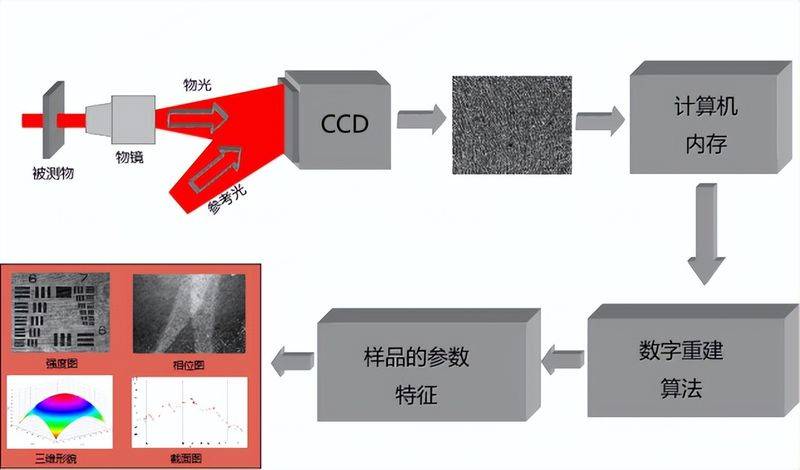
Digital holograms are recorded as digital images through ccds (charge coupling devices) or ccos image sensors, and stored, processed and rebuilt through computer algorithms. In this process, images can be present directly in the form of data rather than traditional light-sensitive materials and can be recovered using algorithms。
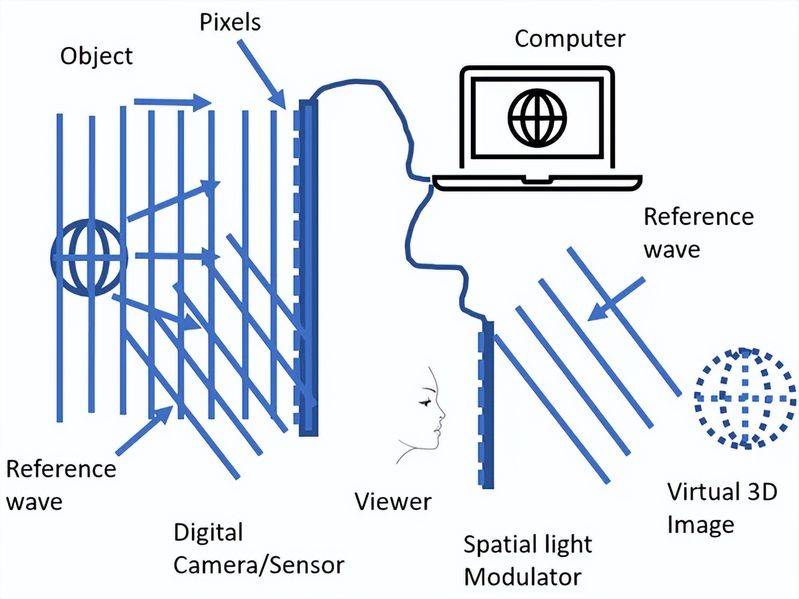
Digital holographic recording and reconstruction process (photo source:)
The central advantage of this approach is that it is “calculable, adaptable, stowage”. For example, we can filter, enhance, focus, and even dynamically recreate images of different depth levels by using software algorithms. Digital holograms are more flexible and operational than traditional optical holograms and are more suitable for integration with artificial intelligence, image recognition, etc。
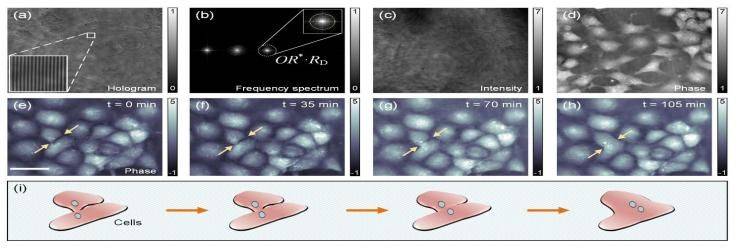
Digital hologram micrometer image of the cell integration process (photo source:)
The advantages of digital holograms are that they are low-cost, equipment is portable and systems are built flexibly; they can be digitized, stored and transmitted over the long term; and they have great potential for dynamic/real-time imaging. The limitation is reliance on high-speed computing resources, with high requirements for algorithm precision and imaging models。
The main thrust of the digital holographic application is as follows:
Biological microimaging: 3d structures and movements of living cells can be observed without dyeing。
Industrial non-destructive detection: precision structures that can be used to detect micro-deformation and stress concentration of materials。
Education and scientific research: can be used in virtual experiments, stereo projection and distance learning。
Three-dimensional profiling based on digital hologram (photo source:)
Calculating hologram technology: a new force to reshape reality
Unlike the first two methods of “predominantly recording physical objects”, the computation of holograms (computer-generated hologaphy, cgh) is a hologram of holograms created by “air”。
Instead of relying on physical or material light interference, it “calculates” a hologram directly from a computer based on a three-dimensional model or mathematical formula, which, after projection or intervention, can recreate the 3d images required. In short, it's a hologram of "model + rendering." cgh is like a 3d printing "optical brother" that builds the virtual world in light。
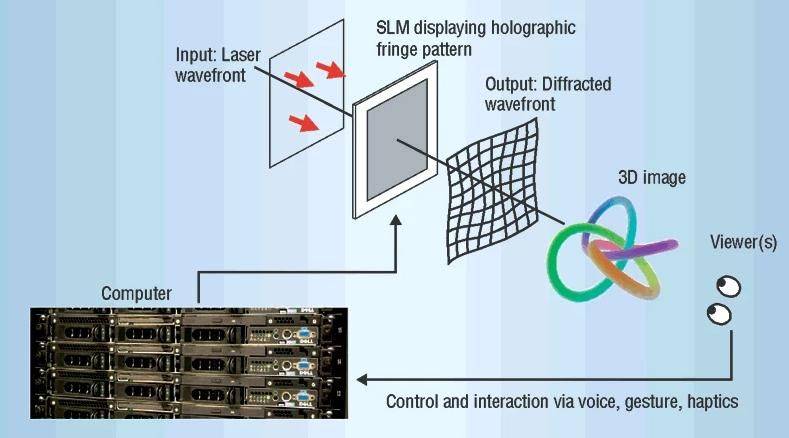
Process for calculating hologram technology (photo source:)
The mathematical core for calculating holograms lies in the simulation of the transmission of light, especially in the calculation of dissipation (e. G., fourier conversion, angular spectrometry). Through these calculations, the system is able to simulate how objects glow in space and transmit light waves, and then generate the corresponding intervention maps。
The advantages of calculating holograms are that they are entirely generated by computing without physical input, with greater flexibility and creative space; that they facilitate integration into digital content production chains, such as games, animations, digital twinning; and that they can be integrated in depth with gpu, ai, etc., and have great potential for real-time rendering. The limitation is that high-resolution high-quality cgh calculations are large and demanding for hardware。
The typical application for calculating holograms is as follows:
The hologram shows: for example, the exhibition was used to create a suspended image, a virtual host。
The virtual reality (vr) and the enhancement of reality (ar) are presented by naked eyes。
Medical visualization: 3d of the re-establishment of organs or surgical scenes。
Future television or film imaging: realization of an immersion experience free of eyeglasses, 360 degrees。
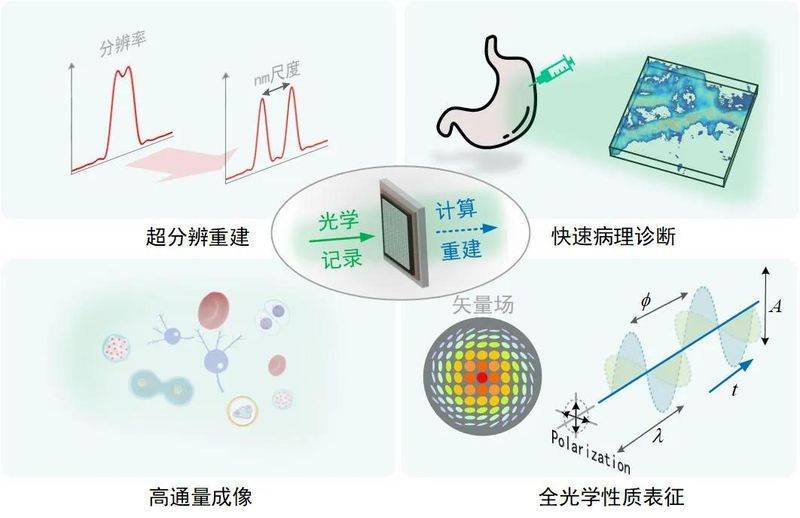
Future directions for holographics (photo source:)
In conclusion, optical holograms record real and high quality; digital holograms are flexible and efficient, suitable for real-time processing and processing; computing holograms, like virtual magicians, create an arbitrary three-dimensional world. These three types of holographic technology open up an unprecedented imagination for our future。