We read a book 10 minutes a day, and today we read barbara minto's pyramid principles. This is one of the books that people in the workplace must read. I wonder if you've ever had a moment when you've spent two hours in a blank document, and the solution that you can barely write has been led to say, “the logic is confused”; when you're meeting, you want to express a point, and no one gets to the point, and then you sit down embarrassed; and even when you talk to your family about a small thing, you talk about it, you run away, and you end up having a bad time — and you can't say it in a clear and structured way, and this “discovery” sense of weakness, which is always anxiety and frustration
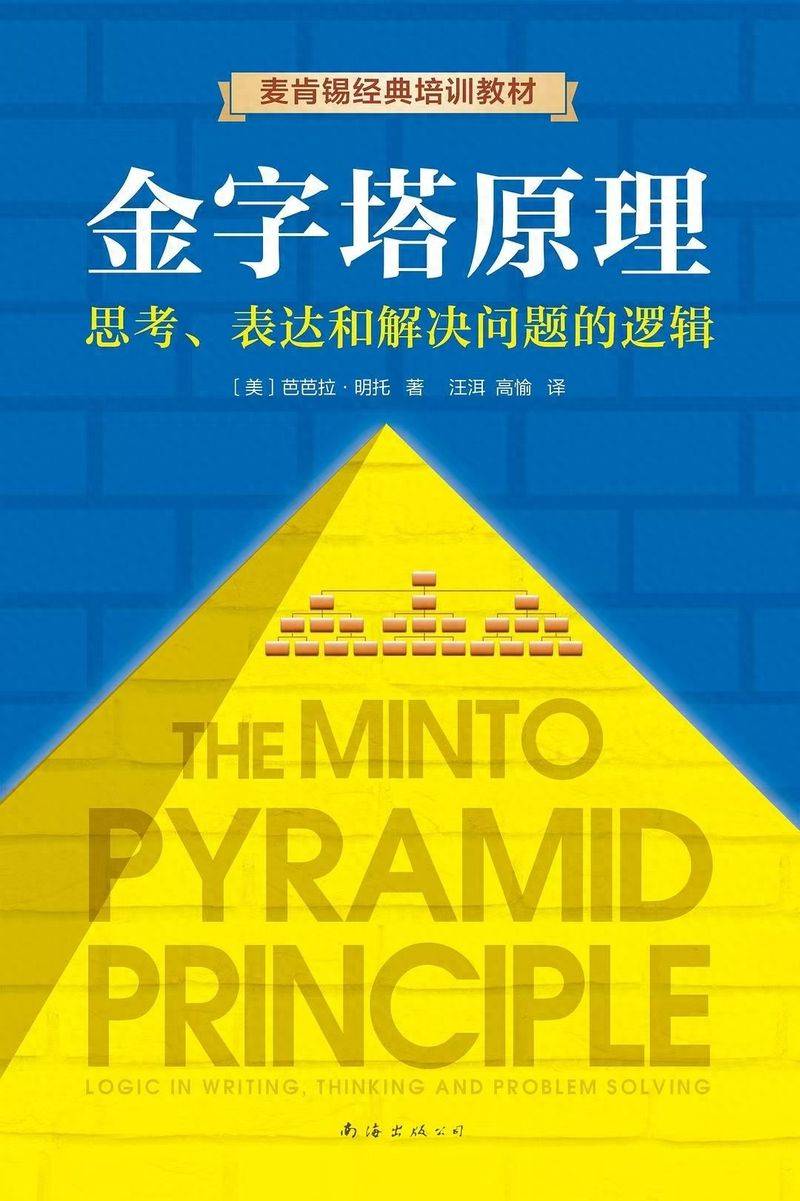
Actually, it's not that you're incompetent, it's not that you're bad at expression, it's that you haven't found the tool to comb the ideal. And barbara minto's pyramid principles is the practical guide that can help you turn the confusion into a "closeline." before we start talking about this book, we need to get to know its author, barbara minto, the first female consultant in the history of mckenzie consulting. Mckenzie in the 1960s, a male-dominated world of work, found that many colleagues, despite their great professional competence, often lost focus and even missed important opportunities for collaboration because of poor communication and poor reporting logic. Looking at reports that are full of data, but unstructured, mintleto begins to think: is there a way for people to structure their ideas quickly, so that listeners or readers can see the core at once? With that question in mind, she brought together her years of consulting experience and research into human cognitive habits, and finally created the "pyramid principles" -- • not only has the quality of mckenzie's advisory reports improved significantly, but it has since been widely applied in areas such as workplace communication, writing, problem solving, etc., and has become a “thinking organization” for millions of people around the globe。
So, let's follow your experience and see how the pyramid works to get you out of this. Remember last month's quarterly work summary? When you looked at the computer, you listed everything you did for three months: you followed up on five clients, organized two training sessions, organized 10 data reports, helped your colleagues solve three system problems... And the ocean spilled over 6000 words, and it got messy, and you didn't even know what you wanted to prove through this summary. You were really scared: "will the leader think i haven't done anything important this quarter? These details he doesn't care about at all?” the anxiety of being "feared of misunderstanding, afraid of being worthless" has made you change and change until after work. As a result, the next day, the leader called you to the office, pointing to one of the paragraphs in the report: “you have written here about the customer follow-up process and about the training, but what i want to know is what core value you have brought to the department this quarter. Is the client conversion rate up, or is the team efficiency up? I didn't see your core conclusion."
And when you walked out of the office, you were confused and confused: "why didn't i tell you what to write, or what to think?" in fact, that's what a lot of people say about the disease -- the "details" being the focus, the "process" being the "conclusion." and the first core principle of the pyramid principle is that, "conclusion first" -- first, you tell each other your core point, then you support it with details and data, like a pyramid, top of which is the core conclusion, and every layer below is the argument behind the conclusion. Then you try to re-engineer the summary using this method: first, to determine the core conclusion - “improving the client transformation rate by optimizing the client follow-up process by 12 per cent during the quarter, while helping the team master the new system by 20 per cent; then to break this conclusion down to two support points, one of which is “customs for the improvement of the client conversion rate”, and then to divide “improving the frequency of the follow-up message” into “customs for creating a customer demand profile” with three sub-points, each supported by “efficacy of team training” and the following sub-pointing “training content design” with “practical application results”. And when you're reordering this structure, you suddenly find that the confusion that preceded you is clear -- you're not "list things," but "prove your worth." that day you sent the revised summary to your leader, and in less than half an hour you received a reply: "the logic is clear, focused, good." you looked at the news, and the stone in your heart finally fell down, and it was even a little fun -- so you didn't have nothing, but you didn't put it right."。
In addition to writing reports, pyramid principles are particularly useful in daily communication. Just like last week's sectoral meeting, the leadership lets you talk about how to solve the project's delays. At the outset, you said, “suppliers are too slow to deliver” and, “the design department has changed three programmes” and “some people in the team have taken too many leave” and “clients have temporarily added demand” ... It was discussed for half an hour, not only without finding a solution, but rather because of the awkwardness of accusing each other. You were sitting next to him, trying to make a statement without knowing where to start, and only taking notes in silence. At this point, you're suddenly reminded of the principle of "grouping" in pyramid principles -- grouping similar problems into one category, and making confusing information coherent. So you raise your hand and you say, "i've sorted out the questions that you've just said, and i've been able to split them into two categories: one category is `external factors' such as vendor extensions, client ad hoc additions and demand; the other category is `internal factors' such as re-engineering of design programmes and team leave. We can discuss solutions to each of these two types of problems separately and then come up with plans.”
After you said it, the room was quiet for a few seconds, and the leader noded, and said, "this classification is clear, just like you said." the ensuing discussion was smooth: for external factors, it was decided to enter into stricter delivery agreements with suppliers, while recognizing needs in advance with clients and avoiding temporary changes; for internal factors, the design department optimized the programme review process and the department of human resources developed a temporary redeployment plan. At the end of the meeting, the leader paid a special tribute to you: "it's important that the classification clears your mind." you were a little embarrassed at the time, but you understood that you weren't smarter than anyone else, but you used a more effective way of thinking -- when everyone was trapped in the "detail fragments," you used the "grouping" to spell the pieces as "complete maps" and float the core of the problem。
In fact, the essence of the pyramid principle is not a set of “simplistic writing formulas”, but rather a way of thinking “in keeping with human cognitive habits”. Our brains are born to like "structured information" — for example, you see a bunch of books that are consciously sorted by "novel" "toolbooks" "scripts" — and you write a shopping list by "vegetables" "fruits" — because classification reduces the brain's "understanding costs" and allows us to focus quickly. And in this age of information explosion, everyone receives a lot of information every day, and if you can't express yourself clearly and methodically, your thoughts can easily be drowned in the noise. And that's why a lot of people feel "self-identifying anxiety" -- not because you're incapable, but because you're not letting people see you; because you're not worth it, but because you're not transmitting it clearly。
The pyramid principles give us much more than "how to write reports, how to meet." it's actually teaching us one of the abilities of self-combination: when you're lost, you use pyramid structures to comb your goals -- what are the core goals? What are the steps to sustain the goal? What needs to be done at each step? When you're in conflict with others, you're communicating in the way of "conclusion first" -- first you say your core claims, then you explain your reasons, so you don't get more misperceptions because you're bending; when you're dealing with complex issues, you use "grouping" to dismantle problems -- to divide big problems into small ones, to solve them one by one, to avoid being crushed。
Many people think that "structured thinking" makes expression "fast," but it's not. As barbara minto says in his book: "the pyramid principle is not to ask you to give up your personality, but to make it easier for others to understand your ideas on the basis of your personality." it's like a "think scaffold" that helps you build a solid "house" where people can clearly see the "structure" and "light" of the house, not just a bunch of "bricks."。
And finally, i want to say, maybe you're going to have a hard-on tomorrow, a hard-on meeting, and maybe you're going to get a little bit of a "discretion," but that's okay. The pyramid is not a book that can be perfected immediately after reading it. It's more like a mind coach who's around you, helping you to figure out what's in your heart when you need it. Next time you're stuck in a blank document, or you don't know how to express yourself, try to ask yourself, "what is my core conclusion? What are the arguments behind this conclusion? How am i supposed to classify these arguments?" a little effort, a little adjustment, you'll find that it's not that hard to express it clearly, and it's not that hard to show you value。
May you no longer be troubled by the indiscretion of words, and express your thoughts to the world in a clear, structured way -- after all, your thoughts deserve to be seen and your values recognized。