Technical regulations for road transport vehicles
(ministry of transport decree no. 3 of 2023 of 24 april 2023, effective 1 june 2023)
Chapter i general provisions
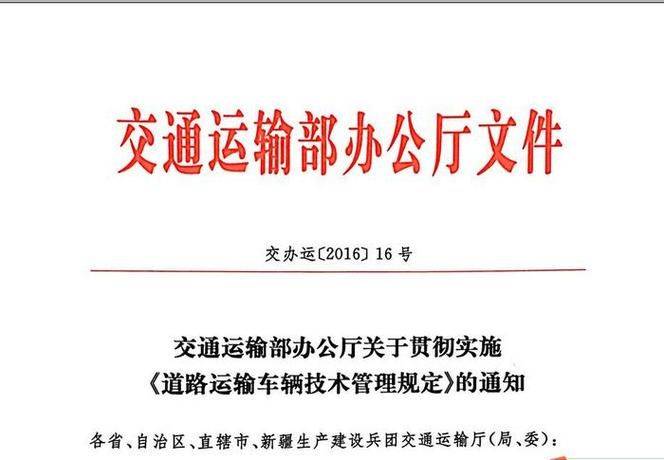
Article 1 - to strengthen the technical management of road transport vehicles, to maintain their good technical condition, to guarantee transport safety, to exercise vehicle efficiency and to promote energy efficiency and reduction of emissions. This provision is based on laws and administrative regulations such as the law of the people's republic of china on safe production and the regulations of the people's republic of china on road transport。
Article 2. Technical management of road transport vehicles shall apply this provision。
Road transport vehicles for the purposes of this provision include road passenger transport vehicles (hereinafter referred to as passenger vehicles), road general cargo transport vehicles (hereinafter referred to as vans) and road cargo transport vehicles (hereinafter referred to as dangerous trucks)。
For the purposes of this provision, the technical management of road transport vehicles is the technical management of the entire process of verification, maintenance, inspection, annual review, cancellation and exit of road transport vehicles。
Thirdly, the technical management of road transport vehicles should adhere to the principles of classification, prevention, safety and efficiency, and energy conservation and environmental protection。
Article iv. Road transport operators are the subjects of technical management of road transport vehicles and are responsible for the selection, correct use, periodic maintenance, repair, periodic inspection and timely updating of road transport vehicles, ensuring that the vehicles involved in road transport operations meet technical requirements。
Article v encourages road transport operators to use safe, energy-efficient and environmentally friendly vehicles, promote intelligent, light quantifying and standardized vehicle-type extension applications, strengthen scientific and technological applications and continuously improve vehicle management and technology。
Article 6 the ministry of transport and communications is responsible for monitoring the technical management of road transport vehicles throughout the country。
The local people's government, above county level, is responsible for monitoring the technical management of road transport vehicles within the administrative area。
Chapter ii. Technical conditions for vehicles
Article 7. Vehicles engaged in road transport operations shall meet the following technical requirements:
(i) the size, axle-load and maximum permissible gross mass of the vehicle shall meet the requirements of the " size, axle-load and mass limit of the car, trailer and train " (gb 1589)。
(ii) the technical capability of a vehicle shall conform to the requirements of the motor vehicle safety technical inspection project and methods (gb 38900), as well as national or industry standards established by law to guarantee the safe production of operating vehicles。
(iii) vehicle-type fuel consumption limits should be in accordance with the requirements of legally established standards for fuel consumption limits for operational vehicles。
(iv) vehicles (other than trailers) shall be of a technical grade that meets the requirements of the national technical grade for road transport vehicles and above. Dangerous trucks, international road transport vehicles, and passenger vehicles carrying class i and ii passenger lines and chartered passenger traffic should be of a technical level。
(v) the type of bus should meet the requirements of the national classification of the type of bus in operation and be above the normal level. The type of passenger bus involved in class i and ii passenger lines, chartered passenger traffic and international road passenger transport should be above the intermediate level。
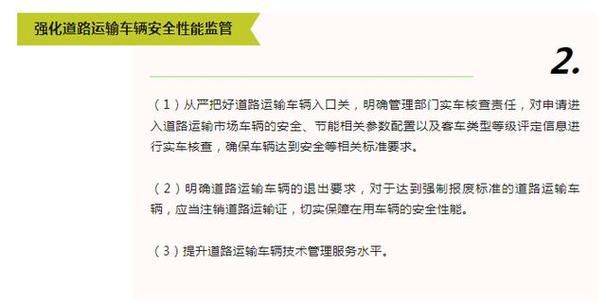
Article 8 the competent transport authorities shall strengthen the management of compliance with the standards of vehicles engaged in road transport operations by organizing, in accordance with the relevant national provisions, physical vehicle verification of vehicles that have applied for road transport operations, as well as by recording such verification, filling in the registration forms for road transport conformity vehicles and not issuing road transport certificates for vehicles that do not meet these requirements。
During the issuance of road transport certificates and the annual examination of trailers, it should be checked whether the trailers have valid travel documents。
Article 9 prohibits the use of end-of-life, unauthorized modifications, reassemblies, inspections and other vehicles that do not meet national requirements for road transport operations。
Article x. Road transport operators shall process the cancellation of road transport certificates in a timely manner for road transport vehicles that meet the end-of-life criteria, in accordance with national standards on mandatory end-of-life standards for motor vehicles。
Chapter iii technical management of vehicle usage
Section i. Basic requirements
Article xi. Road transport operators should abide by the relevant laws and regulations, standards and norms, take seriously the primary responsibility for the management of vehicle technology, establish sound management systems and strengthen the management of vehicle technology。
Article 12 encourages road transport operators to put in place appropriate units for the technical management of vehicles and to provide them with vehicle technical managers according to the number of vehicles and type of operation, with effective technical management of vehicles。
Article 13: road transport operators should enhance operational training in vehicle maintenance, use, safety and energy conservation, upgrade the quality and skills of practitioners and ensure that vehicles are in good technical condition。
Article 14. Road transport operators shall use vehicles correctly, in accordance with the technical standards governing vehicles of road transport enterprises, taking into account their technical condition and operating conditions。
Road transport operators are encouraged to develop technical regulations for vehicle use in accordance with the requirements of the relevant standards, to set economic, technical and periodic standards for vehicle use, and to conduct periodic reviews to improve vehicle technology management。
Article 15: road transport operators shall establish technical vehicle files and implement one-car systems. The archive includes, inter alia, basic vehicle information, motor vehicle inspection reports (including technical grade of vehicles), road transport compliance vehicle verification logs, passenger vehicle type review, vehicle maintenance and repair (including certificate of approval for completion of motor vehicle maintenance), replacement of main vehicle spare parts, vehicle changes, mileage, traffic accidents causing damage to vehicles, etc. The file should be accurate and informative。
When the ownership of the vehicle or its place of origin is transferred, the technical files of the vehicle shall be transferred with the vehicle。
Road transport operators should use information technology to manage the technical archives of road transport vehicles。
Section ii maintenance and repairs
Article 16 road transport operators should establish vehicle maintenance systems。
Vehicle maintenance is divided into routine, primary and secondary maintenance. Daily maintenance is carried out by drivers, primary maintenance and secondary maintenance are organized and recorded by road transport operators。
Article 17 road transport operators shall determine their own vehicle maintenance cycles, in accordance with relevant national standards and vehicle maintenance manuals, instructions, etc., taking into account the type of vehicle, its operating condition, mileage, road conditions and length of use, to ensure its normal maintenance。
The vehicle maintenance operation shall be determined in accordance with the requirements of the state technical regulations on vehicle maintenance and with the publicly available technical information on vehicle maintenance by the car-producing enterprise。
Road transport operators with secondary maintenance capabilities can perform secondary maintenance operations for their own vehicles, ensure that the vehicles in operation meet technical management requirements and do not require secondary maintenance quality testing。
Road transport operators who do not have secondary maintenance capabilities should commission motor vehicle repair operators in category ii or above to perform secondary maintenance operations. Upon completion of the secondary maintenance operation, the motor vehicle repair operator shall issue the commissioning party with the certificate of completion of the motor vehicle repair。
Article 18: road transport operators shall be guided by the principles of tailor-made repairs and safety, and timely repair of vehicles should be carried out on the basis of actual circumstances。
Article 19 road transport operators' specialized vehicles for the transport of highly toxic chemicals and explosives, as well as tanked specialized vehicles (including cannery trailers), should be repaired by enterprises that have conditions for repair of dangerous trucks。
Under the preceding paragraph, a special vehicle tow truck and other vehicles carrying dangerous goods may be repaired by an enterprise with general vehicle maintenance conditions after the road transport operator has eliminated the hazards of dangerous goods。
Section iii. Testing
Article 20 road transport operators should regularly visit motor vehicle inspection and testing agencies with market supervision management qualifications and the capability to test and test road transport vehicles for testing and technical rating。
Article 21 road transport operators shall, from the date on which the road transport vehicle first obtains the road transport certificate, perform inspection tests and technical ratings according to the following cycles and frequency:
(i) the passenger vehicle has been registered for less than 60 months for the first time by the national motor vehicle registration authority and is subject to one test and technical rating every 12 months and one test and technical rating every six months for more than 60 months。
(ii) other road transport vehicles have been registered for less than 120 months for the first time by the national motor vehicle registration authority, with one test test and technical rating every 12 months; and one test and technical rating every 6 months for more than 120 months。
Article 22 the inspection and technical grade of passenger cars and dangerous trucks shall be entrusted to the motor vehicle inspection agency in the place of residence。
Vehicle testing and technical rating can be done at the national level by selecting motor vehicle inspection agencies。
Article 23 motor vehicle inspection and testing agencies engaged in road transport vehicle inspection and detection operations shall carry out inspection tests in accordance with the motor vehicle safety technical testing project and methods (gb 38900), produce motor vehicle inspection reports and include in their reports a description of the technical level of the vehicle。
The transport and transport authority of the place of origin shall indicate the technical level of the vehicle on the road transport certificate. Road transport vehicles who obtain an annual online audit certificate are exempted from marking their technical grade on road transport certificates during the year。
Motor vehicle inspection and testing agencies engaged in road transport vehicle inspection and testing should ensure that inspection and technical rating results are objective, impartial and accurate, and be held legally responsible for testing and technical rating results。
Article 24 motor vehicle inspection agencies engaged in road transport vehicle inspection and detection operations should upload test data and test test reports in a timely, accurate and complete manner。
Article 25 motor vehicle inspection and inspection agencies engaged in road transport vehicle inspection operations should establish vehicle inspection and testing files, including, inter alia, basic vehicle information and motor vehicle inspection reports (including vehicle technical grade)。
Chapter iv oversight and inspection
Article 26: the competent transport authorities shall exercise supervisory control over the technical management of road transport vehicles in accordance with their responsibilities and legal procedures。
Relevant units and individuals should actively cooperate with the monitoring and inspection by the transport authorities and provide relevant information in a factual manner。
Article 27 the transport authorities shall include in the annual examination of road transport vehicles the technical level of the vehicle and the type of passenger vehicle。
Article 28. Motor vehicle inspection and inspection agencies engaged in road transport vehicle inspection operations shall not accept the inspection and inspection reports issued by them and shall copy them to the same market supervisory authority if:
(i) inspections of road transport vehicles that do not conform to technical standards and regulations
(ii) the results of the inspection of road transport vehicles are not tested
(iii) the results of inspection tests for road transport vehicles are not as good as those produced。
Transport authorities may regularly make public information on the failure of motor vehicle inspection agencies engaged in road transport vehicle inspection operations to upload test data and test test reports in a timely, accurate and complete manner。
Article 29: the competent transport authorities shall establish vehicle management files under the road transport management information system, update them in a timely manner and share information on national road transport vehicle management archives。
The files include, inter alia, basic vehicle information, road transport standard vehicle verification logs, motor vehicle inspection and inspection reports (including vehicle technical grades), passenger vehicle type grade reviews, vehicle changes, etc。
Article 30 if the road transport operator uses end-of-life, unauthorized modifications, reassemblies, tests and other vehicles that do not meet national requirements for carrying out road transport operations, or if the technical condition of the road transport vehicle does not meet the relevant criteria set out in article 7, the competent transport authority shall order the correction。
Transport authorities should incorporate inspection and enforcement of technical management of road transport vehicles into the quality certification and credit management of road transport enterprises。