Maslow's early demand level theory
As far as management science is concerned, the maslow theory of the level of demand is known to those who have little contact with psychology. Many can also quickly articulate five levels of need: physical, safe, love for belonging, respect and self-realization。
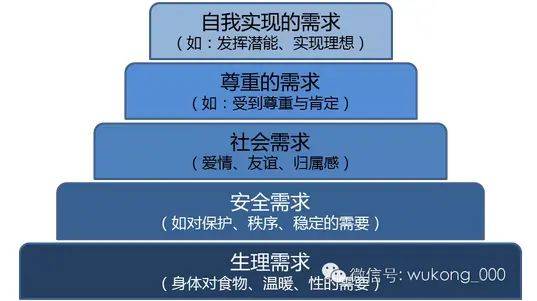
This map is indeed a popular demand-level theory, and in 1954 maslow, a cornerstone of human psychology, published a far-reaching mega-book motive and personality, which sets out the five levels of need mentioned above。
The theory of the demand level is an important theory of the interpretation of personality and of motivation. It suggests that the underlying motivation for individual growth is motivation. The motivation is made up of a variety of levels and nature of needs (need), which are divided into levels and sequences, each of which will determine the individual's personal development context。
He will first need to distinguish between missing and developmental, the first four being missing, and the need for missing from actual or perceived environmental or self-absorption. Individuals seek to find what they need in the environment, whether material, interpersonal or social. The satisfaction of these needs depends entirely on the outside world. And the fifth kind of self-realization is growth, and growth is the processes that lead to self-realization. The motivation for growth is the motivation inspired by the trend towards self-fulfilment。
Managementist mcgrego distinguished management theory from x theory and y theory, based on maslow's early five-tiered theory of needs. The theory of x is an authoritarian management theory, which assumes that people work driven by biological and safety needs, that work is a means of meeting low-level needs and that people are inherently averse to work, and that managers must therefore guide, control, coerce or even punish workers in a way that is directed, controlled, coerced. Mcgregor objected to that theory and presented his y theory, which was based on the need for belonging and love, respect and self-realization at the level that maslow needed。
Sadly, a body of human psychology has gradually become popular rhetoric, such as self-esteem, self-worth, self-assurance, self-improvement, self-fulfilment, etc. These terms, which are self-inflicted, are invoked in such a way that many people see themselves as being more important than anything, turning themselves into unsound self-centres, leading astray, turning self-loathing into selfishness, freedom into irresponsible, self-determination into neglect and self-admission ... The phrase “to live your true self” is a very thoughtful one, but there is no limit to being abused by alcoholics, sexual deranged or aggressive men。
Z theory beyond self
After 1959, he was increasingly involved in the eastern perspective. A study of eastern culture has prompted maslow to reflect on the humanistic vision he has created and, in the light of his in-depth study of the spiritual life and behaviour of self-fulfilment, he has found that there is also an inherent spiritual dimension in human nature, namely self-fulfilment or self-fulfilment as the highest level of need. Maslow then saw human psychology as a transitional stage in psychological development, which should be replaced by a higher stage of psychology. Maslow began to refer to this new psychology as “trans-humanistic psychology”。
Maslow feels that the hierarchy of five levels of demand is incomplete and self-fulfilled and does not constitute the ultimate human goal. He has become increasingly aware that a focus on the level of self-realization leads to unhealthy individualism and even to self-centred tendencies. We should remember that he said, “without the personal transcendent, we will be sick we need something `greater' than us people need to be self-realized and people need to be self-examining”。
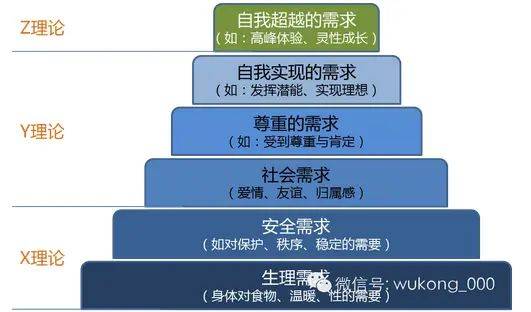
Fifteen years later, before his death, maslo published an important article, theory z, in which he re-examined the demand theory that he had developed over the years and added a sixth level of demand, which was summarized in three sub-theorys, namely, the "x" theory, the "y" theory and the "z" theory, which constituted the following system:
“superpersonal psychology is at the centre of the universe, not just human needs or interests, and transcends the notions of humanity, self and self-fulfilment ... This new trend is likely to provide a concrete, useful and effective response to the declining population, especially the younger generation of “defeating idealists” ... Without a transcendent and supra-personal dimension, we will be sick, brutal, empty, hopeless or indifferent. We need something “greater” than us to inspire a sense of piety and to give ourselves back to a naturalist, empirical, non-ecclesiastical dedication.”
Maslow tries different words to describe the highest needs of the newer, for example: superpersons, transcendence, spirituality, superhumanity, transcendence, mythology, manhood, superhumans (none humans at the centre, but the universe at the centre), human beings, etc. Maslow puts “peak experience” and “highland experience” at this level。
Maslow found that the transcendents were found not only in religious circles, poets, intellectuals, musicians, but also in entrepreneurs, entrepreneurs, managers, educators, politicians. He interviewed and observed in detail 30 or 40 persons and conducted general interviews and research on another 1 or 200 persons。
In his late years, maslow realized that he could not be left with the ultimate human goal of `self-realization' in his demand theory, supplemented by modifications, but that focusing on his early demand theory would inevitably lead to a blind understanding of human nature and promote pride while denigrating the true value of human beings! It would also affect the misunderstanding of human self-exceeding
Unfortunately, the presentation of our psychological and managerial textbooks has always been limited to the early needs-level theory of maslow (x and y theories), without any mention of late amendments, which has led to the recitation of the outdated needs-level theory throughout the new generation。
Meaning of the sixth level of demand
At the outset, maslow appreciated mcgregor's theory, but as the idea of transcending self-realization developed, he felt that it was inadequate, thus presenting z theory. The z theory is based on the x and y theories and emphasizes the need to transcend sexuality. Management based on this need takes into account supra-personal values, existential values or the incentive of universal values, assuming that human beings have the need to die for greater goals than themselves and the spirit of self-sacrifice。
In business administration, management at the x theoretical level is power-oriented and employees are assigned jobs for wages. Management at the y theoretical level is respectful, employees have the right to participate as fully as possible in the management of the organization, and authority is assumed to exist within everyone. Management at the theoretical level of z assumes that all employees are interested in service, that the purpose of the business is to serve the customers or consumers as far as possible, and that authority is assumed to be ultra vires and ethically obvious for each body. We can see the successful practice of the z theory in many excellent service enterprises, such as liz carlton。
Western psychology places special emphasis on positive elements, including self-aware exploration and energy. Unfortunately, there is a lack of awareness of the complementary elements (focus and tranquillity) in the western world. Without the development of concentration and tranquillity, the power of the mind is limited and the breadth of knowledge is limited to the smaller。
On the contrary, the eastern tradition, which places too much emphasis on focus and tranquillity, often creates difficulties. These factors can generate great ecstasy, calm in the heart, and illuminating cynicism, but they are less balanced in the search for and active observation of the truth, so that they do not produce the freedom to become more aware and enlightened。
Maslow believes that it is futile to deliberately look for a peak experience. The spiritual life of self-excessors is not made up of an endless series of intense, highly exciting peak experiences. Although self-excessive life involves the peak experience of time, it is more composed of a sense of sanctity in everyday life. The sacred peace and tranquillity experienced in daily life is called the “highland experience” of maslo, which is distinguished from the peak experience, which also holds an important place in the lives of self-fulfilmenters。
Li ka-sheng, the buddhist's first rich man, said that his motto was “being self, seeking without me”. Looking at lee ka-sheng, who is well known for his achievements, and standing in the elevator door, waiting for some of his peers to visit and returning home early and late every day for 10 hours, knows that he truly knows how to maintain a natural balance between himself and his quest for me: confidence, not pride, and humility。
As li ka-cheng has said, “to build one's own self, to make one's dreams come true; to pursue without me, to make greater ideals come true”. Spiritual growth has two parallel tasks, one to discover that i am not and the other to develop a healthy sense of self and explore what i really mean. Both are seemingly contradictory, but both must be achieved before we have an opportunity to awaken。