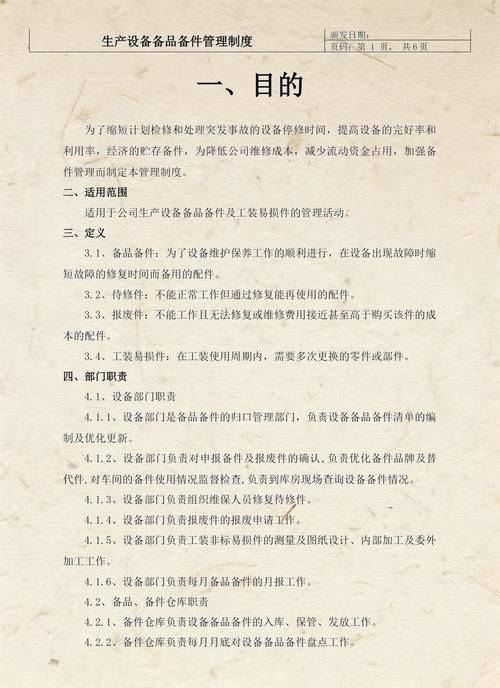
The purpose of paragraph (i) of the management of spare parts for equipment maintenance is to strengthen the management of spare parts for the maintenance of the equipment of the company, ensure the proper operation of the equipment, reduce maintenance costs and increase the useful life of the equipment. (ii) this applies to the management of spare parts for maintenance of all production equipment, office equipment and other related equipment within the company. (iii) basic principle 1. Safeguarding equipment operating principles: ensure the timely supply of spare parts for maintenance to meet equipment maintenance requirements and minimize equipment downtime. 2. Cost-control principle: reasonable control of spare parts stocks and reduction of procurement and inventory costs, subject to ensuring proper operation of equipment. 3. Principles of scientific management: effective management of the procurement, inventory and use of spare parts using scientific methods and tools. Ii. Management responsibility (i) equipment management (i) is responsible for the development of the overall plan and forecast of requirements for spare parts for equipment maintenance. 2. Review applications for spare parts and participate in the evaluation and selection of vendors. 3. Establishment of a spare parts desk for equipment maintenance and regular inventory counts. 4. Oversight of spare parts usage and analysis of spare parts consumption patterns. (ii) procurement unit 1. Is responsible for the procurement of spare parts based on requests for procurement from equipment management. 2. Identify qualified vendors, establish vendor files, conduct procurement negotiations and sign procurement contracts. 3. Follow-up of procurement progress to ensure that spare parts arrive on time. (iii) warehouse management 1. Is responsible for the warehousing, storage, safekeeping and distribution of spare parts. 2. Establish an inventory management system and conduct periodic inventory counts to ensure conformity of accounts. 3. Disaggregated storage of spare parts in stock to protect against tide, rust, fire, etc. (iv) operation 1. Request for spare parts for maintenance of equipment, with details of damage to spare parts and reasons for replacement. 2. Responsible for the proper use of spare parts and the recording of their use. 3. To assist the equipment management in analysing the reasons for the consumption of spare parts and making reasonable recommendations. Iii. The classification and coding of spare parts (i) principle 1. 2. The same category of spare parts should have similar attributes and characteristics. (ii) classification method 1. Classification by equipment system, such as mechanical, electrical, hydraulic, etc. Classification by type of component, e. G. Bearings, gears, electrics, valves, etc. Categorized by the importance of spare parts, such as critical spare parts, general spare parts, etc. (iii) coding rule 1. Use digital coding to ensure unique and systematic coding. The code shall contain information on the type of equipment, the type of component, the serial number of the spare parts, etc. 3. Specific coding rules are as follows: equipment category code: two numerals, e. G. 01 for mechanical systems, 02 for electrical systems, etc. Widget type code: expressed in three numbers, e. G. 001 for bearings, 002 for gears, etc. Serial number code for spare parts: in four digits, serial number from 0001. Iv. Spare parts plans and budgets (i) plans to develop 1. Equipment management plans for spare parts on an annual, quarterly and monthly basis, based on the operational status of equipment, historical data maintenance and production plans. 2. The annual spare parts plan should be developed by the end of each year, including a list of all types of spare parts required for equipment maintenance, the expected quantity and time of procurement. 3. Quarterly and monthly spare parts plans should be refined and adjusted in accordance with annual plans to ensure the timeliness and accuracy of spare parts supplies. (ii) requirements forecast 1. Equipment management should forecast spare parts requirements in the context of the operation patterns, failure rates and maintenance cycles of equipment. 2. Qualitative and quantitative analysis of spare parts requirements can be carried out using statistical analysis methods, empirical judgement methods, etc. 3. Regular assessment and adjustment of demand projection results to improve the accuracy of forecasts. (iii) budget preparation 1. The procurement department shall prepare annual, quarterly and monthly spare parts procurement budgets based on spare parts plans and market prices. 2. The budget shall include the cost of procurement of spare parts, transportation costs, storage costs, etc. 3. Budget preparation should be based on the principles of reasonableness and economy, and procurement costs for spare parts should be strictly controlled. V. Procurement of spare parts (i) supplier selection 1. The procurement department should establish a directory of qualified suppliers to assess and select suppliers ' qualifications, credibility, product quality, price, etc. 2. Prioritize suppliers with good reputation, reliable product quality, reasonable prices and short delivery times. 3. Vendor appraisals are conducted on a regular basis and suppliers that do not meet the requirements are adjusted or phased out in a timely manner. (ii) procurement process 1. Applications for spare parts procurement are submitted by the user department, which completes the request for spare parts procurement form, detailing the name, specification type, quantity, purpose, etc. 2. Equipment management reviews procurement requests and reports them to the supervisory authority for approval upon signature. 3. On the basis of approved procurement requests, the procurement department sends purchase orders to suppliers, specifying the terms of the procurement requirements, delivery dates, etc. 4. Vendors organize the production and delivery of goods as required by purchase orders, and the procurement department follows up on procurement progress to ensure that spare parts arrive on time. Upon arrival of spare parts, the procurement department informs the warehouse management of the receipt and inspection. (iii) procurement contract management 1. The procurement department shall enter into a procurement contract with the supplier specifying the rights and obligations of both parties. 2. The contract shall include terms such as the name of the spare parts, the specification type, the quantity, the price, the delivery period, the quality standards, the manner of payment, etc. 3. Procurement is responsible for contract implementation and tracking and for the timely processing of contract changes and defaults. Vi. Spare parts inventory management (i) inventory planning 1. Warehouse management should rationalize inventory layout and set up different storage areas based on the classification and requirements for spare parts. 2. Establish safe stock, maximum stock and minimum stock levels for all categories of spare parts to ensure that stock levels meet the maintenance needs of equipment without creating backlogs. (ii) upon arrival of spare parts in warehouse management 1. The warehouse management shall organize receipt and inspection in a timely manner to verify whether the name, specification type, quantity and quality of spare parts are consistent with the purchase order. 2. The receipt and inspection of eligible spare parts is processed for warehousing, the completion of the spare parts entry list and the recording in the inventory management system. 3. Unqualified spare parts for inspection and inspection shall be returned in a timely manner by contacting the supplier. (iii) storage management 1. Warehouse management should classify spare parts in accordance with inventory planning, clearly marked, easy to locate and manage. 2. Periodic inspections of spare parts in stock are carried out to ensure that the quality of spare parts is not affected, inter alia, by tide, rust, fire and theft. 3. Establish an inventory count system and conduct inventory counts on a regular basis to ensure conformity of accounts. The inventory results should be reported to the equipment management and finance departments in a timely manner. (iv) treasury management 1. User departments collect spare parts from warehouses on the basis of approved spare parts receipts. 2. Warehouse management issues spare parts in accordance with the spare parts requisition, completes the spare parts release list and updates the inventory management system. 3. For the receipt of valuable or critical spare parts, a system of approval should be introduced, with strict control over the quantity and use of such access. Vii. Spare parts use and end-of-life management (i) use management 1. Use units should use spare parts correctly to ensure the useful life and performance of spare parts, as required by equipment operating protocols and maintenance manuals. 2. Records of the use of spare parts, including the name of the spare parts, the specifications, the time of replacement, the reasons for replacement, the use of the equipment, etc., will be kept regularly to the equipment management. 3. Equipment management should conduct periodic analysis of the use of spare parts, summarize the patterns of spare parts consumption and provide the basis for spare parts planning and procurement. (ii) end-of-life management 1. For spare parts that have been damaged and cannot be repaired or that have exceeded their useful life, a request for end-of-life will be submitted by the user department to complete the request for the end-of-life of spare parts. 2. Equipment management organizes the review of end-of-life applications by relevant personnel and confirms that they are submitted for approval by the supervisory authority. 3. Spare parts that have been approved for write-off are processed by the warehouse management, are completed in the spare parts scrapping form and are written off in the inventory management system. 4. End-of-life spare parts should be kept in safe custody and regularly cleaned and disposed of to prevent leakage and environmental pollution. Viii. Improved information management (i) establishment of the spare parts management system 1. The company should establish the spare parts management system for equipment maintenance and centralization and sharing of spare parts information. 2. The system should cover the procurement, inventory, use and end-of-life aspects of spare parts, including data entry, queries, statistics and analysis. (ii) data maintenance 1. Equipment management, procurement, warehouse management and use units should assign responsibility for data maintenance of the spare parts management system to ensure the accuracy and timeliness of data. 2. Regular backup of system data to prevent data loss. (iii) information application 1. Use of data from the spare parts management system to perform spare parts requirements forecasting, inventory analysis, cost accounting and to provide decision-making support for the management of spare parts for equipment maintenance. 2. Processed management of the acquisition, inventory and use of spare parts through systems to improve efficiency and management. Oversight and appraisal (i) oversight inspection 1. Equipment management should conduct periodic monitoring and inspection of the management of spare parts, including implementation of spare parts plans, inventory management, procurement contract implementation, use of spare parts, etc. 2. The results of the inspection shall form a written report, which shall be fed back in a timely manner to the relevant departments and personnel, and shall provide recommendations for revision。(ii) assessment 1. Establishment of a spare parts management appraisal system for spare parts management and spare parts for equipment management, procurement, warehouse management and utilization