Large molecular flame retardants are a highly flame-retarding elemental structure that is derived from chemical reactions of small molecules, an element-rich structure that interacts better with high molecules, large molecular flame retardants that interact better with high molecules, and large molecular flame retardants that interact better with high molecules。
Large molecular flame retardants have five main characteristics: (1) relatively high molecular mass, which is not easily transferable; (2) more stable than small molecular flame retardants; (3) more compatible with high molecular matrices; (4) more flame retardants or clusters in structures; and (5) less readily prepared。
Technologies for the preparation of large molecular flame retardants
The key to preparing large molecular flame retardants is to find suitable large molecular flame retardants structures and preferred process routes. Ideally, large molecular flame retardants should have multiple flame retardants or structural cells, with better heat stability, a certain molecular mass and good compatibility with most matrices。
Large molecular flame retardant with nitrogen in phosphorus
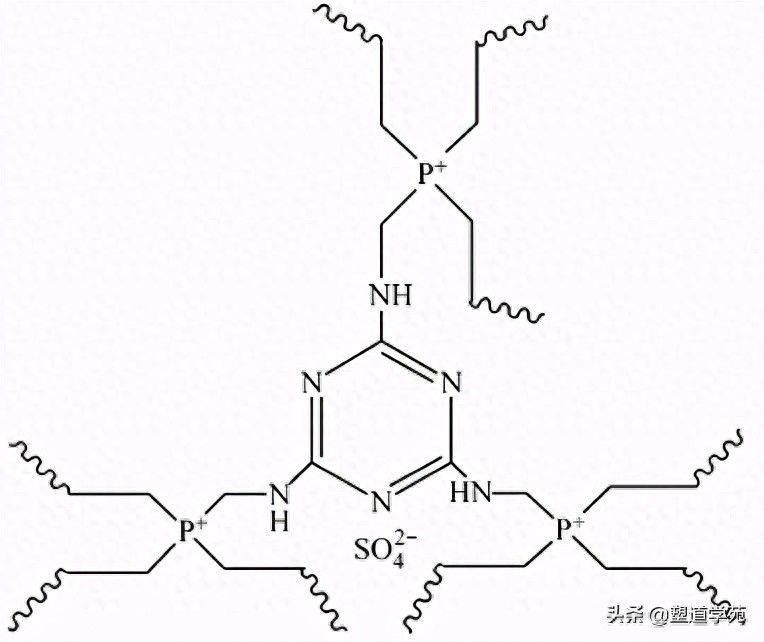
Numerous studies have found better synergies and synergies between phosphorus and nitrogen elements. The expansion of the flame retardation system (ifr) was added to the polyethylene (pe) through a series of flame retardation combination experiments with melamine tetramethyl sulphate (mtppso) and ammonium polyphosphate (app). The results showed that the carbon mass score of the ifr added pe at 800°c was 23. 4%; when the ifr mass score reached 32. 0%, the ultimate oxygen index loi was 26. 0%。
Mtmpso structure chart
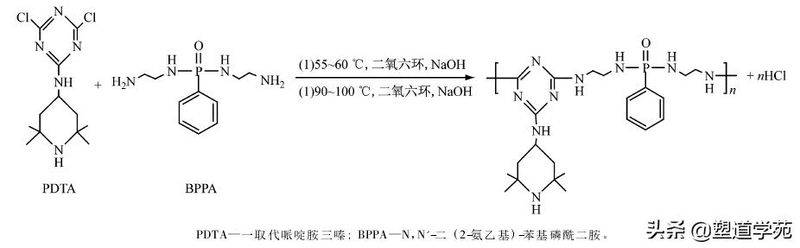
Zhang li li and others have synthesized a new large molecule containing phosphorus nitrogen-based flame retardant - polyphenylamide - using phenylamyl dichloride and zirconium as feedstock. This large molecular flame retardant has a significant flame retardation effect on polycarbonate, with the addition of polycarbonate with a 7. 0% mass score of 34. 8%。
Pphenyl phosphate preparation pathways
Shevari, among others, synthesized a new form of large molecular inflatable flame retardant (hapn) with a free-kid beryllium elimination function and combined it with app flame retardant polypropylene (pp), examining the effects of the quality ratio of the hpn to the pp on the flame retardation performance。
Hapn synthesis route
Large silica-containing molecular flame retardant
Wang l c, among others, successfully synthesized diphosphate phosphoryl chloride/9,10-dihydro-9-oxa-10-phosphate-10-oxa-oxoxin/ethylene methylenedioxysilane (spdv). Spdv and magnesium hydroxide (mdh) are combined to flame retard eva, while loi is 29. 4 per cent, ul-941 is v-0 and has no melting drops after the combination of eva, mdh, spdv by mass of 10:5. 3。
Structure of spdv
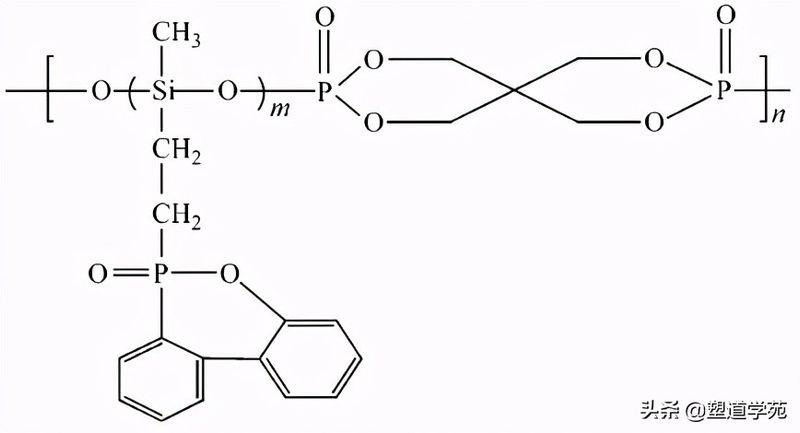
Large molecular flame retardant with phosphorus and nitrogen and silicon
Equivalent for 2 classes of phosphorous, nitrogen, silicon and magnesium flame retardants have been successfully prepared and used in pp flame retardation, using neopentodiol, trichlorophosphorus, dihydroxysilic oil and amino and amino-oxysulfane. The results showed that phosphorus, silicon, nitrogen and nitrogen were flame-retarded, resulting in a significant improvement in the carbon mass score following the degradation of the pp and in the flame-retarding performance。
Structure psin i and psin ii
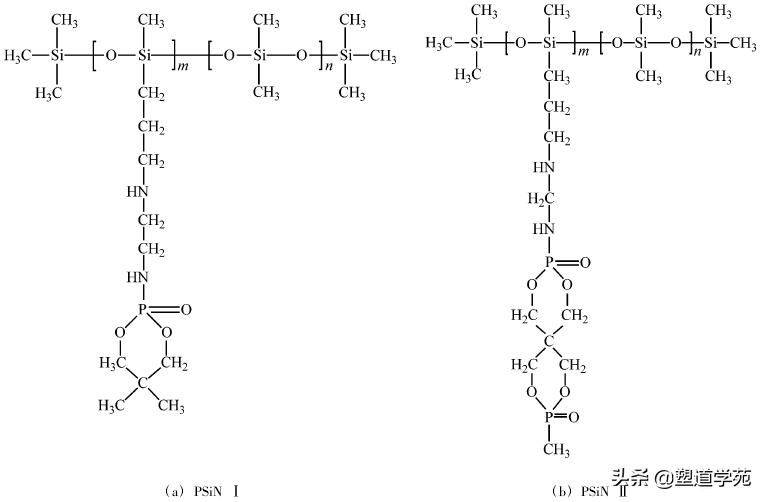
Chen xiaohua, among others, successfully prepared a new type of inflatable flame retardant (p-n-si ifr) integrated with phosphorus, nitrogen, silicon and trichlorophosphorus, dysentery and aminosil oil and applied it to flame retardation in pp. The results show that loi, which contains a 30% p-n-si ifr mass flame retardation system, can be 34% with an average heat release rate (p-n-si ifr) mhrr and charcoal mass scores of 94 kw/mz and 15. 2 per cent respectively; better than 30. 7 per cent (loi), 240kw/mz (mhrr) and 8. 7 per cent (carbon mass scores) of phosphorus-inflated flame retardants in the pp system, are more visible in flame retardation and increased heat stability。
Qiu y et al. Cz37 found in the experiment that the eps with a mass score of 1% siloxane (mvc) and 3% dopo and triazine ring structure compound (tgd) had a better flame retardation effect than the ep with a direct mass score of 4% tgd or 4% mvc, and found that the mvc and the tgd p-n-si ifr had combined a condensation and gas-resistance mechanism and demonstrated a clear synergy。
Organic-inorganic large molecular flame retardants
A triphosphorus derivative is a new type of organic, inorganic, nitrogen-retarding system with a stable six-decimal ring structure, with good heat stability and a strong flame retardation effect in condensation。
Ma haiyun et al. With hexachlorocyclophosphorus (hccp) and 1-oxyphosphate-4-hypermethyl-2,6,7-trioxioxioxin
Two, two, two
Octane (pepa) is a feedstock that synthesizes a phosphorus derivative flame retardant vi (1-oxy-1-phosphorus), 6,7-trioxioxid doublering
Two, two, two
Octane-4 methiophosphate (pepap). The results show that when the pepap mass score is 25 per cent, the loi is 29. 4 per cent, and the system is able to pass the ul 94 v-0 level; and that the integrity of the carbon layer of the system and the presence of the phosphoric acid-like structure indicate that the pep-ap is the fixed flame retardant mechanism。