Mass spectrometry is one of the powerful tools for the identification of organic compounds, including relative molecular quality, chemical-style determination and structural identification。
1. Measurement of relative molecular mass
The relative molecular mass can be measured accurately from the mass ratio of the molecular ion peak. Theoretically, apart from isotopic peaks, molecular ion peaks should be the peaks of the highest mass, but sometimes they cannot be observed because of their poor stability. In the pure sample mass spectra, molecular ion peaks shall have the following properties:
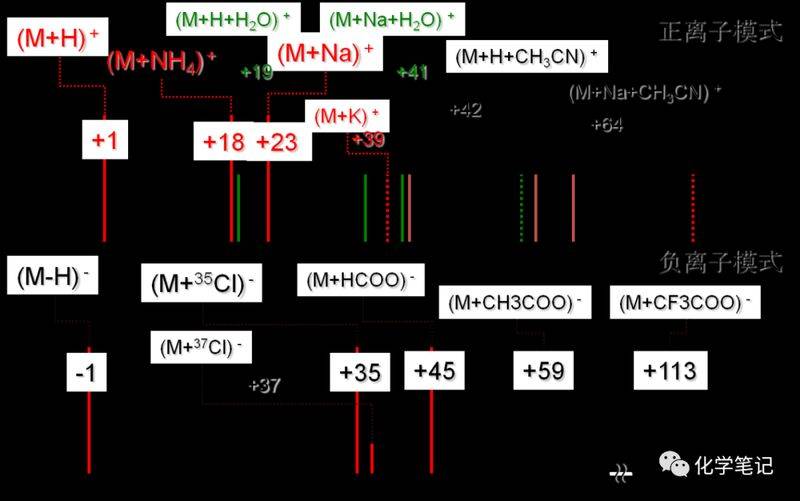
(1) in principle, in addition to isotopic peaks, molecular ion peaks are of the highest quality. However, some samples form protonized and conjunctivated ion peaks. The following figure shows the possible formation of a composite ion in the sample. Under esi-source conditions, double-charged ion such as (m+2h)2+, (m-2h)2- and dipleon ion such as (2m+h)+, 2m+hcoo)- are also frequently observed。
(2) nitrogen: in compounds containing only c, h, o, n, the mass of molecules excluding or containing even atoms is even and the mass of molecules containing odd atoms is odd. This is because, of the organic molecules consisting of elements such as c, h, o, n, p and halogens, only nitrogen atoms is combined for odd numbers and mass for even numbers。
(3) there is a reasonable loss of debris. When organic molecules are ionized, the molecule ion may lose a piece of debris such as h or ch3, h2o, c2h4, with corresponding debris peaks of m-1, m-15, m-18 and m-28。
2. Chemical formula determination
(1) high-resolution mass spectrometers can accurately determine the mass ratio of molecular ion or debris ion, which can be derived from the precise mass of the compound. For both co and n2, the mass is 28, but the exact mass is 27. 9949 and 28. 0061, which can be inferred from n2 if the mass spectrometer measured a mass ratio of 28. 0040。
(2) some elements are naturally present in stable isotopes, so there are peaks of m+1 and m+2 on mass spectrographs, and the ion peaks formed by these isotopes are called isotope ion peaks。
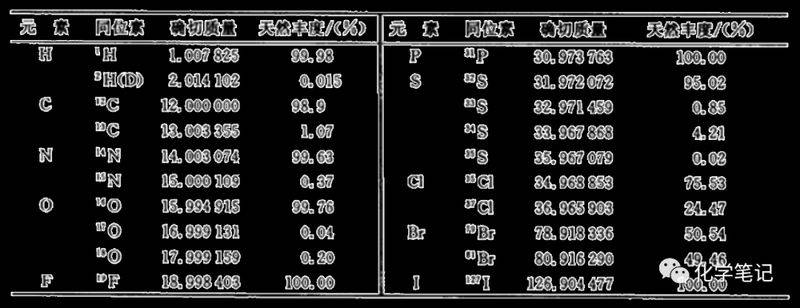
The ratio of the relative strength of the isotope ion peak to the molecular ion corresponds to the statistical pattern:
For carbon atoms, the natural abundance of 12c is 98. 9 per cent, and the natural abundance of 13c is 1. 07 per cent. From the ratio of m+1 to m-strength, it is possible to estimate the number of carbon in molecules, the maximum number of carbon = i(m+1)/i(m)÷1. 1 per cent. Therefore, a compound containing a carbon atom, such as methane, should have a peak strength ratio of 0. 011.
The same pattern is followed for other elements, i(m+2)/i(m)=32. 5% of compounds containing a chlorine atom, while for compounds containing a bromine atom, i(m+2)/i(m)=1. For compounds containing elements with higher natural abundances such as the isotope c, br, cl, the relative strength of the isotope ion is calculated by (a+b)n in a range a and b, respectively, of the light element, the relative abundance of the heavy isotope and n the number of the element in the molecule. In compounds containing two chlorine atoms, a = 3, b = 1, n = 2, so (a + b) 2 = 9 + 6 + 1, the ratio of molecular ion peaks to the corresponding isotope ion peak strength is 9:6:1.
Iii. Structure
Analysis of information on the chemical pattern, m/z, relative peaks of the debris ion, the stable ion, the molecular ion, and the relatively high height of the ion in the spectra, will identify the ways in which the debris ion is generated, depending on the pattern of division of the various compounds, and thus the entire molecular structure。
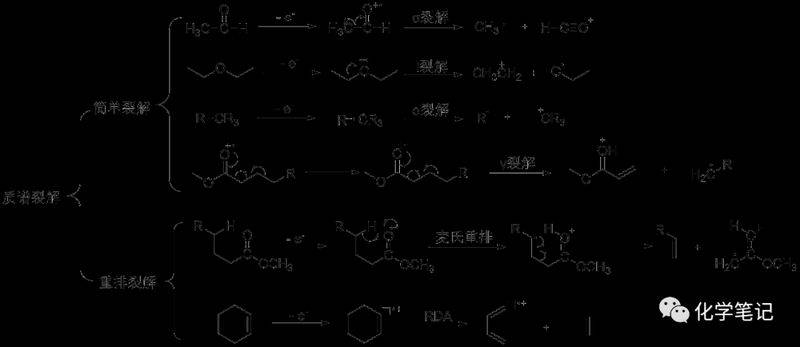
Fracking reactions common in organic mass spectra are as follows:
(1) alpha fissure: in a strange electron ion, the external key of its adjacent atom is fractured, it is an electronic transfer of the atom and forms a more stable debris ion with a non-relative electron at the centre of the free radical。
(2)i fracking: in a strange electron ion, a pair of electrons connected to a positive charge centre is attracted entirely to the positive charge, resulting in the break of a single key and the transfer of the charge。
(3) fragmentation: the molecular middle key loses an electron under an electronic bombardment, which is followed by a molecular crack to create a debris ion。
(4) gamma cracking: a process triggered by a free-base, re-constituted new keys and resulting in fragmentation at the gamma level。
(5) mcnugget retrain: side chain benzene, alkyl, epoxy compounds, formaldehyde, ketone, etc. With gamma-hydrogen atoms are transferred to the atoms with a positive charge through a six-hull transition pattern, while cracking between alpha and beta atoms。
(6) anti-diels-alder (rda) fragmentation: a compound with a structure type of cyclohexane can decomposition to this type, typically forming a co-synthetic nion and a neutral fraction of an alkyl。
References:
Ip kung-jian and others
Wang guanghui, the bear, the organic mass spectrometry
Menjongji and others, organic pope analysis
Wu shijun and others, intermediate organic chemistry experiment
Lcms information for shimazu