Infective diseases are one of the most common diseases in emergency care, and the overall inflammation syndrome caused by infection is the most fundamental pathological change of sepsis. Due to the complexity of the response to systemic inflammation, there are no ideal diagnostics, tiered, pre-posterative tools, and treatment programmes with significant results. Early and accurate diagnosis and monitoring of sepsis is therefore one of the decisive factors in improving the prognosis. The relevance of calcium reduction (procalcitonin, pct) to infection and sepsis is good and, after nearly 20 years of research and practice, has been recommended for diagnosis, stratification, treatment monitoring and pre- and post-assessment of bacterial infectious sepsis
1pct introduction
1. 1 the biological effects of the main biological effects of the pct are not yet conclusive, and the main biological effects are the role of secondary inflammation factors, the role of the convergence factor, the resistance to inflammation and protective effects
1. 2 pct testing methods and stability
At present, pct can be tested in semi-quantitative and quantitative terms. Semi-quantitative methods include gelatinous marking tests. Quantification methods include radioimmunisation analysis, immuno-fluorescent, bi-anti-cardiological immunochemical luminescence, enzyme exemptions, etc. Pcts are very stable in blood samples, with blood taken and placed at room temperature 24h and pct mass concentrations reduced by only about 12%, and if kept at 4°c, by only 6%. The effects of freezing, anticondens, serum or plasma, artery or intravenous blood on detection results are minimal
1. 3 normal value and reference range of pct
The mass concentration of pcts in healthy people is below 0. 05 ng/ml,
In general, however, it does not exceed 0. 3 ng/ml
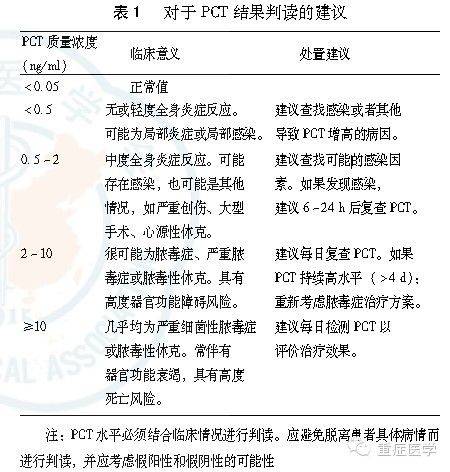
The clinical significance of pct mass concentrations and recommendations for disposal are shown in table 1
1. 4. Common diseases leading to the rise of the pct
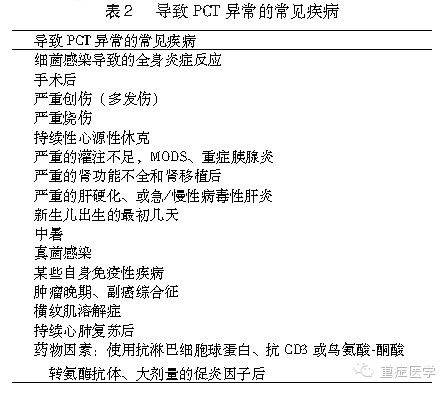
The common diseases leading to the increase in the pct are shown in table 2
2. Recommendations for clinical application of pct level monitoring of common infectious diseases in emergency situations
2. 1 bacteriological infections
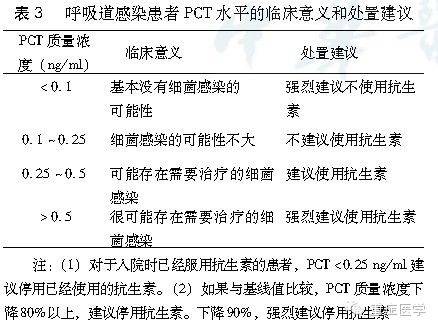
2. 1. 1 respiratory infections cause pneumonia in a larger variety of pathogen microorganisms, including viruses, bacteria, fungi and atypical pathogens. The pct level is therefore diverse among pneumonia patients, mainly related to the type of pathogen, the severity of pneumonia and the severity of the overall inflammation response
Patients of bacterial pneumonia have higher levels of pct than those of viruses, atypical pathogens (other than legionella) and tuberculosis. Not all patients of bacterial pneumonia have higher levels of pct, with about 50% of bacterial pneumonia patients
2. 1. 2 the initial symptoms of bacterial endometriflammitis are not specific, but pct levels may increase. In cases where there are associated risk factors (e. G. Cardiac valve disease, post-drive replacement, low immunity, intravenous drug use, etc.) and symptoms of non-specific infections, the possibility of bacterial endocrinitis needs to be considered if the pct level increases. Pct should be reviewed in the short term if the ultrasound motion map (including the esophagus ultrasound tee) results are normal
The most appropriate boundary value for the diagnosis of membrane is 2-3 ng/ml for pct and 0. 1 ~0. 25 ng/ml for exclusion
2. 1. 3 the acute bacterial meningitis bacterial meningitis is generally higher than 0. 5 ng/ml. The viral meningitis and stoic infections are generally not elevated. If pct > 5ng/ml is used as the diagnostic boundary value, the sensitivity of diagnosis of bacterial meningitis is 94% and the specificity 100%
If the pct is negative and other evidence supports the diagnosis of bacterial meningitis, it should also start treating antibiotics. The use of antibiotics may be considered for discontinuation if the pct is continuously monitored for continuous negativeness and if other evidence supporting bacterial meningitis is insufficient
2. 1. 4 bacteria peritonealitis studies have found significant increases in plasma pct levels for bacterial peritonealitis, limiting peritonealitis (accorditis), plasma pct levels increase only moderately or not
2. 2 virus infection
Pcts do not increase or increase only slightly, and generally do not exceed 1~2 ng/ml. Pcts identify viral diseases as more sensitive and specific than traditional markers (e. G. C reaction protein, white cells, red cell deposition rates, etc.). A recent study comparing the ability of multiple biomarkers to identify bacterial and viral infections, including pct, il-1b, il-6, il-8, il-10, il-12, tnf-α, ifn-gamma, scd14, among others, found that pct is the most sensitive and specific to bacterial infections, with an area of 0. 952 below the roc curve for diagnosis of bacterial infections, with a median pct of 1. 84 ng/ml for bacterial infections and 0. 05 ng/ml for viral infections
2. 3 fungal infections
Quality concentrations of pcts vary according to the type of fungi infection: pcts can increase in the case of invasive fungi infections, and pcts are rarely higher in the case of impregnated fungi infections, especially when immunosuppressive and neutral particle cells reduce the combination of fungi infections. The value of pct’s diagnosis of fungi infection is therefore limited. Pct cannot return to the normal range of infected patients after long periods of antibiotics treatment and needs to consider the possibility of combining fungi infections