1) air brakes:
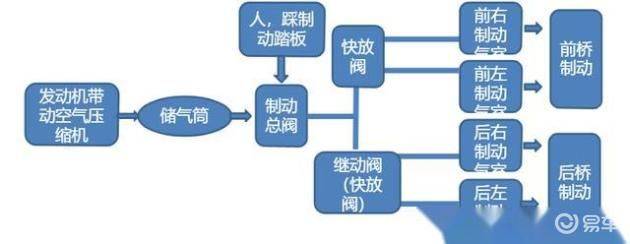
A simple process: an engine-driven air compressor, compressed gas is stored in the gas tank through a pipe, a foot-stamping pedal is used to make the brake total valve work, then the brake chamber pole is rolled out by controlling the gas into the brake chamber, the brake arm is rotated, the brake hooves are stretched, the hooves and brakes are formed to make power。
2) liquid brakes
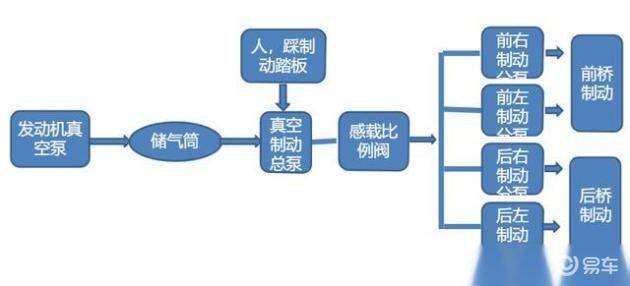
Simple process: engine vacuum pump vacuum vacuums in gas cylinders and pipes. After stepping on the brake pedal, the vacuum brake total pump is pumped into the brake pedestal, the sensory ratio valve adjusts the intake of the pre- and post-bridge brake subpumps according to the load, splits the top of the pump to make the brake hooves to generate power。
3) description of the principles of drum brakes
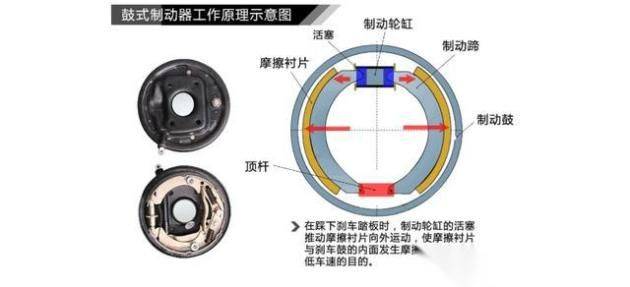
The drum brakes consist mainly of brake subpumps (brand arms), brake hoofs, brake drums, friction blades, springs, etc. It is primarily by hydraulic pressure (or brake arm) that frictions occur on the inside side of the brake drum that moves with the wheel, thus acting as a brake。
Analysis of brake bias
The so-called brake bias of the car, i. E., when the wheel is brakeed, the wheels of both sides cannot act as brakes at the same time; even the wheel of one side is brakeed, while the other side is still spinning, resulting in the vehicle not being able to park along a straight line. This was caused by the imbalance of the left- and right-wheeling rectangles on the same axis and by a clear turner feeling on the steering wheel that the car was moving towards the side of the road. Road tests can be seen from the drag marks on brake wheels and the ground, and can see deep drag marks on one side and shallow, if not no drag marks on the other. The margin of the maximum power generated by the left and right brake wheels at the end of the brake process can be seen in the whole vehicle detection line。
The fact that brakes require sufficient attached coefficients for wheels and pavements and that brakes tend to have a brake bias because of muddled roads, condensed cavities, tilts, etc., requires that we conduct road tests on flat, dry, clean, high-intensity cement or asphalt surfaces to exclude the effect of road factors on car brakes。
Test method: gb7258 provides that any part of the motor vehicle during the brake process (except where the width is excluded) shall not be allowed to exceed the edge of the test channel of the specified width on a 2. 5 m wide road。
1. The main reasons for the difference between the power of the right and the left wheel are the following:
1) concordant gas pressure of the two front tyres
Measures to address: filling up the front wheel to the same pressure。
2) concordance between front-wheel brakes and brake drums
Solutions: adjustment of the front bridge brake arm, one-two buttons for large-powered wheels, one-two buttons for small-powered wheels, and determination that the front wheel is not too tight。
3) there are significant differences between front-wheel brakes and drum contact
Settlement measures: redeployment of the front bridge brake adjustment arm to the minimum of the brake space, low-speed vehicle 3-5 km to stop after smoke from the front wheel brakes, release of brake adjustment arm from three buttons, to be validated after cooling of the first wheel brake drums, to be adjusted in accordance with article 2 if minor brakes remain in place。
4) uneven and deformed pre-wheel-to-left brake drum processing
Resolution measures: re-validation of brake drums with control, validation of brake effects and replacement of less-powered brake drums in reverse direction。
5) fore wheel left-to-hand brake chamber caps do not synchronize during brake
Measures to address: dismantling of the brake airpipe, blocking of the brake airpipe by hand (e. G., if conditioned to connect to the pressure gauge), stepping down the brake pedal, checking whether the vent exit pressure is the same, replacing, if basic consistency exists, the air chamber where the brake chamber pole is slow, and inspecting the main valve if the vent pressure is clearly different。
6) unsatisfactory lengths on either side
Solutions: measurement of consistency between the right and the right axes and the difference between the right and the left axes of more than 5 mm require adjustment of the right and the right axis。
The uneven distribution of vehicle loads, the incorrect positioning of the front wheel and the movement of the back and forth axis will lead to a brake bias。
If the above-mentioned measures do not solve the problem of the brakes, the reasons for the rear bridge can be analysed in accordance with the above-mentioned measures。
There are fewer cases of brake bias in the liquid brakes, which, due to the presence of sensory ratio valves at the back bridge, are able to control the supply of the bridge on the basis of the load, and the brake bias is virtually non-existent at the time of braking, as follows:
1) the pressure of the tyre is not consistent to the left
Measures to address: filling up the front wheel to the same pressure。
2) unconsistent adjustment of left-and-right brake breaks
Measures to address: the required adjustment of the left- and right-wheel brakes of the front bridge ensures that the right- and right-wheel breaks are generally consistent, but that the gap cannot be too tight to accommodate heat during travel。
3) inconsistencies in the state of processing of front-wheeled drums
Solutions: replace new drums and rebug。
4) a failure of the pre-wheel brake subpump
Solutions: in the event of unadjusted pre-wheel brakes, the brake subpumps should fail and the brakes need to be replaced and rebugged。