Look, our forward technology
On october 10, october 10th, the daily light newspaper, shanghai, plant growth depends not only on sunlight and rain, but also on the "unseen world" in the soil - there are a large number of micro-organisms that are attached to the roots, helping plants absorb nutrients and resist adversity. How the roots interact and collaborate with microorganisms is the “underground puzzle” that scientists are trying to solve. In recent days, the centre for excellence in molecular plant science and innovation, the zhou feng team of plant efficient carbon sequestration laboratory of the chinese academy of sciences, in collaboration with researchers from the university of lausanne, switzerland, published a cover paper in the international academic journal science, which for the first time accurately revealed how plant roots lead microorganisms to “settling home” on their surfaces, drawing “settling maps” of root microorganisms and deciphering the “molecult code” that controls their interaction with microorganisms。
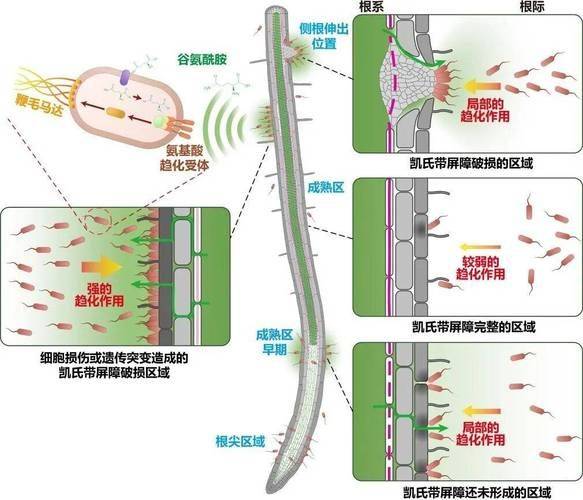
Using plant seedlings as models for research, combined with fluorescent-marked living microorganisms and high-resolution micro-imaging techniques, the research team found that the “settling” of microorganisms on the root surface was not random, but rather a regular spatial distribution. This “settling” pattern is closely linked to the integrity of the kai belt, a particular barrier that is rooted within. When there is a “gap” in the cayes belt structure, it causes internal nutrient leakage. Further studies have confirmed that the main nutrients leaked from these “gaps” are amino acids, in particular an amino acid molecule called “agoamamine”。
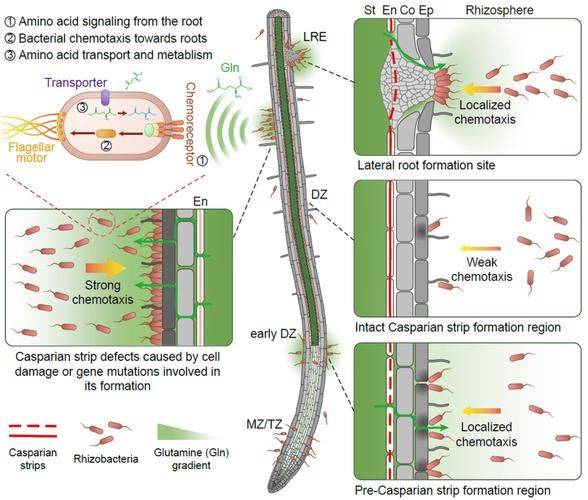
Micro-organisms can sense nutrients in the environment and move in the direction of their own “likes”, a phenomenon known as the “concentration” of micro-organisms. The study found that root-spilled azinamides have a significant degree of homogenization of microorganisms and are capable of significantly regulating the behaviour of microorganisms, such as convergence and reproduction. Based on the location of these “populated areas”, researchers accurately map the settlement of the roots of microorganisms. Research has also shown that beneficial microorganisms, even if they are “settled” in large numbers, do not damage root systems and can contribute significantly to their growth and uptake when locally formed high-density planting. However, a large number of pathogenic microorganisms can seriously jeopardize the health of both the root and the plant. This phenomenon highlights the key role of the cayes as a “smart gate”: the health balance of the root micro-organisms is maintained by stabilizing the nutrients that are internal to the root, and by preventing random leakage。
The study not only revealed, for the first time at the micro level, the precision mechanism for the management of the spatial distribution of roots micro-organisms through the release of local amino acids, but also provided an entirely new idea for sustainable agricultural development: in the future, it may be possible to significantly increase the absorption efficiency and resilience of crop nutrients by designing amino acid microbiological fertilizers that are precise guides for the development of useful strains. Of particular importance is the fact that the strategy is equally important for enhancing the carbon sink function in the soil, providing a theoretical basis and a technical approach to the development of carbon sequestration-based green agriculture。
The day of light (11 october 2025, 04th edition)